What Is Bluetooth Low Energy? Ultimate Guide with 7 Uses
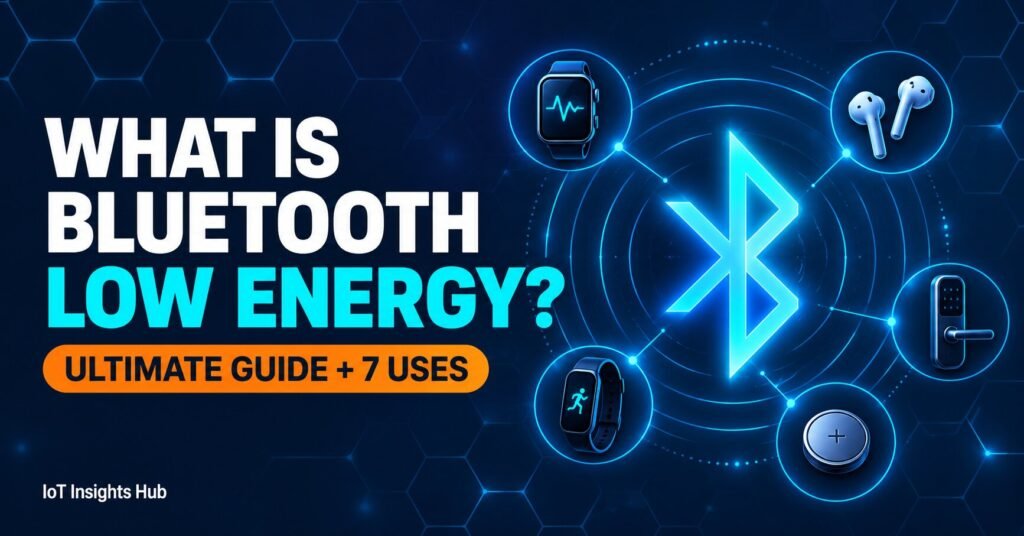
What is Bluetooth Low Energy, and why does it sit inside so many watches, earbuds and sensors? This IoT Insights Hub guide explains what is Bluetooth Low Energy, how BLE works, and how its range, speed and power use compare with Classic Bluetooth.
What Is Bluetooth Low Energy? Ultimate Guide with 7 Uses
So, what is Bluetooth Low Energy, and why does it sit inside your watch, your earbuds and half the sensors in a modern building? It is a version of Bluetooth designed to sip power instead of gulping it. Devices send short bursts of data, then go back to sleep.
This guide from IoT Insights Hub answers what is Bluetooth Low Energy in plain English. It covers how BLE works, its range and speed, its power use, its security, seven real uses and where it falls short. Where sources disagree, or are old, the text says so.
New to connected devices? Read our beginner guide to IoT first. BLE often competes with the mesh networks in our explainer on what is Zigbee.
What is Bluetooth Low Energy and how is it different from Classic?
Bluetooth Low Energy, or BLE, is a wireless technology for short-range, low-power data exchange. It first appeared in Bluetooth Core 4.0 and runs alongside Classic Bluetooth, not instead of it. BLE suits small bursts of data from sensors and wearables, while Classic suits continuous streaming such as audio.
According to the Bluetooth SIG’s primer, BLE “first materialized in Bluetooth Core 4.0,” alongside the older BR/EDR variant. Wikipedia traces its roots to Nokia’s Wibree, publicly released in October 2006. The iPhone 4S, in October 2011, was the first 4.0 smartphone.
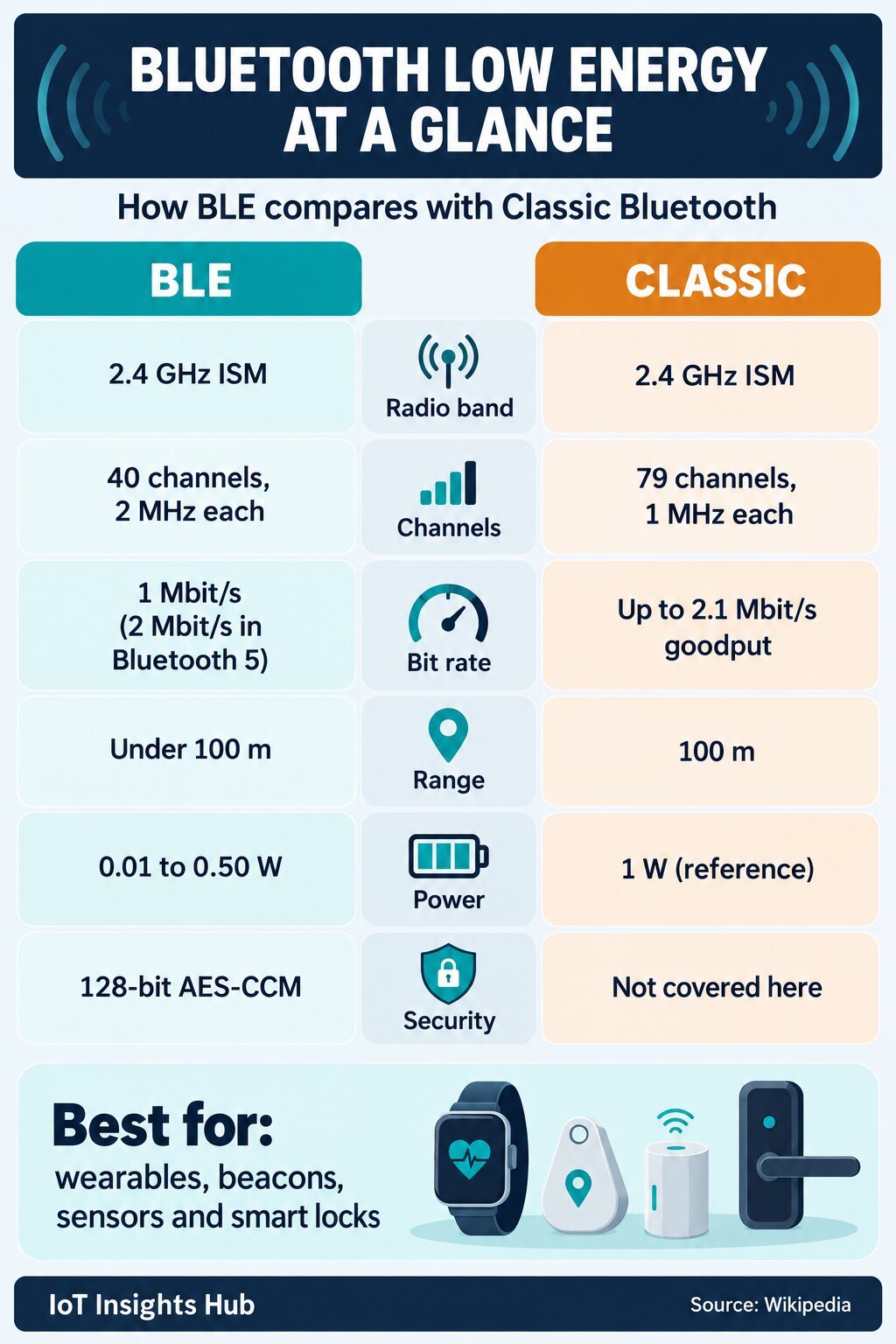
Both share the 2.4 GHz ISM band, but they use it differently. This table shows the differences, drawn from Wikipedia and the Bluetooth SIG.
| Feature | Bluetooth Low Energy | Classic Bluetooth |
|---|---|---|
| Radio band | 2.400 to 2.4835 GHz ISM | Same band |
| Channels | 40 channels of 2 MHz | 79 channels of 1 MHz |
| Bit rate | 1 Mbit/s; 2 Mbit/s option in Bluetooth 5 | 1 Mbit/s (BR); 2 Mbit/s (EDR) |
| Goodput | 0.27 to 1.37 Mbit/s | 0.7 to 2.1 Mbit/s |
| Nominal range | Under 100 m | 100 m |
| Power | 0.01 to 0.50 W, depending on use | 1 W (reference) |
| Peak current | Under 15 mA | Under 30 mA |
| Best for | Short bursts from sensors and wearables | Continuous streams (our view) |
One caveat. Wikipedia notes that power consumption is not part of the Bluetooth specification, so the figures describe typical designs, not a guarantee. IoT Insights Hub treats them as a guide to the trade-off, not a battery promise.
How does Bluetooth Low Energy work?
BLE devices announce themselves through advertising packets, then a central device such as a phone connects to a peripheral such as a sensor. Data is organised through GATT into services and characteristics that apps can read or write. Advertising alone can also broadcast data to an unlimited number of receivers.
The Bluetooth SIG describes asymmetric roles. Battery-rich devices, such as smartphones, do more of the work, so tiny coin-cell peripherals can sleep most of the time. That design choice is the secret behind BLE’s battery life.
Advertising is the discovery step. The SIG says it can occur “once every 20 milliseconds to once every 10.24 seconds.” Legacy advertising packets carry up to 31 octets, while extended advertising allows packets up to 255 octets, chained for up to 1,650 bytes.
Once connected, GATT defines “services, characteristics and descriptors,” per the SIG. In plain terms, a heart-rate monitor offers a heart-rate service, and your phone reads its value. A second layer, GAP, covers security modes and discovery.
- Point-to-point: a phone and a single device, the classic wearable pattern.
- Broadcast: one device transmitting to many receivers, as beacons do.
- Mesh: Bluetooth Mesh enables many-to-many communication, with specifications released on 18 July 2017, per Wikipedia. The SIG says it can support networks of tens of thousands of devices.
Many BLE sensors end up feeding a gateway that forwards data to the cloud. A common pattern, in our view, is a lightweight messaging protocol on that gateway, and our explainer on what is MQTT covers the most common one.
What are Bluetooth Low Energy’s range and speed?
BLE’s nominal range is under 100 metres, and its base speed is 1 Mbit/s, with a 2 Mbit/s option in Bluetooth 5. The optional Coded PHY trades speed for distance: the SIG says its S=8 mode roughly quadruples range at 125 kbit/s. Real range depends on walls, antennas and transmit power.
The Bluetooth SIG lists four physical layers, or PHYs. LE 1M is mandatory, while LE 2M and LE Coded are optional.
| PHY | Protocol data rate | Approx. application data rate | Range multiplier |
|---|---|---|---|
| LE 1M | 1 Mbit/s | 800 kbit/s | 1 |
| LE 2M | 2 Mbit/s | 1,400 kbit/s | 0.8 |
| LE Coded S=2 | 500 kbit/s | 400 kbit/s | 2 |
| LE Coded S=8 | 125 kbit/s | 100 kbit/s | 4 |
The trade-off is plain. Longer range costs speed, and the SIG says the Coded PHY “increases the effective range of transmissions but reduces the application data rate.” Wikipedia quotes the Bluetooth 5 claim of quadrupled range, which depends on that coded layer or higher transmit power.
Compared with other protocols, BLE sits in the middle. It links to phones directly, which Zigbee generally does not, and loses to LoRaWAN on distance. Our guide on Zigbee vs LoRaWAN shows how those two compare.
How much power does Bluetooth Low Energy use?
Very little, but it depends on the design. Wikipedia lists BLE at 0.01 to 0.50 W against a 1 W reference for Classic Bluetooth, with peak current under 15 mA. The Bluetooth SIG says devices can run for days, weeks or more on small coin-sized batteries. Sleep time and message rate decide the real result.
BLE saves energy by doing little. Devices advertise rarely, connect briefly and sleep in between. The SIG describes peripheral latency, which lets a peripheral skip listening during some connection events, and subrated connections for low duty cycles.
For a real-world number, Wikipedia cites an Aislelabs study saying beacons usually run one to two years on a 1,000 mAh coin cell. That is one study on one device type, so do not stretch it to every sensor. Our guide to energy-efficient IoT protocols compares the wider trade-offs.
- Send less often. Every transmission costs battery.
- Keep payloads small. Smaller packets mean shorter radio time.
- Test on the real device. Datasheet figures rarely match field behaviour.
The last three points are IoT Insights Hub’s practical advice, not quotes from the specification.
What is Bluetooth Low Energy used for? 7 real uses
BLE suits any job that needs small, occasional data close to a phone or gateway. Common uses include wearables, healthcare devices, beacons, key fobs, hearing aids and audio, retail shelf labels and lighting, and asset tracking. IoT Insights Hub notes that several figures below come from forecasts, not measured results.
-
%%USES%%
Across all seven, what is Bluetooth Low Energy doing? Moving small packets between a nearby device and a phone or gateway, cheaply. For more on how wearables use this, read our piece on IoT in wearable tech, and for home setups see smart homes and comfort.
A sensor alert is only useful if someone sees it. IoT Mail Bridge explains how to turn device events into email in its guide to setting up IoT email automation. For larger fleets, see its write-up on a reliable SMTP relay for IoT and M2M fleet alerts.
A note for founders: building a connected product? The Business Perspective tracks the funding side. Its Q3 2026 venture funding analysis puts AI at 64% of funding in its headline finding, and its Indian startup funding report for Q3 2026 covers 63 deals.
Is Bluetooth Low Energy secure?
BLE has solid building blocks, but security depends on how a product uses them. Wikipedia lists 128-bit AES in CCM mode, plus a 24-bit CRC and a 32-bit message integrity check. The Bluetooth SIG describes a pairing protocol and integrity checks that protect against tampering. Weak pairing choices still leave devices exposed.
Per Wikipedia, Encrypted Advertising Data lets some or all of an advertised payload be encrypted, with a defined way to share key material. That matters because advertising is broadcast: the SIG says one device can transmit “to an unlimited number of receivers simultaneously.”
The SIG also notes that its Channel Sounding feature, which measures distance, has its own security topics, including spoofing and relay attacks. We could not read the full details, so we flag it rather than describe it.
- Use authenticated pairing wherever the device allows it.
- Keep sensitive details out of advertising packets.
- Update firmware, and retire devices that no longer get updates.
Those three points are practical advice from IoT Insights Hub, not quotes from a standard. For wider habits, read our guide to IoT security risks and how to fix them. IoT Mail Bridge covers the data-in-transit side in its piece on edge-to-cloud data security for IoT fleets.
What do critics say about Bluetooth Low Energy?
Critics point to modest throughput, a crowded 2.4 GHz band, short range compared with long-range networks and the need for a gateway to reach the internet. Market numbers also deserve scrutiny, since many come from vendor-linked forecasts. Supporters reply that BLE was built for small, nearby, battery-powered devices, not for everything.
- Throughput: Wikipedia puts LE goodput at 0.27 to 1.37 Mbit/s, below Classic’s 0.7 to 2.1 Mbit/s.
- Crowded band: BLE shares the 2.4 GHz ISM band with Classic Bluetooth, per Wikipedia. Our view is that Wi-Fi and other devices add to the crowding, so test in your own space.
- Range: under 100 m nominal is short next to the kilometres LoRaWAN can reach, as covered in our LoRaWAN guide.
- Market claims: an RCR Wireless report (James Blackman, April 2022) carried a headline that Bluetooth growth was “fixed at 20%,” but the body gave segment growth from about 7% to 25%. The 20% applied only to IoT network solutions.
- Uncited statistics: the same report quoted the SIG saying Bluetooth powers 35% of IoT connected devices without citing a source.
- Competition: for fixed devices across a whole home, a mesh such as Zigbee or Z-Wave may fit better. See our Zigbee vs Z-Wave comparison.
Several sources here are a few years old, and Wikipedia gives conflicting dates for when BLE joined Bluetooth 4.0 (December 2009 against “early 2010”), so we avoid that date. If your project mixes protocols, our guide to multi-protocol IoT systems shows how to combine them.
Bluetooth Low Energy FAQs
What is Bluetooth Low Energy in simple words?
Bluetooth Low Energy is a power-saving version of Bluetooth for small devices. Instead of streaming constantly, a sensor or wearable sends short bursts of data and sleeps in between, so a coin cell can last a long time. It usually connects to a phone or gateway nearby.
Is Bluetooth Low Energy the same as Bluetooth?
Not exactly. BLE first appeared in Bluetooth Core 4.0 and sits alongside Classic Bluetooth, which handles continuous streams such as audio. Both use the 2.4 GHz band, but BLE uses 40 channels instead of 79. Many devices support both, which is known as dual-mode.
What is the range of Bluetooth Low Energy?
Wikipedia gives a nominal maximum range of under 100 metres. The optional Coded PHY in Bluetooth 5 can extend that: the Bluetooth SIG says its S=8 mode roughly quadruples range, at a lower 125 kbit/s speed. Walls, antennas and transmit power change real-world results, so test in your own space.
How long does a Bluetooth Low Energy battery last?
It depends on the device and how often it transmits. Wikipedia cites an Aislelabs study saying beacons usually run one to two years on a 1,000 mAh coin cell, but power use is not part of the specification. Treat any lifetime claim as a guide and test your own design.
Is Bluetooth Low Energy secure?
It can be, if the product uses its features well. Wikipedia lists 128-bit AES in CCM mode and message integrity checks, and the Bluetooth SIG describes a pairing protocol. Advertising packets are broadcast to anyone nearby, so keep sensitive data out of them and use authenticated pairing.
Is Bluetooth Low Energy better than Zigbee?
They suit different jobs. BLE connects directly to phones and suits wearables, beacons and nearby sensors. Zigbee is a mesh designed for many fixed devices across a home or building, and usually needs a hub. Choose BLE for phone-centred products and Zigbee for networks of lights and sensors.
Sources behind this what is Bluetooth Low Energy guide from IoT Insights Hub
- Wikipedia, “Bluetooth Low Energy” (band, channels, rates, range, power, security, history, applications)
- Bluetooth SIG, “The Bluetooth Low Energy primer” (design goals, PHYs, advertising, GATT, topologies; the SIG’s own page)
- RCR Wireless News, “Bluetooth growth fixed at 20% for five years in key IoT segments” (James Blackman, 7 April 2022; Bluetooth SIG and ABI Research forecast)
- Aislelabs beacon battery study, as cited by Wikipedia
Is Bluetooth Low Energy right for your project?
Pick BLE when a nearby device sends small packets, runs on a coin cell and talks to a phone or gateway. Pick a mesh network for many fixed devices across a home, or LoRaWAN for kilometres. If you remember what is Bluetooth Low Energy in one line: a radio mode built to sleep.
IoT Insights Hub will keep publishing practical guides on IoT protocols, networks and security. For the business side of building in this space, read The Business Perspective’s guide to raising seed funding.
About The Author