Zigbee vs Z-Wave: Ultimate Guide with 7 Key Differences
Zigbee vs Z-Wave: Ultimate Guide with 7 Key Differences
Zigbee vs Z-Wave is the smart-home argument that never quite ends. Both build a mesh of small, low-power devices. Both run bulbs, locks and sensors. They simply do it on different radios, with different rules and different crowds behind them.
This guide from IoT Insights Hub sets Zigbee vs Z-Wave side by side on frequency, range, speed, network size, security and cost, then gives a clear verdict. Where sources disagree, or are old, we say so.
Want the background first? Read our explainer on what is Zigbee. For a very different comparison, see our guide to Zigbee vs LoRaWAN.
What is the difference between Zigbee vs Z-Wave?
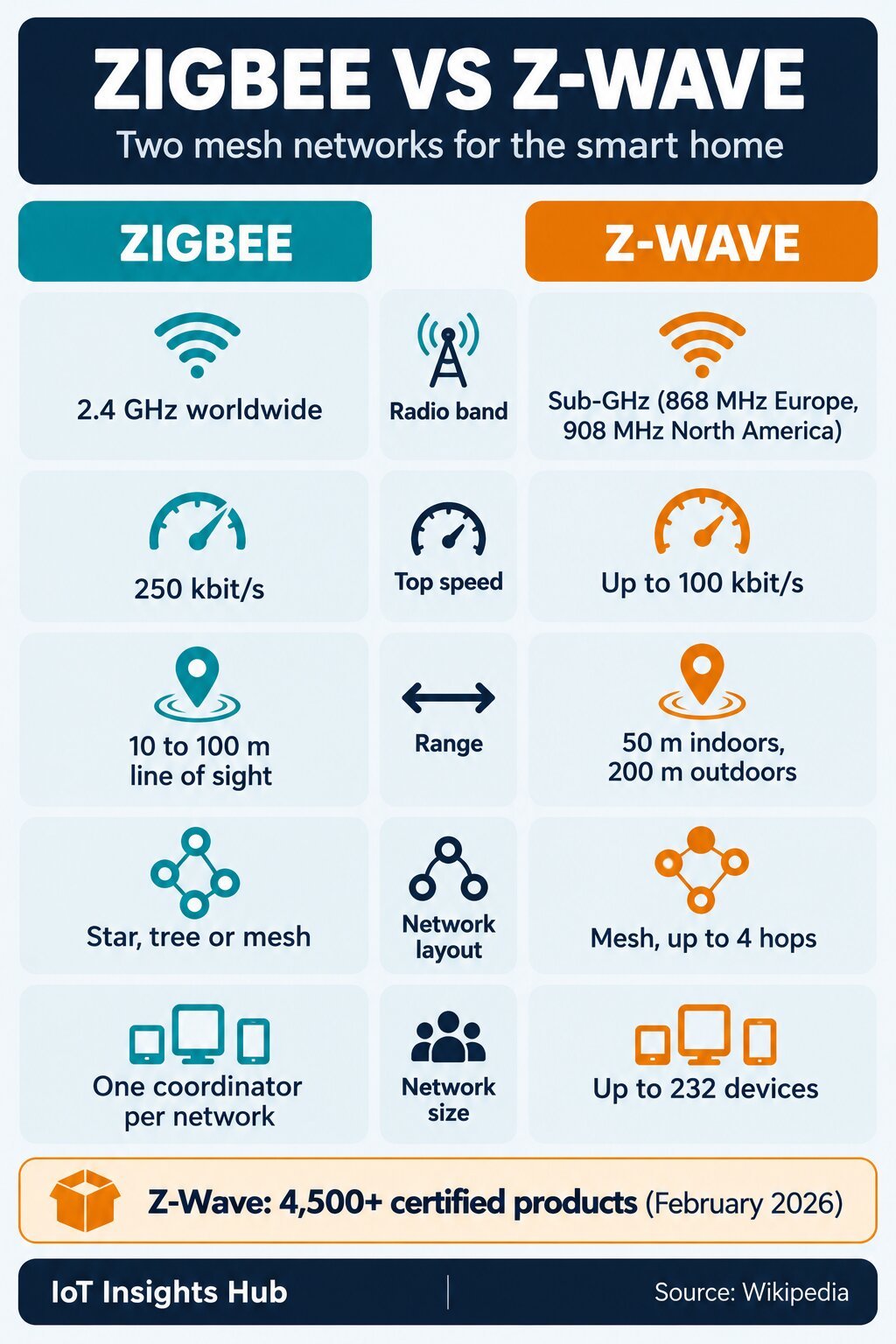
Zigbee is a mesh standard built on IEEE 802.15.4 that mostly uses the 2.4 GHz band and reaches 250 kbit/s. Z-Wave is a mesh technology on sub-GHz bands, designed for up to 100 kbit/s, with stricter certification. Zigbee is faster, while Z-Wave has less crowded airwaves and longer indoor reach.
Here are the seven key differences in one table. The Zigbee column draws on Wikipedia and the Connectivity Standards Alliance coverage we cited in our Zigbee guide. The Z-Wave column draws on Wikipedia.
| Key difference | Zigbee | Z-Wave |
|---|---|---|
| 1. Frequency | 2.4 GHz worldwide; 868 MHz and 915 MHz regionally | Sub-GHz: 868 to 869 MHz in Europe; 908 to 916 MHz in North America |
| 2. Range | 10 to 100 m line of sight; 10 to 20 m indoors at 2.4 GHz | 200 m outdoors and 50 m indoors (standard); about 1.6 km for Long Range |
| 3. Speed | Up to 250 kbit/s | Designed for up to 100 kbit/s; 9.6 and 40 kbit/s options |
| 4. Layout and size | Star, tree or mesh; one coordinator per network | Mesh with up to four hops and 232 devices; Long Range is a star with up to 4,000 nodes |
| 5. Certification | Run by the Connectivity Standards Alliance | 4,500+ certified interoperable products as of February 2026 |
| 6. Security | 128-bit keys; Zigbee 3.0 requires random network keys | S2 mandatory for certification since 2 April 2017; AES-128 |
| 7. Cost and supply | Chips from multiple vendors (2012 report) | Silicon Labs has owned the Z-Wave business since 2018 |
A note on row 7: neither source gives a neutral price list, so we compare structure rather than invent figures. Row 5 compares different things, too. One is a certified-product count, the other a standards body, and the Zigbee equivalent is in our Zigbee guide.
Zigbee vs Z-Wave range and speed: which is better?
Zigbee is faster and Z-Wave reaches further per hop. Zigbee manages up to 250 kbit/s, against up to 100 kbit/s for Z-Wave. Wikipedia gives standard Z-Wave 200 metres outdoors and 50 metres indoors, versus 10 to 20 metres indoors for Zigbee at 2.4 GHz. Smart-home messages are small, so range often matters more.
Sources differ on Z-Wave range. Wikipedia’s infobox says 100 to 800 m, while its text gives 200 m outdoors and 50 m indoors for standard devices. The 700 series is described as up to 100 m point to point and 800 m across a network. We use the text figures and treat the rest as upper bounds.
| Measure | Zigbee | Z-Wave (standard) | Z-Wave Long Range |
|---|---|---|---|
| Indoor range | 10 to 20 m at 2.4 GHz | 50 m | Not stated |
| Outdoor, line of sight | 10 to 100 m | 200 m | 1.6 km or more |
| Top speed | 250 kbit/s | Up to 100 kbit/s | 100 kbit/s modulation |
| Layout | Mesh | Mesh, four hops | Star, up to 4,000 nodes |
Why does speed matter less here? A switch command or a door sensor flag is a handful of bytes. Both are fast enough, and in IoT Insights Hub’s view the real question is whether a message reliably reaches the far room.
Z-Wave Long Range deserves a mention. Wikipedia says it uses a star topology with direct hub-to-device links, and that standard and Long Range nodes can coexist. Ecolink was the first certified Long Range brand, on 15 March 2022. For how these pieces fit together, see our IoT architecture guide.
Zigbee vs Z-Wave frequency: which suffers less interference?
Z-Wave usually has the cleaner airwaves. Zigbee mostly shares the 2.4 GHz band with Wi-Fi and Bluetooth, while Z-Wave sits in sub-GHz bands used by fewer home devices. Electronic Design called Wi-Fi coexistence a big issue for Zigbee in 2012. Real results depend on your home, so test before you commit.
Wikipedia notes that Zigbee’s 2.4 GHz band has 16 channels spaced 5 MHz apart, and that Zigbee also has 868 MHz and 915 MHz versions. Z-Wave lives only below 1 GHz, with different frequencies in different regions. That regional split matters: a Z-Wave device is built for its own region’s frequency, so check the region before you buy.
Electronic Design’s Lou Frenzel made the interference point in March 2012, so treat it as a principle, not a current measurement. Wi-Fi equipment and channel planning have changed since. The principle still holds: fewer neighbours on a band means less competition for airtime.
- If your home is crowded with Wi-Fi, Bluetooth and microwaves, a sub-GHz mesh may feel steadier.
- If you buy abroad, check the region on the box before you buy Z-Wave.
- If you use Zigbee, set your Wi-Fi and Zigbee channels apart where your hub allows it.
The last three points are practical advice from IoT Insights Hub, not quotes from a standard. For power and band trade-offs across protocols, see IoT Insights Hub’s guide to energy-efficient IoT protocols.
How do network size, devices and security compare?
Zigbee reportedly scales to larger networks, while Z-Wave caps a standard network at 232 devices. Both use AES-128 encryption. Z-Wave made S2 security mandatory for certification from 2 April 2017, and Zigbee 3.0 requires randomised network keys. Older gear in both families has known weaknesses, so the device version matters.
On size, Electronic Design reported in 2012 that Zigbee can support up to 65,000 nodes, against 232 for Z-Wave. Wikipedia confirms 232 for standard Z-Wave and 4,000 for Long Range. Few homes come near either limit, so this matters mostly for buildings and commercial sites.
On devices, Wikipedia reports more than 4,500 certified interoperable Z-Wave products and over 100 million installed devices as of February 2026. The Z-Wave Alliance’s own site makes a similar claim of “more than 4,500 products,” but that page is marketing. Fierce Network reported in May 2021 that the Connectivity Standards Alliance certified more than 560 Zigbee devices in 2020. The two numbers measure different things.
On security, both have a history worth knowing:
- Zigbee: Home Automation 1.2 used known fallback keys, per Heise Online as cited by Wikipedia. Zigbee 3.0 added mandatory key randomisation.
- Z-Wave: Wikipedia reports 2022 vulnerabilities affecting chipsets up to the 700 series. The 100, 200 and 300 series cannot be updated, while the 500 and 700 series can be mitigated by firmware.
- Z-Wave 800 series (late 2021): supports S2 and Silicon Labs Secure Vault, per Wikipedia.
The upshot, from IoT Insights Hub: buy newer devices, keep the hub updated and read our guide to IoT security risks and how to fix them. IoT Mail Bridge covers the data-in-transit side in its piece on edge-to-cloud data security for IoT fleets.
Which should you choose for your smart home?
Choose Zigbee for the widest device choice, higher speed and larger networks, and Z-Wave for cleaner airwaves, longer indoor reach and a tightly certified ecosystem. Choose by what you already own, since the hub and devices must match. If you are starting fresh, check Matter support on the hub you buy.
| Your situation | Better fit (our view) | Why |
|---|---|---|
| Crowded Wi-Fi and Bluetooth at home | Z-Wave | Sub-GHz band, less competition |
| Large house with thick walls | Z-Wave | 50 m indoor figure beats Zigbee’s 10 to 20 m |
| Many sensors and bulbs, tight budget | Zigbee | Multiple chip vendors and a large ecosystem |
| Large building or commercial site | Zigbee | Higher node limits and 250 kbit/s |
| Rural plot or outbuildings | Z-Wave Long Range | About 1.6 km star links |
| Mixed devices already owned | A hub supporting both | The two do not talk to each other directly |
The Matter question is worth a sentence. The Connectivity Standards Alliance’s chief executive said in 2021 that Zigbee “will continue to be a very important pillar of our standards, but it’s one of many,” per Fierce Network. We found no equally clear public statement for Z-Wave, so check your hub’s support list.
A sensor alert is only useful if someone sees it. IoT Mail Bridge explains how to route device events into email in its guide to setting up IoT email automation. For fleets, see its write-up on a reliable SMTP relay for IoT and M2M fleet alerts.
A note for founders: building a smart-home product? The Business Perspective tracks the funding side. Its Q3 2026 venture funding analysis puts AI at 64% of funding in its headline finding, and its Indian startup funding report for Q3 2026 covers 63 deals.
If you run several protocols side by side, our guide to multi-protocol IoT systems shows how to combine them.
What do critics say about each?
Zigbee’s critics cite 2.4 GHz crowding, fragmentation across profiles and weak older security. Z-Wave’s critics cite a smaller ecosystem, regional frequency splits, a single main chip supplier and vulnerabilities in older chipsets. Supporters reply that both are mature, certified standards and that most problems come from old devices or poor placement.
- Zigbee, interference: Electronic Design (March 2012) called coexistence with Wi-Fi and Bluetooth a big issue for the 2.4 GHz band.
- Zigbee, fragmentation: Network World (November 2014) reported that matching logos did not guarantee compatibility, per John Calagaz of CentraLite Systems.
- Z-Wave, openness: Electronic Design said in 2012 that the standard was “not open like many wireless standards.” The Z-Wave Alliance now calls it open-source on its own site, so sources conflict.
- Z-Wave, supply: Wikipedia reports that Silicon Labs bought the Z-Wave business in 2018, and that Texas Instruments announced on 4 February 2026 it will acquire Silicon Labs for about $7.5 billion, with closing expected in early 2027. A single main supplier is a concentration risk, in our view.
- Z-Wave, older chipsets: the 2022 vulnerabilities Wikipedia lists affect chipsets up to the 700 series.
Several sources here are old, so we name each date. The 2012 article is a useful frame but not a current benchmark, and the Z-Wave Alliance page is marketing. IoT Insights Hub suggests treating the quotes as perspectives and checking current specs before you buy.
Zigbee vs Z-Wave FAQs
What is the main difference between Zigbee and Z-Wave?
The radio. Zigbee mostly uses the crowded 2.4 GHz band and reaches 250 kbit/s, while Z-Wave uses sub-GHz bands, such as 908 MHz in North America, and is designed for up to 100 kbit/s. Zigbee is faster, while Z-Wave offers longer indoor reach per Wikipedia and stricter certification.
Is Z-Wave better than Zigbee?
Neither wins outright. Z-Wave offers cleaner airwaves, 50 metres of indoor range and a strictly certified ecosystem. Zigbee offers higher speed, a larger device ecosystem and room for bigger networks. For a typical home both work well, so choose the one your existing hub and devices already support.
Which has better range, Zigbee or Z-Wave?
Z-Wave, by the published figures. Wikipedia gives standard Z-Wave 200 metres outdoors and 50 metres indoors, against 10 to 100 metres in line of sight and 10 to 20 metres indoors for Zigbee at 2.4 GHz. Both extend coverage by relaying through mesh devices.
Are Zigbee and Z-Wave compatible with each other?
Not directly. They use different radios and protocols: Zigbee is built on IEEE 802.15.4, while Z-Wave runs in sub-GHz bands. A device from one cannot join the other’s network. To mix them, use a hub or controller that supports both, and check its device list before you buy.
Which is more secure, Zigbee or Z-Wave?
Both use AES-128 encryption, so the version of your devices matters more. Zigbee 3.0 requires randomised network keys, while Z-Wave S2 has been mandatory for certification since 2 April 2017. Older gear in both families has documented weaknesses, so favour current devices and update your hub.
Does Zigbee interfere with Wi-Fi?
It can, because both commonly use the 2.4 GHz band. Electronic Design called coexistence with Wi-Fi and Bluetooth a big issue for Zigbee in 2012. Z-Wave sits in sub-GHz bands with less competition. Modern equipment has improved, so test your home and separate Wi-Fi and Zigbee channels where possible.
Sources behind this Zigbee vs Z-Wave guide from IoT Insights Hub
- Wikipedia, “Z-Wave” (bands, data rates, range, topology, certification, security, Silicon Labs)
- Wikipedia, “Zigbee” (standard, bands, data rate, range, security)
- Electronic Design, “What’s the Difference Between ZigBee and Z-Wave?” (Lou Frenzel, 29 March 2012; vendor-influenced and dated)
- Z-Wave Alliance, “About Z-Wave technology” (marketing page)
- Fierce Network, “Zigbee Alliance morphs into CSA, introduces Matter” (Monica Alleven, 12 May 2021)
- Network World, “ZigBee 3.0 promises one standard for many uses” (Stephen Lawson, 18 November 2014)
- Heise Online, report on Zigbee Home Automation 1.2 fallback keys (as cited by Wikipedia)
Is Zigbee or Z-Wave the right call?
Pick Zigbee for the biggest device choice, higher speed and larger networks. Pick Z-Wave for cleaner airwaves, longer indoor reach and strict certification. Whatever you choose in Zigbee vs Z-Wave, buy current-generation devices and keep the hub updated.
IoT Insights Hub will keep publishing practical guides on IoT protocols, networks and security. For the business side of building in this space, read The Business Perspective’s guide to raising seed funding.
About The Author