What is IoT? Explained in a Simple Beginner Guide
A few years ago, the idea that your watch could track your heartbeat and send data to your phone felt advanced. Today, it is normal. That shift is powered by IoT.
So, what is IoT? In simple terms, IoT (Internet of Things) connects everyday objects to the internet so they can collect and share data. This guide, What is IoT? Explained in a Simple Beginner Guide, will help you understand how this technology quietly runs much of today’s digital world.
From smart homes to industrial machines, IoT is already part of daily life. And the interesting part is this: most people use it without even realizing it.
What is IoT? Explained in a Simple Beginner Guide
To understand what is IoT, think of objects that normally don’t talk to each other. Now imagine they can communicate through sensors and the internet.
That is IoT.
Devices like:
- Smart TVs
- Fitness bands
- Smart refrigerators
- Traffic sensors
All of them collect data and send it over the internet for processing. This creates a connected system that reacts in real time.
In this What is IoT? Explained in a Simple Beginner Guide, you will see how this simple idea becomes powerful in real-world applications.
How IoT Actually Works
IoT works through a simple flow, but each step plays an important role.
1. Devices and Sensors
Everything starts with a device. These devices collect data from the environment. For example, a temperature sensor checks room heat.
2. Internet Connectivity
Next, the device sends this data using Wi-Fi, Bluetooth, or mobile networks.
3. Data Processing
The data goes to a cloud system or server. Here, it gets analyzed.
4. Action or Response
Finally, the system takes action. It may send alerts, adjust settings, or trigger machines.
This entire cycle happens in seconds, often without human involvement.
For a deeper technical breakdown, you can also check this guide on IoT systems architecture:
👉 https://iotinsightshub.com/blog/iot-architecture
Key Components of IoT
To clearly understand what is IoT, you need to know its core building blocks.
✔ Sensors and Devices
These collect real-world data like temperature, motion, or location.
✔ Connectivity
This allows devices to communicate through networks.
✔ Data Processing Systems
Cloud platforms analyze incoming data.
✔ User Interface
This is where users interact, like mobile apps or dashboards.
Each component works together to form a complete IoT system.
Real-Life Examples of IoT
The best way to understand what is IoT is through examples you already see around you.
🏠 Smart Homes
Lights that turn on automatically or ACs controlled by mobile apps.
⌚ Wearable Devices
Fitness trackers that monitor heart rate and steps.
🚗 Connected Cars
Cars that provide navigation, safety alerts, and diagnostics.
🏭 Industrial Machines
Factories using sensors to predict machine failure before it happens.
🚦 Smart Cities
Traffic systems adjusting signals based on congestion.
These examples show how deeply IoT is already integrated into modern life.
Benefits of IoT Technology
IoT is not just about connectivity. It solves real problems.
✔ Better Efficiency
Machines and systems work faster with less human effort.
✔ Cost Savings
Automation reduces manual work and operational costs.
✔ Real-Time Insights
Data is available instantly for decision-making.
✔ Improved Safety
Sensors detect issues before they become dangerous.
✔ Convenience
Users can control devices from anywhere.
Because of these benefits, IoT adoption is growing rapidly across industries.
Challenges of IoT
Even though IoT is powerful, it has some challenges.
🔒 Security Risks
Connected devices can become targets for cyberattacks.
📡 Network Dependency
IoT systems depend heavily on stable internet.
💾 Data Overload
Large volumes of data need proper management.
⚙ Compatibility Issues
Not all devices work well together.
These challenges are being solved gradually with better technology and standards.
IoT in Modern Industries
IoT is not limited to homes. It is transforming industries.
🏥 Healthcare
Remote patient monitoring improves treatment speed.
🏗 Manufacturing
Machines predict breakdowns before failure.
🚚 Logistics
Companies track shipments in real time.
🌾 Agriculture
Farmers use sensors to monitor soil and crop health.
These applications prove that IoT is more than just a trend. It is a foundation for digital transformation.
Future of IoT
The future of IoT looks even more advanced.
With AI integration, IoT systems will become smarter. Devices will not only collect data but also make decisions.
Edge computing will also reduce delays by processing data closer to devices.
According to GSMA IoT research, connected devices are expected to grow rapidly in the coming years:
👉 https://www.gsma.com/iot/
This means what is IoT today will look very different in the next decade.
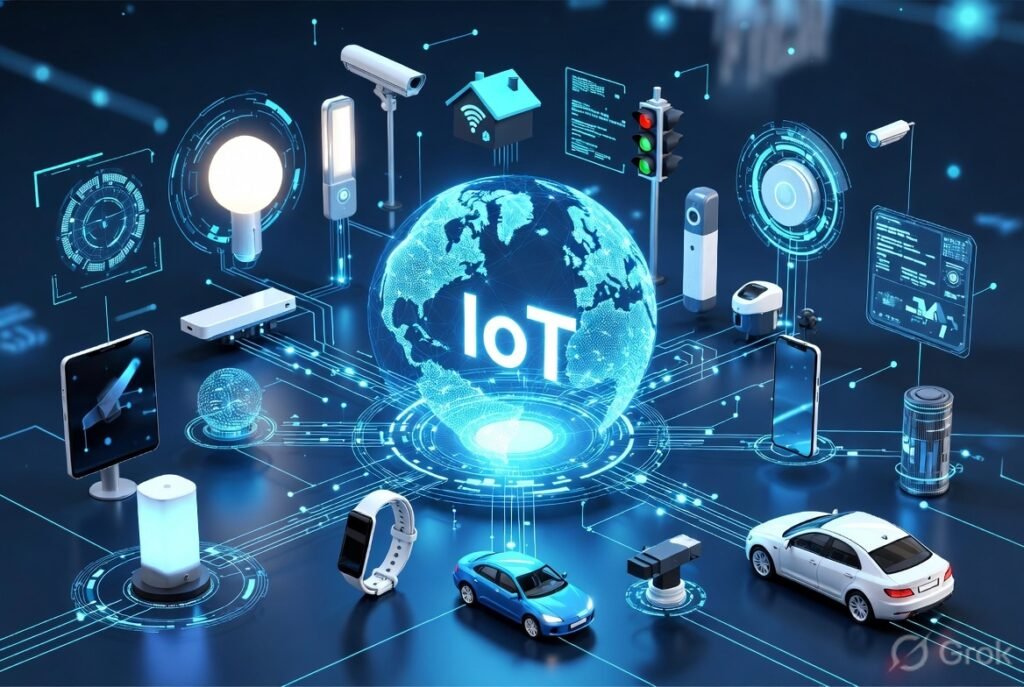
Image Section
Suggested Image (for blog cover or section visual):
- Alt text: What is IoT explained with smart connected devices illustration
You can use a visual showing:
- Smart home devices
- Cloud connection lines
- Sensors and data flow
- City + industrial IoT elements
Why Understanding IoT Matters Today
Understanding what is IoT is not just for engineers. It is useful for students, professionals, and businesses.
Technology is moving toward full automation. IoT sits at the center of this change.
Even simple decisions like choosing smart devices or working in tech industries become easier when you understand this concept clearly.
About The Author