What Is LoRaWAN? Complete Guide with 7 Real-World Uses
What Is LoRaWAN? Complete Guide with 7 Real-World Uses
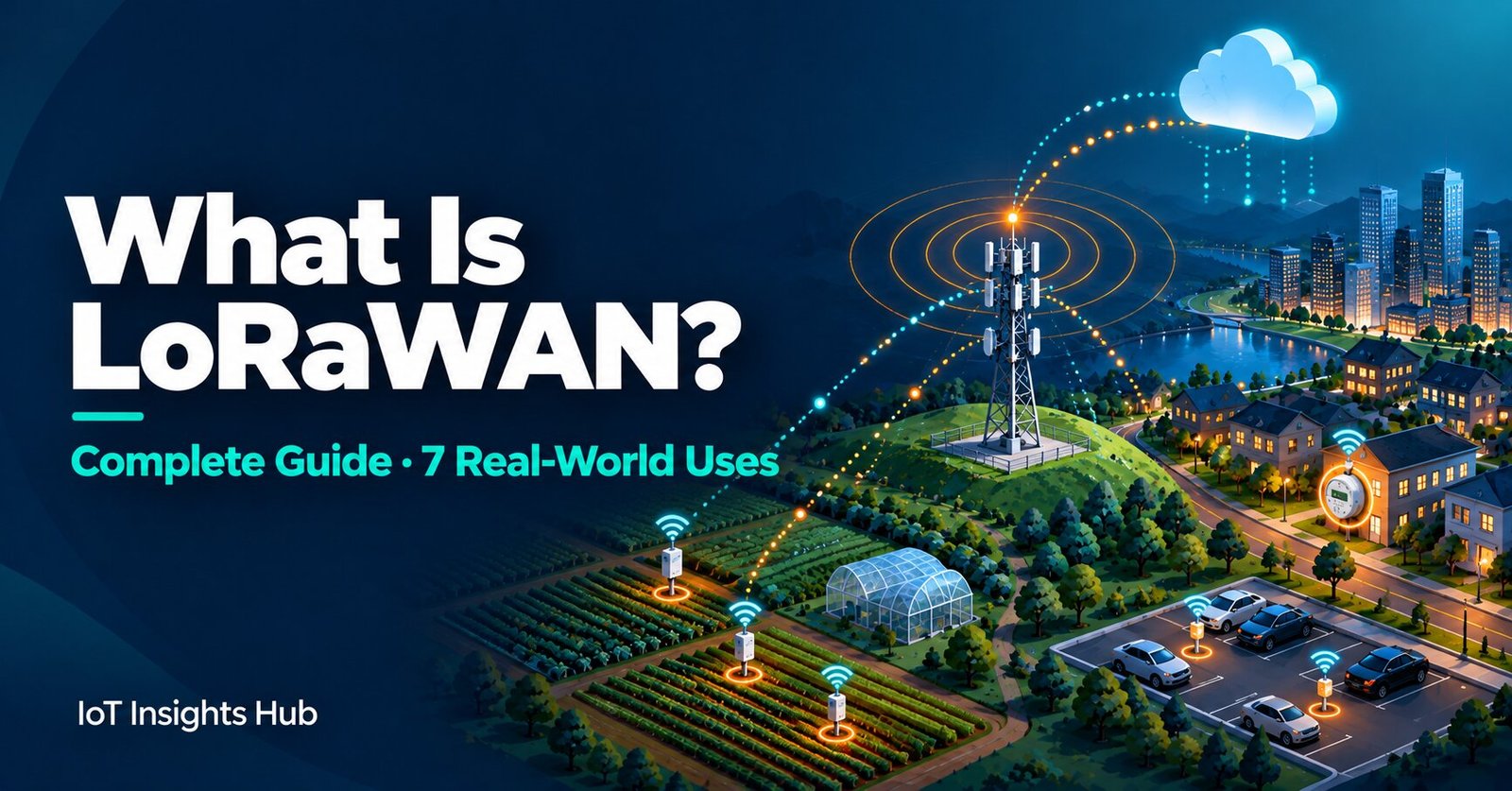
So, what is LoRaWAN, and why do farmers, utilities and city planners keep choosing it over cellular? Because it lets a small, cheap sensor send a few bytes across kilometres without a SIM card or a Wi-Fi password. The battery can last for years, at least on paper.
This guide from IoT Insights Hub covers how the network works, what range and speed to expect, which band India uses, and where the technology struggles. Every figure below carries a named source. Where vendors and independent testers disagree, we say so.
New to connected devices? Start with our beginner guide to IoT, then come back.
What is LoRaWAN and how is it different from LoRa?
LoRaWAN is an open networking standard that lets low-power sensors send small messages over long distances. It runs on top of LoRa, a radio technique from Semtech. LoRa is the radio layer. LoRaWAN adds addressing, security and network rules, so thousands of devices can share gateways reliably.
The LoRa Alliance, a nonprofit formed in 2015, maintains the LoRaWAN specification. Anyone can build a network on it because it runs on licence-exempt radio bands. No spectrum auction. No operator contract. IoT Insights Hub tracks it closely because it keeps turning up in farm, utility and city projects.
Think of LoRa as the road and LoRaWAN as the traffic rules. Without the rules, devices can still shout across a valley. They just cannot be sure anyone heard them, or that the message stayed private.
One thing beginners often miss: sensors do not talk to each other. Every message goes to a gateway first, per Microchip’s protocol overview. That keeps the sensors simple and cheap. For the wider stack around it, see our IoT architecture guide.
How does a LoRaWAN network work?
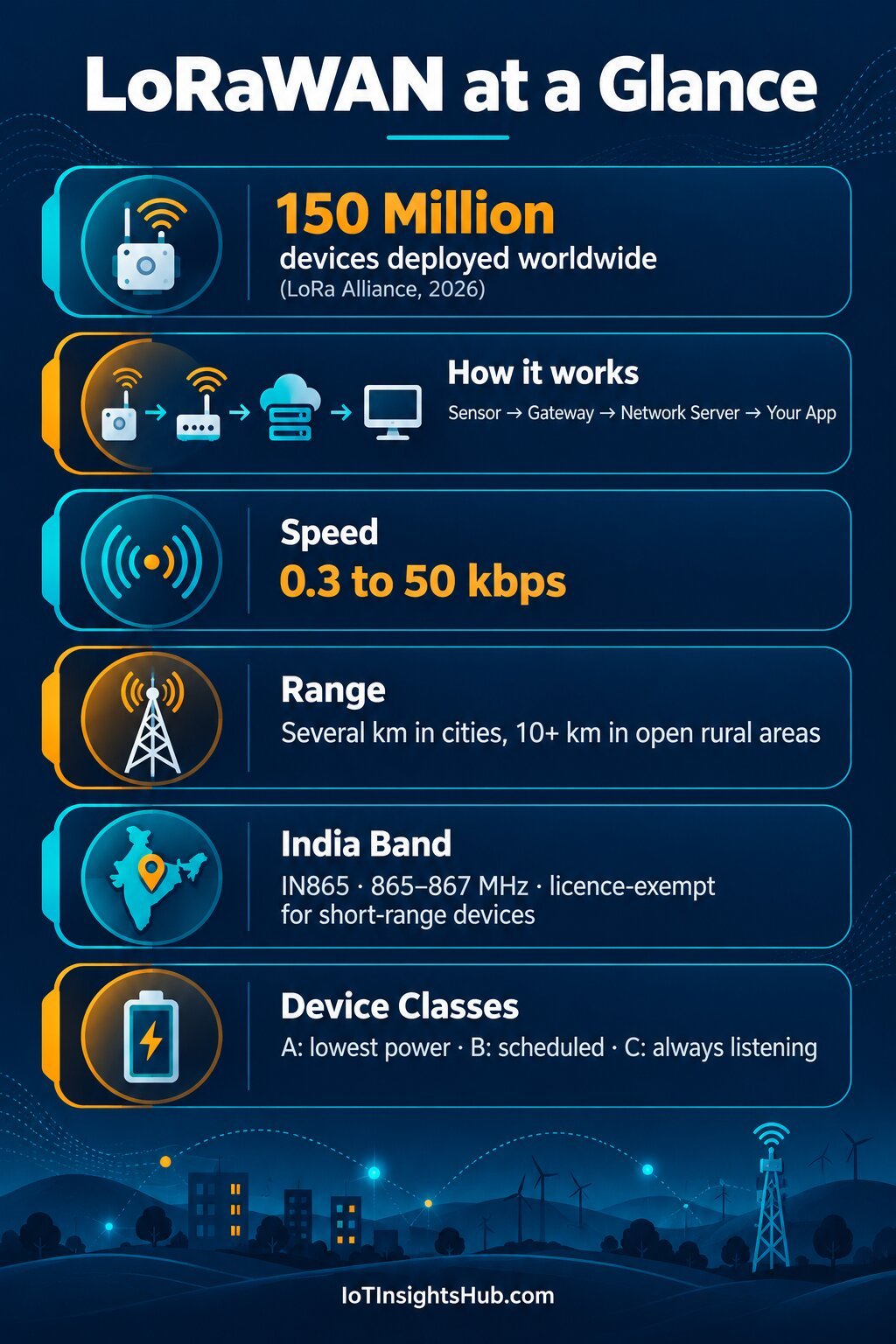
A LoRaWAN network has four parts: end devices, gateways, a network server and application servers. Sensors broadcast small radio packets. Any gateway in range picks them up and forwards them over the internet. The network server removes duplicates, checks security and hands clean data to your application.
The layout is called a star-of-stars. Many sensors reach one gateway, and many gateways feed one server. Add a gateway and coverage improves for every device nearby.
LoRaWAN also defines three device classes. According to AWS documentation, long battery life is only possible when devices sleep most of the time, which means Class A or Class B.
| Class | How it listens | Power use | Typical device |
|---|---|---|---|
| Class A | Short receive windows right after it sends | Lowest | Battery sensors, meters |
| Class B | Extra scheduled receive slots | Medium | Battery-powered actuators |
| Class C | Listens almost all the time | Highest | Mains-powered controllers |
Class C devices listen almost constantly, so they usually sit on mains power. Pick the class before you pick the hardware.
How far and how fast can LoRaWAN really go?
LoRaWAN reaches a few kilometres in cities and over 10 km in open rural areas. Data rates run from 0.3 kbps to 50 kbps, which suits sensor readings but not video or voice. Slower settings stretch range, while faster ones save battery and free up network capacity.
Wikipedia’s LPWAN entry gives the same range picture: a few kilometres in urban areas, over 10 km in rural settings. Sources do not agree on the top speed, though. Semtech’s FAQ puts LoRa modulation at 0.3 to 11 kbps, with one FSK mode reaching 50 kbps in Europe. AWS documentation lists a ceiling of 27 kbps.
The trade-off is simple. The network server tunes each device through adaptive data rate. Sensors close to a gateway use fast, low-power settings, while sensors at the edge of coverage use slow, high-power ones.
| Setting | Speed | Range | Battery and capacity |
|---|---|---|---|
| Low spreading factor (SF7) | Faster | Shorter | Best battery life, best capacity |
| High spreading factor (SF12) | Slowest | Longest | Shortest battery life, lowest capacity |
Payloads are tiny. Semtech lists a maximum of 51 bytes at the slowest setting (SF12, 125 kHz) and 222 bytes in FSK mode. That is enough for a temperature, a location or a meter reading. It is not enough for a photo.
Now the battery claim. Vendors often quote ten years or more. A Wikipedia summary of LPWAN research notes that real-world application tests have not confirmed the longest claims. Message frequency and temperature move the result a lot. IoT Insights Hub’s advice: treat any battery claim as a hypothesis until your own pilot confirms it.
Which frequency does LoRaWAN use in India?
India uses the IN865 plan, which covers 865 to 867 MHz. The band is licence-exempt for short-range devices under the Wireless Planning and Coordination wing of the DoT. The default channels sit at 865.0625, 865.4025 and 865.985 MHz. Buy gateways and modules built for this band, not 868 or 915 MHz.
Indian retailers Zbotic and ThinkRobotics describe IN865 the same way in their deployment guides. ThinkRobotics adds that commercial deployments may still need DoT equipment approval. Rules change, so confirm with current WPC notifications before you scale.
Here is a mistake that costs real money: ordering an 868 MHz or 915 MHz module off a global marketplace. Zbotic’s India guide warns that modules built for EU, US or China bands will not operate on the correct Indian frequencies. Check the actual frequency range on the datasheet, not the product title.
On the network side, The Things Network runs community clusters in India. Zbotic also lists the Helium Network and AWS IoT Core for LoRaWAN as alternatives. Want to see what is LoRaWAN in a real field build? Try our budget LoRaWAN smart agriculture setup guide. IoT Insights Hub suggests buying one sample gateway first and testing it on your actual site.
What is LoRaWAN used for? 7 real-world uses
LoRaWAN suits any job that needs small, infrequent data over long distances on battery power. Common uses include smart metering, farming, smart cities, asset tracking, worker safety, industrial monitoring and building management. Utilities are among the biggest adopters, with millions of meters already connected on LoRaWAN networks worldwide.
- Smart metering. Veolia runs 4 million active smart meters in France on LoRaWAN, per the LoRa Alliance. ZENNER Connect operates 11.6 million sensors and 174,000 gateways across 15 countries.
- Agriculture. Soil moisture and weather sensors cover big fields without cellular fees. IoT Mail Bridge covers the farm side in its piece on smart agriculture with real-time IoT tools.
- Smart cities. Parking, street lighting and waste bins suit small, cheap sensors. Our piece on smart city technology has more examples.
- Asset tracking. The LoRa Alliance lists tracked pallets, bikes and smart padlocks among current LoRaWAN devices.
- Worker safety. Centegix has deployed 800,000 wearable panic buttons, per the same alliance report.
- Industrial monitoring. Vibration and temperature sensors flag faults early. IoT Mail Bridge offers a practical checklist for deploying industrial IoT sensors.
- Building management. Door, leak and occupancy sensors run without new wiring.
Here is the part people forget. When a sensor trips an alert, a human has to receive it. That is where an SMTP relay for IoT and M2M fleet alerts earns its place.
So what is LoRaWAN really good at? Cheap, patient, low-volume data. Every use above fits that description.
Growth is steady. The LoRa Alliance reported 125 million devices in December 2025 and 150 million by September 2026, a compound annual growth rate of about 25%. It also counts more than 695 certified devices and close to 1,000 products in its marketplace. That said, the alliance promotes its own standard, so treat these numbers as industry-reported.
LoRaWAN vs NB-IoT: which one should you pick?
Choose LoRaWAN for cheap, battery-powered coverage on spectrum you can run yourself. Choose NB-IoT when you need lower, more predictable latency and an operator standing behind the network. LoRaWAN uses unlicensed sub-GHz bands, while NB-IoT rides on licensed mobile spectrum. Neither wins everywhere.
| Feature | LoRaWAN | NB-IoT |
|---|---|---|
| Spectrum | Unlicensed sub-GHz bands | Licensed LTE bands |
| Data rate | 0.3 to 50 kbps | Up to about 250 kbps |
| Latency | Higher, limited by duty cycle | Under 10 seconds by specification |
| Duty cycle (EU rules) | 1% uplink, 10% downlink | None |
| Who runs the network | You or an operator | A mobile operator |
The numbers come from different studies. The NB-IoT latency figure is from a Multi-RAT paper on arXiv that tested it against the 10-second target. The 250 kbps ceiling comes from an arXiv analysis by Augustin and colleagues. The duty-cycle row is from Deutsche Telekom’s IoT comparison.
So what is LoRaWAN best at in this matchup? Cost and control. If cellular looks like the better fit, IoT Mail Bridge makes its case in 5 reasons NB-IoT is the future of smart connectivity. For the battery angle, see our post on how NB-IoT cuts power use.
A note for founders. Building a connectivity product? The Business Perspective’s Q3 2026 venture funding report flags that 64% of dollars went to AI, a warning for everyone else. Hardware teams should also read its take on the AI wrapper vs deep tech startup trap.
How do you start a LoRaWAN project?
Start with a small pilot: five to ten sensors, one gateway and a community network. Confirm the IN865 frequency plan, test range on site, and watch battery drain for several weeks. Only then decide whether to scale with your own network server or a commercial operator.
- Define the data you need and how often you need it. Fewer messages mean longer battery life.
- Choose IN865-compatible sensors and a gateway.
- Register your devices on a network server such as The Things Network.
- Place the gateway high and test coverage across the whole site.
- Connect the data to a dashboard or alert tool, and lock down your keys.
Mixed fleets are normal. IoT Insights Hub’s rule of thumb: start small, then add protocols only when a use case demands it. Our guide to multi-protocol IoT systems shows how to combine LoRaWAN with Wi-Fi, Zigbee or cellular.
Security deserves its own line in the plan. IoT Mail Bridge explains edge-to-cloud data security for IoT fleets, and we list fixes in our guide to IoT security risks.
What do critics say about LoRaWAN?
Critics point to four problems: low data rates, small payloads, duty-cycle limits in some regions and higher latency than cellular. Raw LoRa also has no built-in encryption. Supporters answer that these limits are the price of cheap, long-life sensors, and that the technology was never meant for video or real-time control.
- Duty cycle bites. An arXiv survey notes that LoRa devices face a 1% duty cycle in the EU 868 MHz band. The Multi-RAT study found a 1,600-byte payload could take from 42 minutes to 68 hours to send under that limit.
- Security needs work. Trend Micro’s LoRaWAN security paper says raw LoRa has no native encryption, so protection depends on LoRaWAN and on your key handling.
- A rival’s view. Haystack Technologies, which pitches its own alternative, calls LoRaWAN an incomplete stack with high latency and security risks in a public presentation.
- The middle ground. The Things Network’s documentation lists LoRaWAN’s strengths, then states plainly that it is not suitable for every use case. Augustin and colleagues reach a similar balance, noting that unlicensed bands favour private networks without a mobile operator.
Both camps agree on one point: match the technology to the job. IoT Insights Hub reads the evidence the same way.
LoRaWAN FAQs
Is LoRaWAN free to use?
The radio spectrum is free in licence-exempt bands, so you pay no airtime licence. Community networks such as The Things Network offer free access in many areas. Commercial operators charge for access, and you still pay for sensors and gateways. Budget for hardware, not spectrum.
Can LoRaWAN work without internet?
Gateways need a route to a network server, but that server can run on your own premises. A fully private LoRaWAN setup can therefore operate without public internet access. Many deployments still use the internet to reach cloud dashboards, so plan your backhaul before you plan your sensors.
How long does a LoRaWAN battery last?
Vendors claim ten years or more for Class A sensors that send a few messages a day. Real results depend on message frequency, spreading factor and temperature. A Wikipedia summary of LPWAN research notes that real-world tests have not confirmed the longest claims, so measure your own pilot before you promise anyone a decade.
Is LoRaWAN secure?
LoRaWAN encrypts traffic with AES-128 keys and checks message integrity, per the LoRaWAN specification. Security still depends on how you generate, store and rotate device keys. Trend Micro’s LoRaWAN security paper adds that raw LoRa, used without LoRaWAN, has no native encryption at all.
What is LoRaWAN, and how is it different from LoRa?
What is LoRaWAN? It is an open standard for long-range, low-power IoT networks. LoRa is the radio technique that carries the signal, developed by Semtech. LoRaWAN is the protocol on top that handles addressing, security and communication between sensors, gateways and servers, and it is maintained by the LoRa Alliance.
Is LoRaWAN legal to use in India?
Yes. India’s 865 to 867 MHz band is licence-exempt for short-range devices, so you need no individual spectrum licence. ThinkRobotics notes that commercial deployments may still need DoT equipment approval. Rules change, so check the latest WPC notifications before a large rollout.
Sources behind this what is LoRaWAN guide from IoT Insights Hub
- LoRa Alliance, 2025 End of Year Report (February 2026)
- GlobalSpec Electronics360, “There are now 150 million LoRaWAN devices deployed globally” (September 2026)
- ARC Advisory Group, “LoRa Alliance Reports 150 Million LoRaWAN Devices Deployed Globally”
- Semtech, LoRaWAN FAQ
- AWS, “Implementing LPWAN solutions with AWS: LoRaWAN”
- Wikipedia, “Low-power wide-area network”
- Microchip, “Overview of LoRaWAN Protocol”
- Frontiers in Computer Science (2025), “Machine learning-based spreading factor optimization in LoRaWAN networks”
- Zbotic, LoRa frequency guides for India; ThinkRobotics, “LoRaWAN Gateway Setup India”
- arXiv 2104.10536, “Multi-RAT for IoT: The Potential in Combining LoRaWAN and NB-IoT”
- arXiv 2008.08639, “Low Power Wide Area Networks: A Survey of Enabling Technologies, Applications and Interoperability Needs”
- Augustin et al., “Understanding the Limits of LoRaWAN” (arXiv 1607.08011)
- Deutsche Telekom IoT, “NB-IoT, LoRaWAN, Sigfox: An up-to-date comparison”
- Trend Micro, “The Current State of LoRaWAN Security”
- The Things Network documentation, “LoRaWAN limitations”
- Haystack Technologies, “LoRaWAN vs. Haystack” presentation
Is LoRaWAN the right choice for your next IoT project?
So, what is LoRaWAN in plain terms? A cheap, battery-friendly way to connect thousands of sensors without cellular bills. Pick it for farms, utilities and campuses. Pick NB-IoT when latency matters more than cost.
IoT Insights Hub will keep adding guides on LoRaWAN, edge AI and industrial IoT. For the business side of building in this space, read The Business Perspective’s guide to raising seed funding and browse Rise of Startups for founder stories.
About The Author