

What Is Zigbee? Ultimate Guide with 7 Real-World IoT Uses
What Is Zigbee? Ultimate Guide with 7 Real-World IoT Uses
So, what is Zigbee, and why is it still inside so many bulbs, switches and sensors? It is a low-power wireless protocol that lets small devices form a mesh network and pass messages from one to the next. Because each router can relay for its neighbours, a network can cover far more ground than any single radio could.
This guide from IoT Insights Hub answers what is Zigbee in plain English. It covers how the network is built, its range and speed, how it compares with Wi-Fi, seven real uses and where it falls short. Where sources disagree, or sell something, the text says so.
New to connected devices? Read our beginner guide to IoT first. Our guide on what is LoRaWAN covers long-range radio, and our explainer on what is MQTT covers the messaging layer that often sits on top.
What is Zigbee and why do IoT devices use it?
Zigbee is a low-power, low-data-rate wireless protocol for small devices, built on the IEEE 802.15.4 radio standard. Devices form a mesh network and relay each other’s messages, so a bulb or sensor needs little energy and no direct line to a router. It is used mostly in smart homes, building controls and sensor networks.
According to Wikipedia, the idea was conceived in 1998 and standardised in 2003. The IEEE 802.15.4-2003 Zigbee specification was ratified on 14 December 2004, and the ZigBee 2004 Specification (v1.0) was announced on 13 June 2005. Network World, reporting in November 2014, notes that the technology has existed since 2004.
Zigbee Pro followed in 2007, adding a sub-GHz band alongside 2.4 GHz. The Zigbee Alliance is now the Connectivity Standards Alliance (CSA), which Fierce Network covered in May 2021. CSA’s chief executive Tobin Richardson told the outlet that Zigbee “will continue to be a very important pillar of our standards, but it’s one of many.”
The appeal is simple. Small devices such as bulbs, door sensors and plugs rarely need much bandwidth, but they do need to run for a long time and talk to dozens of neighbours. IoT Insights Hub treats Zigbee as a sensible default for exactly that kind of job.
How does Zigbee work? Coordinators, routers and end devices
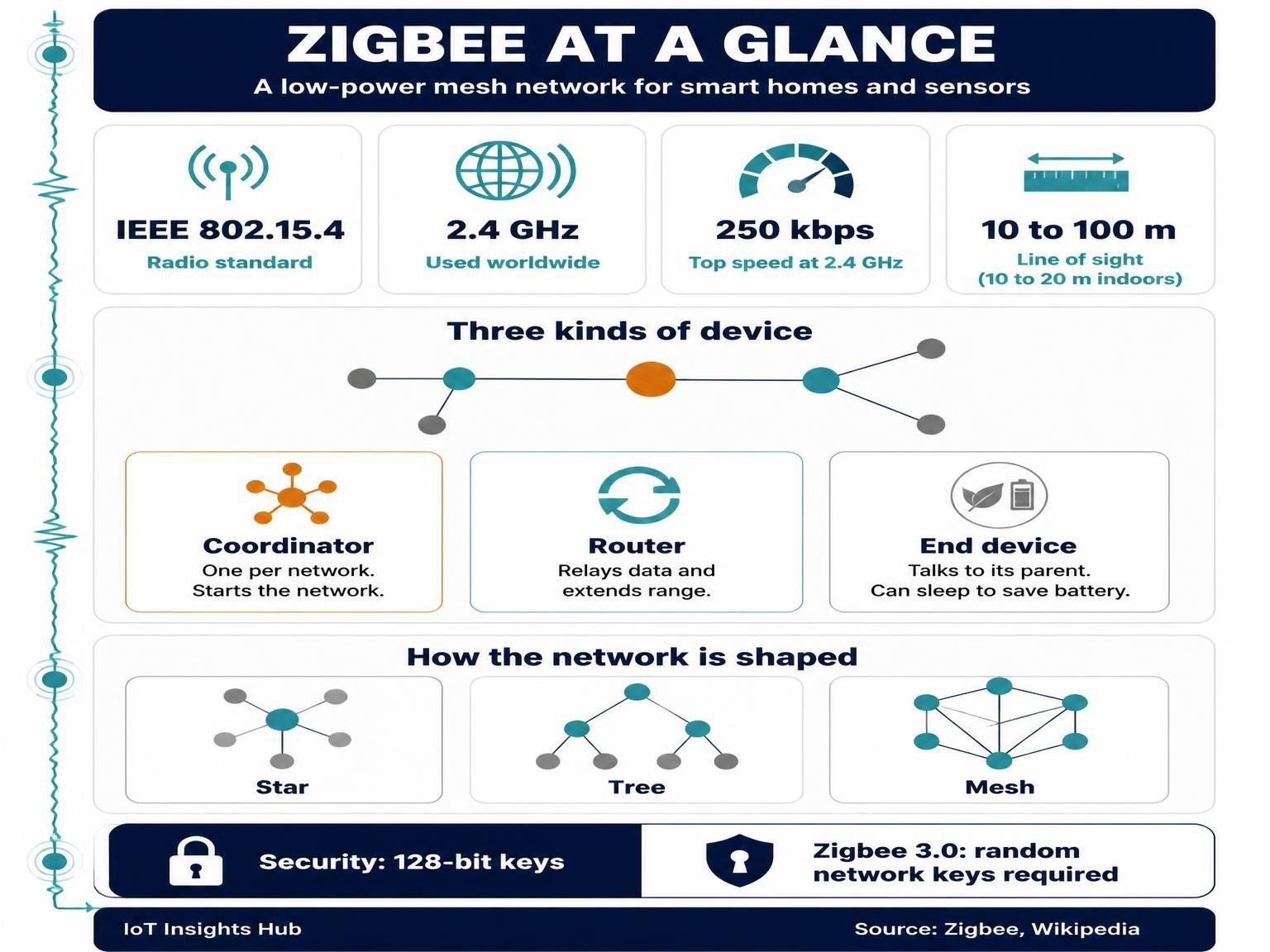
A Zigbee network has three kinds of device. One coordinator starts the network and acts as its trust center. Routers relay messages and extend range. End devices only talk to a parent and can sleep to save battery. Together they can form a star, tree or mesh layout, and mesh lets messages hop through several devices.
The three Zigbee device roles, from network start to battery-powered edge.
| Role | What it does | Typical example (our view) |
|---|---|---|
| Coordinator | Exactly one per network. Forms the network and acts as the trust center. | A smart-home hub or gateway |
| Router | Relays data for other devices and extends range. | A plug or bulb that stays powered |
| End device | Talks only to its parent and can sleep. | A battery door or motion sensor |
Wikipedia describes three topologies: star, tree and mesh. IoT Insights Hub sees mesh as the feature that defines Zigbee. Mesh is the one most people mean when they talk about Zigbee, because every router adds another possible path. For how this sits within a full IoT stack, see our IoT architecture guide.
Application profiles define what devices actually say to each other. Home Automation was the first, announced on 2 November 2007. Smart Energy 2.0 is an IP-based profile for energy and water. Network World reported in 2014 that the original 2004 standard used separate profiles for each setup, which is why Zigbee 3.0 was proposed to unify them.
What are Zigbee’s range, speed and frequency bands?
Zigbee runs on 2.4 GHz worldwide, 868 MHz in Europe and 915 MHz in the Americas and Australia. Top speed is 250 kbit/s at 2.4 GHz, about 40 kbit/s at 915 MHz and about 20 kbit/s at 868 MHz. Range is 10 to 100 metres in line of sight, and 10 to 20 metres indoors at 2.4 GHz.
| Band | Where it is used | Data rate (Wikipedia) |
|---|---|---|
| 2.4 GHz | Worldwide | Up to 250 kbit/s |
| 902 to 928 MHz | Americas and Australia | About 40 kbit/s |
| 868 to 868.6 MHz | Europe | About 20 kbit/s |
The 2.4 GHz band has 16 channels spaced 5 MHz apart, each using 2 MHz of bandwidth, per Wikipedia. Indoor range depends on construction materials and walls. In IoT Insights Hub’s view, that makes router placement matter more than the headline numbers.
One caution. You may see claims that Zigbee devices must last at least two years on a battery. Wikipedia tags that statement as dubious, so check each device’s own specification. Our guide to energy-efficient IoT protocols compares power trade-offs across protocols.
Zigbee vs Wi-Fi: which suits smart devices better?
Neither wins everywhere. Zigbee uses little power and builds a mesh in which routers relay messages, but it is slow, at up to 250 kbit/s. Wi-Fi is far faster and talks to your router directly, but it generally draws more power. Pick Zigbee for many small sensors and switches, and Wi-Fi for cameras and speakers.
| Feature | Zigbee | Wi-Fi (typical home setup) |
|---|---|---|
| Speed | Up to 250 kbit/s | Far higher, suited to video and large files |
| Layout | Star, tree or mesh | Usually a star around one router |
| Power | Designed for low power | Generally higher draw |
| Hub or gateway | Usually a coordinator or hub | Connects straight to the router |
| Link to IP networks | Needs a bridge or gateway | Native |
| Best for | Many small sensors, bulbs and switches | Cameras, speakers, anything streaming |
The Zigbee column draws on Wikipedia’s technical description, and Vesternet’s 2022 note that Zigbee is a radio protocol that cannot connect directly to TCP and UDP networks. The Wi-Fi column is our general summary, not a measured benchmark. Note that Vesternet sells Zigbee and Z-Wave products.
Both can share the 2.4 GHz band, so in a crowded building it is worth planning channels. Need range measured in kilometres rather than metres? Our guide on what is LoRaWAN covers that side of the field.
What is Zigbee used for? 7 real-world IoT uses
Zigbee suits small, low-power jobs spread across a building. Common uses include smart lighting, home automation, energy monitoring, building automation, industrial control, medical data collection and smoke and intruder warning. IoT Insights Hub notes that this list comes largely from the standard’s own description, so real-world scale varies by vendor.
- Smart lighting: The Connectivity Standards Alliance describes a Zigbee bulb paired with a wireless switch that needs no hub, no cabling and no ongoing upkeep, with setup taking seconds.
- Home automation: Home Automation was the first Zigbee application profile, announced on 2 November 2007, per Wikipedia. Network World lists appliances, bulbs, security systems and thermostats as typical devices.
- Energy monitoring: Wikipedia names home energy monitors as a typical use. Its Smart Energy 2.0 profile covers monitoring and control of energy and water, including EV charging, prepay and demand response.
- Building automation: Wikipedia lists building automation among Zigbee’s main application areas, where many small sensors and switches spread across floors and rooms.
- Industrial control: Industrial control also appears in Wikipedia’s list. Low data rates are fine when the job is switching, status flags and simple readings.
- Medical data collection: Wikipedia lists medical data collection as a use, again where the payload is small and battery life matters.
- Smoke and intruder warning: Smoke and intruder warning systems also feature on the list, where a short alert must cross a building reliably.
Wikipedia also lists wireless light switches and traffic management among typical examples. It adds that Zigbee is not suited to situations with high mobility among nodes.
Across all seven, what is Zigbee doing? Moving short messages between many small devices at very low power.
A smoke or intruder alert is only useful if a person sees it. IoT Mail Bridge explains how to turn device events into email in its guide to setting up IoT email automation. For fleets, see its write-up on a reliable SMTP relay for IoT and M2M fleet alerts.
A note for founders: building an IoT product? The Business Perspective tracks the funding side. Its Q3 2026 venture funding analysis puts AI at 64% of funding in its headline finding, and its Indian startup funding report for Q3 2026 covers 63 deals.
Is Zigbee secure? Keys, versions and common mistakes
Zigbee uses 128-bit symmetric keys and a CCM* security design, with a trust center that distributes keys. Zigbee 3.0 makes network key randomisation mandatory. Older Home Automation 1.2 devices used fixed fallback keys, which Heise Online described as highly vulnerable. Security depends on the version, so check what your devices support.
According to Wikipedia, keys can be tied to a network or to a link. The trust center distributes keys and maintains the network key, and link and master keys are visible only to the application layer. Zigbee 3.0 also adds an optional manufacturer installation key and countermeasures against key capture during re-pairing.
That is why the Home Automation 1.2 finding matters. Heise Online, as cited by Wikipedia, reported that known fallback keys that cannot be changed leave encryption highly vulnerable. We could not confirm how many devices in the field still ship with that profile, so treat it as a reason to check versions rather than a headline number.
- Prefer Zigbee 3.0 devices over older Home Automation 1.2 gear.
- Keep the coordinator or hub firmware up to date.
- Protect the hub’s cloud account with a strong, unique password.
- Do not expose the hub or gateway directly to the internet.
The last four points are IoT Insights Hub’s practical advice, not a quote from the standard. For wider habits, read our guide to IoT security risks and how to fix them. IoT Mail Bridge covers the data-in-transit side in its piece on edge-to-cloud data security for IoT fleets.
What do critics say about Zigbee?
Critics point to four weak spots: low data rates, fragmentation across profiles, the need for a bridge to reach IP networks, and weak security in older versions. Supporters reply that Zigbee 3.0 unified the profiles and that low power and mesh range are the point, not raw speed. Newer standards such as Matter add competition.
- Fragmentation: Network World (November 2014) said Zigbee arrived early, when most wireless networks served a single domain. Matching logos did not guarantee compatibility, John Calagaz, CTO of CentraLite Systems, told the outlet, and some consumers needed a bridge to control certain bulbs.
- No direct IP link: Vesternet (July 2022) says Zigbee is a radio protocol in itself and needs a bridge or gateway to reach TCP and UDP networks. Vesternet is a retailer of Zigbee and Z-Wave products and is openly sceptical of Matter, so weigh its view accordingly.
- Competition: Network World named Thread, AllJoyn, Z-Wave, Bluetooth Low Energy and 6LoWPAN as rivals. Fierce Network (May 2021) reported that Matter, a CSA working group, would first run on Ethernet, Wi-Fi and Thread, with Zigbee not in that list.
- Speed and mobility: Zigbee’s top rate is 250 kbit/s, and Wikipedia says it is not for situations with high mobility among nodes.
- Older security: Heise Online’s finding on Home Automation 1.2 fallback keys, covered above.
Several of these sources are a few years old, so we name each date. Check current device support before you buy. If your site mixes protocols, our guide to multi-protocol IoT systems shows how to combine them.
Zigbee FAQs
What is Zigbee in simple words?
Zigbee is a low-power wireless language that lets small smart devices talk to each other. Bulbs, switches and sensors pass messages along like a relay team, which builds a mesh that covers a home or building. It is slow but sips energy, so it suits simple commands and sensor readings rather than video.
Is Zigbee better than Wi-Fi for smart homes?
For many small devices such as bulbs, switches and sensors, usually yes. Zigbee uses little power and forms a mesh in which routers relay messages. Wi-Fi is much faster and connects straight to your router, so it suits cameras and speakers. Many homes use both, with Zigbee handling the simple devices.
What is the range of Zigbee?
Wikipedia gives a range of 10 to 100 metres in line of sight, and 10 to 20 metres indoors at 2.4 GHz, depending on walls and building materials. Because routers relay messages, a mesh can cover far more ground than one link. Walls change the result, so place routers with care.
Is Zigbee the same as Matter?
No. Matter is a separate smart-home standard from the Connectivity Standards Alliance, the group that took over from the Zigbee Alliance. Its first specification was reported to run on Ethernet, Wi-Fi and Thread, not Zigbee. Zigbee devices need a bridge to reach IP networks, and the Alliance said in 2021 that Zigbee stays an important pillar.
Does Zigbee need Wi-Fi or the internet to work?
No. Zigbee devices talk to each other over their own mesh radio, so a local network can run without Wi-Fi. A coordinator or hub is still needed to start the network. You need the internet only for cloud features or remote control through an app, so check how your hub behaves when offline.
What is Zigbee 3.0?
Zigbee 3.0 is the version meant to bring older application profiles, such as Home Automation and Light Link, under one standard, per a 2014 Network World report. According to Wikipedia, it also makes network key randomisation mandatory, adds an optional manufacturer installation key and guards against key capture during re-pairing.
Sources behind this what is Zigbee guide from IoT Insights Hub
- Wikipedia, “Zigbee” (standard, bands, data rates, range, topologies, security, application areas)
- Network World, “ZigBee 3.0 promises one standard for many uses” (Stephen Lawson, 18 November 2014)
- Fierce Network, “Zigbee Alliance morphs into CSA, introduces Matter” (Monica Alleven, 12 May 2021)
- Connectivity Standards Alliance, “Zigbee use case: simple setup, no hub”
- Vesternet, “Zigbee vs Matter” (David Bell, 26 July 2022; retailer of Zigbee and Z-Wave products)
- Heise Online, report on Zigbee Home Automation 1.2 fallback keys (as cited by Wikipedia)
Is Zigbee the right protocol for your next IoT project?
Pick Zigbee when you have many small, low-power devices spread across a home or building and each one sends only a little data. Pick Wi-Fi when devices need speed, and look at LoRaWAN when you need kilometres. Either way, buy Zigbee 3.0 devices and secure the hub.
IoT Insights Hub will keep publishing practical guides on IoT protocols, networks and security. For the business side of building in this space, read The Business Perspective’s guide to raising seed funding. In plain terms, what is Zigbee? A low-power mesh protocol that has quietly run smart lights and sensors since 2004.
About The Author




2 thoughts on “What Is Zigbee? Ultimate Guide with 7 Real-World IoT Uses”
Comments are closed.