Modbus RTU vs TCP: Ultimate Guide with 7 Key Differences

Modbus RTU vs TCP comes down to the wire: RTU sends the same Modbus message over a serial cable, while TCP carries it over Ethernet. This IoT Insights Hub guide compares Modbus RTU vs TCP across wiring, speed, error checks, addressing and security.

Modbus RTU vs TCP: Ultimate Guide with 7 Key Differences
Modbus RTU vs TCP looks like a big decision. In practice it is a smaller one than most people expect. Both speak the same Modbus, so the choice comes down to what is between your controller and your devices: a twisted-pair cable or an Ethernet network.
This guide from IoT Insights Hub sets out the seven differences that matter, which one suits which job, how to mix them, and where they share the same weaknesses. Where sources disagree or come from vendors, the text says so.
If the basics are new to you, read our explainer on what is Modbus first. It covers the client and server roles, the four data tables and the function codes that both variants share.
What is the main difference in Modbus RTU vs TCP?
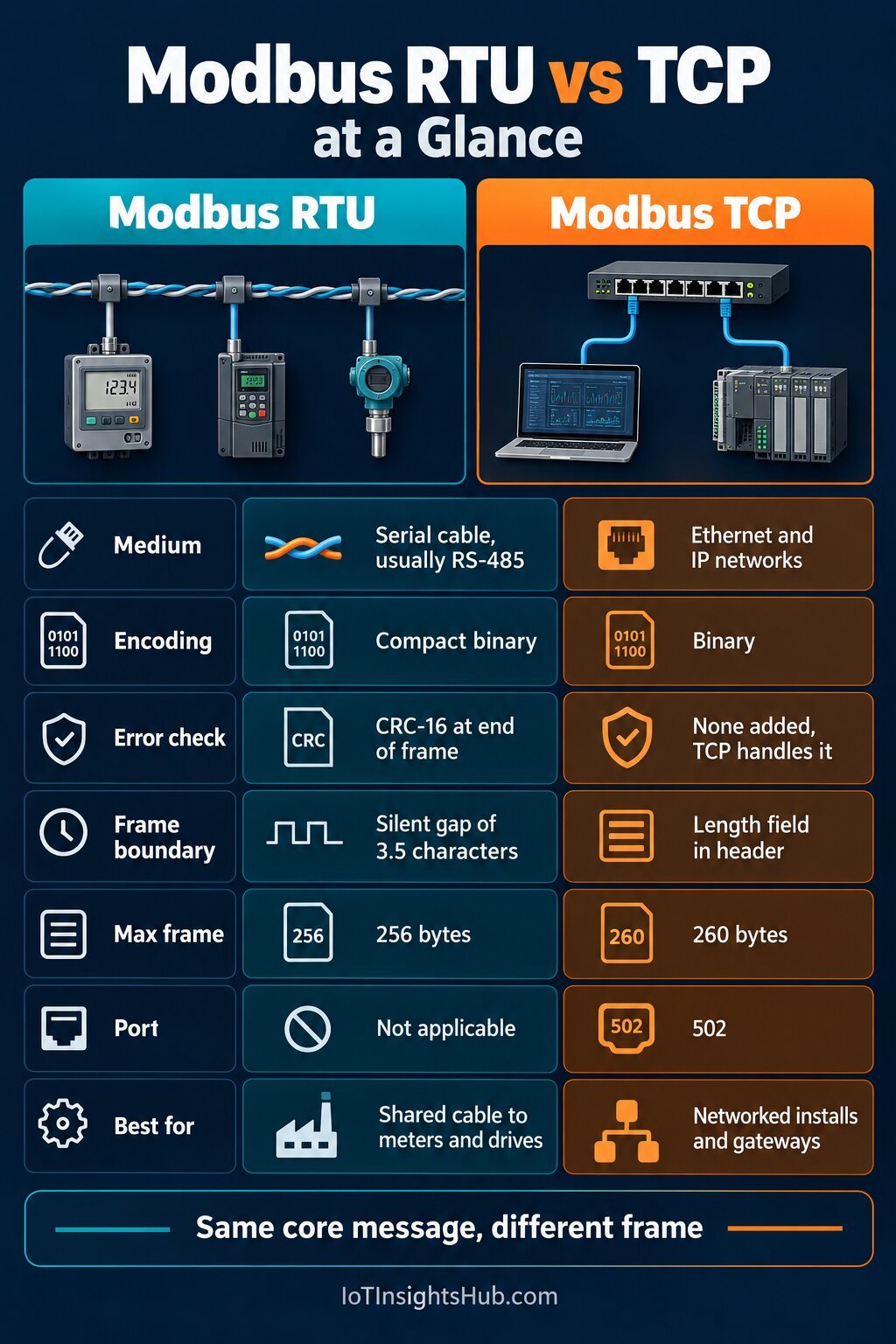
Modbus RTU sends compact binary frames over a serial cable, usually RS-485, and protects them with a CRC. Modbus TCP puts the same core message inside a TCP/IP packet on an Ethernet network, typically on port 502. The commands and data model are the same. Only the wrapper and the wire differ.
The same Modbus message, wrapped two different ways.
Per Wikipedia, the PDU is the function code plus its data, with a maximum of 253 bytes. The full frame, the ADU, tops out at 256 bytes on RS-232 or RS-485 and 260 bytes over TCP. That 7-byte difference is the TCP header.
Wikipedia describes RS-485 two-wire as the most popular serial option, and Modbus TCP as running on port 502. National Instruments adds that all three variants, including ASCII, carry the same kind of messages and differ in how those messages are packaged.
What are the 7 key differences between Modbus RTU and TCP?
The seven differences are the medium and wiring, the frame and error check, frame timing, addressing and device limits, speed and distance, multiple clients, and security. The table below sums them up, and each is explained in the sections that follow. Figures come from Wikipedia, National Instruments, Wevolver and Schneider Electric.
| Difference | Modbus RTU | Modbus TCP |
|---|---|---|
| 1. Medium | Serial cable, usually RS-485 | Ethernet and IP networks |
| 2. Frame and error check | Address, PDU, 2-byte CRC-16 | MBAP header plus PDU, no CRC added |
| 3. Frame timing | Silent gap of 3.5 character times | Length field in the header |
| 4. Addressing | Addresses 1 to 247 on one bus | IP address, plus a 1-byte unit ID |
| 5. Speed and distance | Up to 1,200 m at lower speeds | Ethernet speeds, 100 m per copper segment |
| 6. Multiple clients | One client per bus | Several clients are possible |
| 7. Security | None built in | None built in, TLS option on port 802 |
1. Medium and wiring
RTU usually runs on RS-485, a multi-drop serial bus. Wikipedia says it should be wired as a line rather than a star, with termination at each end that matches the cable, typically 120 ohms for twisted pair. Wevolver describes the same daisy-chain layout.
TCP runs over standard Ethernet. Wevolver says devices connect to switches or routers in star, tree, ring or mesh layouts. For a building that already has network cabling, that can mean no new cable at all.
2. Frame and error checking
An RTU frame is the address, the PDU and a 2-byte CRC. Wikipedia says the CRC is CRC-16, sent low byte first. Schneider Electric also notes the last two bytes of a serial message are the CRC.
TCP leaves the CRC out. Wikipedia explains that no checksum is needed because lower layers provide one. Instead, the MBAP header carries a transaction ID, a protocol ID, a length and a unit ID, per Wikipedia.
3. Frame timing
Here is where RTU can bite. It has no start or end marker, so the receiver finds frame boundaries from silent gaps. Wikipedia puts the gap at 3.5 character times, and each RTU byte is 11 bits with even parity by default.
National Instruments warns that USB-to-serial adapters can introduce gaps that cause RTU timing errors. TCP avoids the whole issue, because the length field in the header says where the message ends.
4. Addressing and device limits
On a serial bus, Wikipedia says servers are addressed 1 to 247, with address 0 for broadcast. Wevolver adds a practical limit: modern RS-485 transceivers allow up to 32 servers without repeaters, and repeaters can raise the count to 247. Its own text is inconsistent on this point, so check your transceiver datasheet.
TCP addresses devices by IP address instead. The 1-byte unit ID matters mainly behind a gateway, where, per a distributor knowledge-base page from Industrial Monitor Direct, it carries the downstream serial address. National Instruments says it is typically unused on devices with their own IP.
5. Speed and distance
Wikipedia puts RS-485 reach at up to 1,200 m (4,000 ft), but only at lower speeds. Wevolver says RS-485 typically runs from 1.2 to 115.2 kbaud, while Schneider Electric’s own example uses 9600 baud.
Ethernet is faster. Wevolver lists 10 Mb/s, 100 Mb/s and 1 Gb/s or higher, with 100 m per copper segment and effectively no limit once you add switches and routers. That said, Modbus messages are small, so IoT Insights Hub’s view is that raw link speed is rarely your bottleneck. That is a judgement, not a sourced finding.
6. Multiple clients
A serial Modbus bus has one client. Wikipedia says only the client starts a transaction, and that on serial links the client has to poll because field devices cannot send events on their own.
TCP can serve several clients at once. The Industrial Monitor Direct page says the protocol sets no connection limit, that embedded servers commonly allow 4, 8, 16 or 32 concurrent connections, and that there is no write arbitration, so the last writer wins. It is a distributor’s page and gives some figures without a source, so treat the numbers as rough.
7. Security
Neither variant has built-in security. Wikipedia says the protocol offers no protection against unauthorised commands or interception. Wevolver notes that on RTU the main protection is physical, since an attacker needs access to the cable, while TCP is reachable by anyone on the network.
The Modbus Organization announced Modbus Security in October 2018, which wraps Modbus in TLS and uses port 802. More on that in the security section below.
Which should you pick in the Modbus RTU vs TCP decision?
Pick RTU for a few devices on one cable, legacy equipment and tight budgets. Pick TCP for networked installs, remote monitoring and anything that must reach IT systems. Wevolver suggests RTU for local control and TCP for distributed systems. Many sites use both, joined by a gateway.
| If your project is… | Lean towards | Why |
|---|---|---|
| A handful of meters or drives in one cabinet | RTU | Cheap RS-485 wiring on one bus (our view) |
| Older equipment with a serial port only | RTU | It is what the device speaks |
| Devices spread across a site or several buildings | TCP | Uses existing Ethernet, scales with switches |
| Remote monitoring and diagnostics | TCP | Reachable over the network, per Wevolver |
| More than one system needs to read the same values | TCP | Several clients are possible |
| A mix of old and new gear | Both, with a gateway | Keeps legacy devices working |
Cost is part of it. Wevolver says RTU hardware is low-cost and Ethernet hardware slightly more expensive, though existing cabling can cut installation cost. It also says RTU may need field visits for maintenance, while TCP allows remote diagnostics. Those are one author’s views, so weigh them against your own site.
Whichever you pick, plan what happens to the data next. A gateway often forwards readings upward using a lightweight protocol, and our explainer on what is MQTT covers the most common one. For the bigger picture, see our guide to industrial IoT architecture.
Can Modbus RTU and TCP work together?
Yes. A Modbus gateway sits between the two worlds. It accepts a TCP request, strips the TCP header, builds an RTU frame with a CRC, sends it down the serial bus, then wraps the reply back into TCP. That lets old serial devices join an Ethernet network without being replaced.
Wevolver calls this a common hybrid: RTU on the factory floor, with a TCP gateway collecting data from each RTU segment and passing it to SCADA over Ethernet. The Industrial Monitor Direct page describes the same gateway steps and says one socket can reach up to 247 serial addresses through it.
Two cautions. First, the unit ID matters here, because behind a gateway it selects which serial device you are talking to, and some gateways reject the default 255, per the same page. Check the gateway manual. Second, a gateway adds delay. That page claims 5 to 50 ms, but gives no source, so measure it yourself.
If your site mixes protocols beyond Modbus, our guide to multi-protocol IoT systems shows how to keep them tidy. A gateway also turns device events into alerts, and IoT Mail Bridge explains the email side in its guide to setting up IoT email automation. For larger fleets, see its write-up on a reliable SMTP relay for IoT and M2M fleet alerts.
A note for founders: building an industrial IoT product? The Business Perspective tracks the funding side. Its Q3 2026 venture funding analysis puts AI at 64% of funding in its headline finding, and its Indian startup funding report for Q3 2026 covers 63 deals.
Is Modbus RTU or TCP more secure?
Neither is secure by default. Wikipedia says Modbus gives no protection against unauthorised commands or interception. RTU is harder to reach, since an attacker needs the cable. TCP is reachable across a network. A TLS-based Modbus Security specification exists, using certificates and port 802, but plain Modbus remains common.
The Modbus Organization’s 29 October 2018 press release says Modbus Security combines Transport Layer Security with traditional Modbus, uses X.509v3 certificates to authenticate server and client, and carries role-based access control in a certificate extension. It says interoperability was first shown in May 2017 and that products were expected in 2019.
IoT Insights Hub could not confirm how many devices ship with it today. In IoT Insights Hub’s view, the safest assumption is that your Modbus is plain, which means the network has to do the protecting.
- Keep Modbus on its own network segment, away from office and guest traffic.
- Never expose port 502 to the internet.
- Put a gateway between Modbus devices and the cloud, and let it handle logins and encryption.
- Log which clients write to coils and holding registers, since writes change how equipment behaves.
Those four points are IoT Insights Hub’s practical advice, not quotes from a standard. For wider habits, read our guide to IoT security risks and how to fix them and our piece on industrial cybersecurity. IoT Mail Bridge covers the data-in-transit side in its piece on edge-to-cloud data security for IoT fleets.
What do critics say about Modbus RTU vs TCP?
Critics say the debate hides a bigger issue: both share Modbus’s age, polling design, thin data model and lack of security. Others say TCP’s advantages are overstated, because small Modbus messages rarely need Ethernet speeds. Many comparison pages also come from companies selling gateways or hardware, so read them with care.
- Shared weaknesses: both variants have no built-in security, per Wikipedia and Wevolver, and both rely on the client polling.
- Source quality: the Wevolver comparison is a single-author article. It gives 32 devices in one place and 247 in another, and calls Modbus TCP both connection-oriented and connectionless.
- Vendor bias: the Industrial Monitor Direct page is a distributor’s knowledge-base article with product promotion, and some of its figures have no source.
- No live measurements: none of the pages we read tested RTU and TCP side by side, so claims about response times are not backed by data here.
- Not always cheaper or simpler: TCP can mean more hardware, and Wevolver itself calls Ethernet hardware slightly more expensive.
- Timing risk on RTU: the 3.5-character gap rule can cause errors with USB adapters, per National Instruments.
It is also fair to ask whether either is the right choice for new designs. If you need self-describing data, events and strong security, a newer protocol may fit better. That is IoT Insights Hub’s view, and our guide to Zigbee vs Z-Wave shows the same kind of trade-offs on the wireless side.
Modbus RTU vs TCP FAQs
What is the difference between Modbus RTU and Modbus TCP?
Modbus RTU sends compact binary messages over a serial cable, usually RS-485, and checks them with a 2-byte CRC. Modbus TCP wraps the same core message in a TCP/IP packet over Ethernet, typically on port 502, and adds no CRC. The commands and data tables are identical in both.
Is Modbus TCP faster than Modbus RTU?
Usually, because Ethernet runs at 10 Mb/s to 1 Gb/s or more, while RS-485 typically runs from 1.2 to 115.2 kbaud, per Wevolver. Modbus messages are small, though, so the link speed is rarely the limit. Polling design and device response times often matter more.
Can Modbus RTU and Modbus TCP be used together?
Yes. A Modbus gateway converts between them. It takes a TCP request, builds an RTU frame with a CRC, sends it over the serial bus, then returns the reply as TCP. This lets older serial devices join an Ethernet network. Check the unit ID setting, since it selects the serial device.
How many devices can Modbus RTU and TCP support?
Wikipedia says a serial bus supports servers addressed 1 to 247. Wevolver says RS-485 transceivers allow 32 servers without repeaters, and up to 247 with them, though it is inconsistent on this. Modbus TCP uses IP addresses, so the limit comes from your network and each device’s connection cap.
Is Modbus TCP more secure than Modbus RTU?
Not by default. Neither has built-in security, per Wikipedia and Wevolver. RTU is harder to reach because an attacker needs the cable, while TCP is reachable across the network. A TLS-based Modbus Security specification exists on port 802, so isolate plain Modbus and never expose port 502 to the internet.
Which should I use for a new IoT project, Modbus RTU or TCP?
Choose TCP if your devices are spread out, already on Ethernet, or need remote access. Choose RTU for a few devices on one cable, or older equipment with only a serial port. If you have both, use a gateway. Always check what your devices actually support before deciding.
Sources behind this Modbus RTU vs TCP guide from IoT Insights Hub
- Wikipedia, “Modbus” (PDU and ADU sizes, RTU and TCP framing, CRC-16, port 502, addressing, polling, security)
- Wikipedia, “RS-485” (multi-drop bus, 120 ohm termination, 1,200 m at lower speeds)
- National Instruments, “The Modbus Protocol In-Depth” (updated 30 May 2025; framing differences, USB-to-serial timing, unit ID)
- Schneider Electric, “What is Modbus and how does it work?” (247 servers, CRC, serial example)
- Wevolver, “Modbus RTU vs TCP: A Comprehensive Comparison of Industrial Protocols” (Muhammad Sufyan; published 23 May 2023, updated 31 October 2025; topology, speed, cost, gateways; contains internal inconsistencies noted above)
- Industrial Monitor Direct, “Modbus TCP: Sockets, Unit ID 255, and Multi-Master Architecture” (distributor knowledge base; multiple clients, gateways, unit ID)
- Modbus Organization, “Modbus Security” press release, 29 October 2018 (TLS, X.509v3, port 802)
So, Modbus RTU vs TCP: which one wins?
Neither wins outright. Choose RTU for a few devices on one cable and for older gear. Choose TCP for networked sites and remote access, and use a gateway when you need both. In the Modbus RTU vs TCP choice, the message is the same, so the wire and the network around it decide.
IoT Insights Hub will keep publishing practical, sourced guides on IoT protocols and industrial networks. For the business side of building in this space, read The Business Perspective’s guide to raising seed funding.
About The Author