Industrial IoT Architecture: The Ultimate Guide for 2026
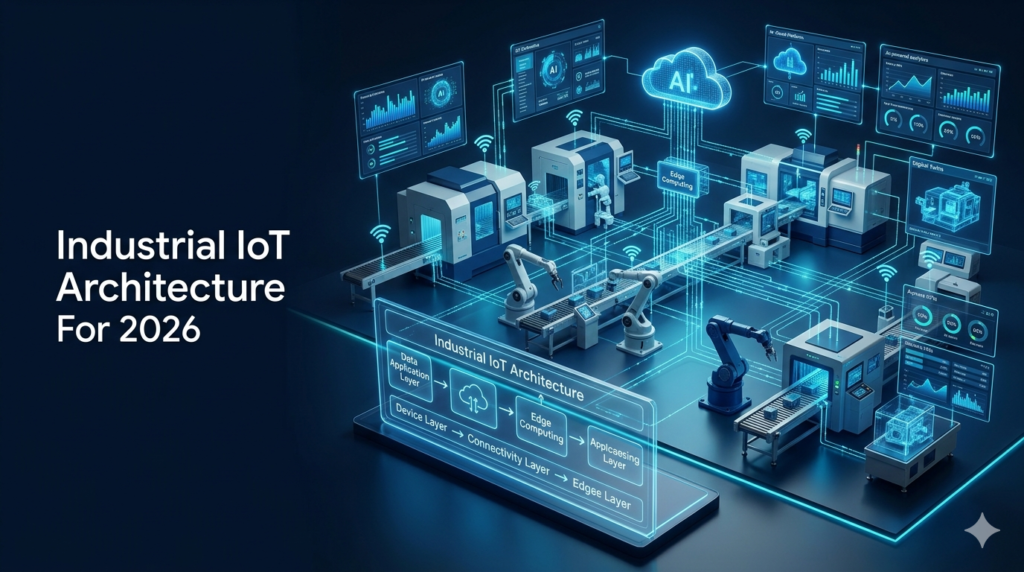
What Is Industrial IoT Architecture?
Industrial IoT Architecture refers to the structured framework that enables industrial devices, machines, sensors, and software systems to communicate and exchange data efficiently.
It provides a blueprint for how information flows from physical equipment to data processing systems and finally to business applications.
In simple terms, Industrial IoT Architecture acts as the backbone of a smart factory. It ensures that every connected device can collect, transmit, process, and use data effectively.
Modern Industrial IoT systems rely on this architecture to support:
- Smart manufacturing
- Predictive maintenance
- Asset monitoring
- Quality control
- Industrial automation
- Supply chain optimisation
As industries continue adopting Industry 4.0 technologies, the importance of Industrial IoT Architecture continues to grow.
Why Industrial IoT Architecture Matters
Many organisations invest heavily in sensors and connected devices. However, devices alone cannot deliver meaningful results.
A well-designed Industrial IoT Architecture helps organisations:
- Collect accurate operational data
- Improve production efficiency
- Reduce downtime
- Strengthen cybersecurity
- Support future scalability
- Enable real-time decision-making
For example, a manufacturing plant may use hundreds of sensors to monitor machine performance. Without a proper architecture, managing this data becomes difficult. With the right framework in place, companies can identify equipment failures before they occur and prevent costly disruptions.
Key Layers of Industrial IoT Architecture
1. Device Layer
The device layer forms the foundation of Industrial IoT Architecture.
This layer includes:
- Sensors
- Industrial machines
- Actuators
- PLCs (Programmable Logic Controllers)
- Smart equipment
These devices gather operational data such as temperature, pressure, vibration, humidity, and machine status.
For instance, vibration sensors installed on industrial motors can continuously monitor equipment health and detect unusual patterns.
2. Connectivity Layer
Once devices collect data, they must transmit it securely.
The connectivity layer handles communication between devices and processing systems.
Common communication technologies include:
- Wi-Fi
- Ethernet
- 5G
- LoRaWAN
- MQTT
- OPC UA
Reliable connectivity ensures that data reaches its destination quickly and accurately.
3. Edge Computing Layer
Edge computing plays a critical role in modern Industrial IoT Architecture.
Instead of sending all data directly to the cloud, edge devices process information closer to the source.
This approach offers several advantages:
- Faster response times
- Reduced latency
- Lower bandwidth usage
- Better operational efficiency
For example, a factory robot can analyse sensor data locally and make immediate adjustments without waiting for cloud processing.
4. Data Processing Layer
This layer transforms raw data into meaningful information.
Data processing may occur at:
- Edge servers
- Data centres
- Cloud platforms
Advanced analytics tools filter, organise, and analyse incoming information.
As a result, businesses gain valuable insights into operations, equipment performance, and production trends.
5. Application Layer
The application layer provides users with dashboards, reports, and management tools.
It helps decision-makers:
- Monitor operations
- Track performance metrics
- Manage assets
- Predict maintenance needs
- Improve production planning
Applications convert complex industrial data into easy-to-understand information.
Core Components of Industrial IoT Architecture
Several components work together to create an effective Industrial IoT Architecture.
Smart Sensors
Sensors collect real-time operational data from machines and equipment.
IoT Gateways
Gateways act as intermediaries between devices and central systems. They aggregate and filter data before transmission.
Cloud Platforms
Cloud platforms provide scalable storage, analytics, and management capabilities.
Analytics Engines
Analytics solutions identify trends, anomalies, and performance issues.
Security Systems
Cybersecurity tools protect devices, networks, and data from potential threats.
Together, these components create a reliable Industrial IoT ecosystem that supports continuous improvement.
Real-World Applications of Industrial IoT Architecture
Industrial IoT Architecture supports a wide range of practical applications.
Predictive Maintenance
Companies use connected sensors to monitor equipment health continuously.
Instead of waiting for machines to fail, maintenance teams can identify issues early and schedule repairs proactively.
This reduces downtime and lowers maintenance costs.
Smart Manufacturing
Manufacturers use Industrial IoT Architecture to optimise production processes.
Real-time visibility enables better resource allocation and improved productivity.
Asset Tracking
Businesses can track equipment, inventory, and vehicles throughout their operations.
This improves efficiency and reduces losses.
Energy Management
Industrial facilities can monitor energy consumption and identify opportunities to reduce waste.
As a result, organisations lower operating costs and support sustainability goals.
About The Author