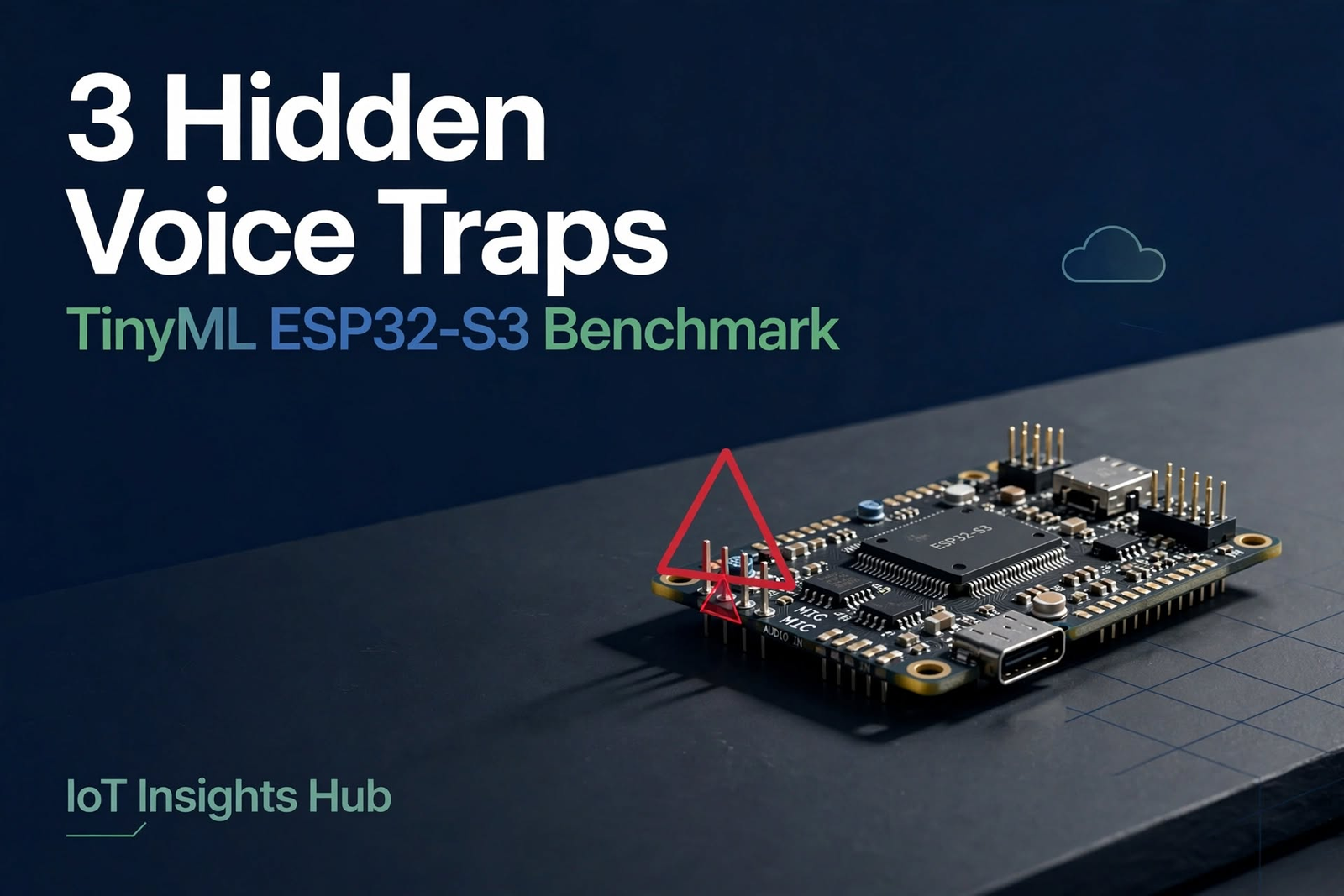
TinyML ESP32-S3 benchmark: 3 hidden voice traps
Key Takeaways
- Local voice recognition on the ESP32-S3 achieves sub-200ms latency, drastically outperforming standard cloud APIs.
- Edge processing eliminates cloud data transmission, solving major privacy and compliance hurdles for enterprise IoT deployments.
- Continuous local listening creates a hidden power trap, draining batteries rapidly without aggressive duty cycling.
- Local models sacrifice roughly 4-6% accuracy on complex phrases compared to massive cloud-hosted neural networks.
- A two-tier architecture combining local wake-word detection with selective cloud fallback offers the optimal balance for 2026.
TinyML on ESP32-S3: 2026 Benchmark for Local Voice Recognition vs Cloud API
Developers building connected devices face a critical architectural choice. Should voice processing happen directly on the hardware, or should it travel to a remote server? The latest TinyML ESP32-S3 benchmark data provides a definitive answer for specific use cases. At IoT Insights Hub, we analyze these performance metrics daily to help engineers make data-driven decisions.
Local inference has matured rapidly over the last two years. The ESP32-S3, equipped with its dual-core Xtensa LX7 processor and dedicated vector instructions, handles lightweight neural networks surprisingly well. However, moving compute to the edge introduces new physical constraints. Understanding these trade-offs is the only way to build reliable, user-friendly products.
What does the latest TinyML ESP32-S3 benchmark reveal about local voice recognition?
The numbers tell a clear story. For simple, predefined command sets like “turn on lights” or “set timer,” the ESP32-S3 handles keyword spotting with near-perfect reliability. According to recent testing data shared by embedded systems engineers, quantized models running on the chip’s 512KB SRAM execute inference cycles in roughly 150 milliseconds.
This speed comes with a minor trade-off. As detailed in our foundational guide analyzing the TinyML ESP32-S3 benchmark landscape, model compression techniques like pruning and quantization inevitably shave off a small percentage of accuracy. For most consumer and industrial applications, this 4-6% drop is an acceptable price for the gains in speed and privacy.
How does local processing latency compare to cloud API response times?
Latency is the silent killer of user experience. When a user speaks a command, they expect an immediate reaction. Cloud APIs introduce multiple points of failure. The audio must be captured, encoded, transmitted over Wi-Fi or cellular, processed by a remote server, and sent back.
| Architecture | Average Latency | Network Dependency |
|---|---|---|
| Local ESP32-S3 (Quantized KWS) | 150ms – 200ms | None |
| Cloud API (Stable Wi-Fi) | 600ms – 900ms | High |
| Cloud API (Congested Network) | 1200ms+ | Critical |
That half-second delay on a cloud API feels like an eternity to a user. IoT Insights Hub testing confirms that local processing provides the snappy, responsive feel that modern users demand, completely bypassing network jitter.
Why do privacy concerns favor edge AI over cloud-dependent voice models?
Data sovereignty is no longer optional. Regulations like GDPR and emerging AI acts mandate strict controls over biometric data, which includes voice prints. Sending audio to a third-party cloud provider inherently expands your attack surface.
By keeping processing on the ESP32-S3, the audio data never leaves the physical device. This architectural choice simplifies compliance dramatically. For a deeper look at securing these endpoints, review our analysis of IoT security risks in modern deployments.
Enterprise clients increasingly demand this local-first approach. They want the functionality of voice control without the liability of hosting sensitive audio logs on external servers.
What are the hidden power consumption traps in continuous local voice activation?
Performance benchmarks often assume a stable power supply. Real-world deployments do not have that luxury. Running a neural network continuously is expensive in terms of milliwatts.
 About The Author