

IoT startup funding: 5 deals that quietly reshaped Q3
Key takeaways
- The five largest disclosed IoT rounds in Q3 2026 pulled in roughly $749 million between 3 and 30 September.
- Exein took $270M at a $1.7B valuation — a 30-fold jump in two years and Italy’s newest unicorn.
- Four of the five winners sell infrastructure: security firmware, satellite connectivity, cellular networks, silicon. Only Ultrahuman sells a consumer device.
- Crunchbase puts Q3 robotics venture funding at $9.9B, up 185% year on year. European hardware funding fell 53.4% in H1 2026.
- Capital concentrated at the top. Median IoT revenue multiples sit near 12x private, while public IoT comps trade around 2.8x.
IoT startup funding: 5 deals that quietly reshaped Q3
Five rounds. Roughly $749 million in disclosed capital. And a pattern that most funding roundups missed entirely.
Between 3 and 30 September 2026, the largest IoT startup funding deals did not go to smart-home gadgets or another fleet-tracking dashboard. They went to firmware security, satellite Bluetooth, cellular plumbing and a processor built to run AI without a data centre. The Business Perspective reviewed each announcement, cross-checked the figures against company statements and funding databases, and found a quarter that looks like a boom at the top and a squeeze everywhere else.
That distinction matters if you are raising. The headline numbers say capital is back. The detail says it is back for a specific kind of company.
What were the five biggest IoT startup funding deals of Q3 2026?
Here is the quarter in one table. Amounts are as disclosed by the companies; Onomondo’s dollar figure uses the approximate conversion reported alongside the euro announcement.
| Company | HQ | Amount | Valuation | Lead | What it sells |
|---|---|---|---|---|---|
| Exein | Rome | $270M | $1.7B | Headline | Kernel-level security for embedded devices |
| Hubble Network | Seattle | $200M | $1.6B | Smith Point Capital | Bluetooth-to-satellite connectivity |
| Onomondo | Copenhagen | €100M+ | Undisclosed | Aspirity Partners | Cellular IoT infrastructure |
| Efficient Computer | Pittsburgh | $97M | $650M | TQ Ventures | Energy-efficient edge processors |
| Ultrahuman | Bengaluru | $70M | $365M | Qualcomm Ventures | Smart rings and on-device health AI |
Two things stand out. First, the size spread is brutal — the top round is nearly four times the fifth. Second, three of the five are European or Indian, not Silicon Valley. That is a shift worth noting for anyone who still assumes IoT capital is a Bay Area story.
The Business Perspective has tracked IoT rounds for long enough to remember when connectivity startups were treated as low-margin utilities. Q3 2026 broke that assumption, at least for the companies with real network assets.
Why did Exein’s $270M round value a security company at $1.7B?
Start with the speed. Exein was valued near $55 million two years ago, according to reporting by Startup Business. It closed a Series C in December 2025 at roughly $800 million. Nine months later it raised again at $1.7 billion — and deliberately declined to give the round a letter.
That detail is not cosmetic. When a company raises at more than double its last price inside a year, attaching “Series D” to it implies an orderly ladder the business has already outrun. TechCrunch noted the same omission. Read it as a signal about how the company views its own trajectory.
The commercial case is harder to dismiss. Exein’s software runs on the device itself, at the kernel level, because a robot or a vehicle cannot be defended the way a laptop is. There is no agent to install and no patch window. The company says it now protects more than two billion connected devices across industrial automation, automotive, energy and healthcare, and that first-half 2026 annual recurring revenue grew fourfold year on year.
The round was oversubscribed. Headline led, with Sofina, Goldman Sachs, the European Investment Bank Group’s ETCI, KfW Capital, T.Capital and Balderton joining, plus existing backers HV, Intrepid Growth Partners, 33N Ventures, Lakestar, Supernova Invest, Blue Cloud Ventures and Geodesic Capital. Including debt, Exein has now raised more than $600 million.
The defensible layer in physical AI may not be the cloud where models are trained. It may be the silicon where they act.
If you want the investor-side mechanics behind marks like this, our breakdown of how VCs value pre-revenue hardware startups walks through the same valuation logic from the other side of the table.
What does Hubble Network’s $200M Series C say about satellite IoT?
The pitch is unusually clean: a Bluetooth chip that already exists in millions of sensors can talk to orbit without new hardware. Hubble says its network is now open to any standard Bluetooth device and already reaches millions of devices through partners.
Smith Point Capital led, with Seraphim Space, Carthona Capital, Earthshot Ventures, Y Combinator and RPM Ventures participating. Total funding now stands at $300 million.
The risk sits in the capital intensity. Going from six satellites to 60 by 2030 is a manufacturing and launch schedule, not a software roadmap, and launch costs do not negotiate. That is the trade investors accepted: a $1.6 billion mark on a network that is still being built.
For context on where connectivity standards are heading, IoT Insights Hub maintains a practical guide to IoT connectivity options that pairs well with this deal.
Why is connectivity infrastructure like Onomondo attracting private equity?
This is the round that does not fit the venture pattern at all. It is a control transaction, not a growth equity cheque, and it went to a connectivity company — a category investors spent a decade calling commoditised.
Onomondo’s answer to that critique is vertical integration. The company owns its stack, from the device through the radio access network to the cloud, and has deployed what it believes is the largest private LTE network at sea across more than 450 Maersk vessels. Cargo can move between a shipboard private network and public networks without a handoff drama.
Aspirity’s co-founder Ralph Choufani framed the thesis as a shift “from merely linking endpoints to the internet toward orchestrating a ubiquitous and continuous fabric of connectivity.” Joseph O’Mara, the firm’s founder and managing partner, noted it is Aspirity’s first Nordic investment under a pan-European strategy.
The strategic read: private equity now sees IoT connectivity as essential infrastructure with recurring revenue, not as a venture bet. That changes the exit math for every connectivity startup behind Onomondo.
What do Efficient Computer and Ultrahuman have in common?
Efficient Computer is a Carnegie Mellon spinout building processors around its Fabric architecture. TQ Ventures led the Series B, with Eclipse, Union Square Ventures, Toyota Ventures, Giant Ventures, Triatomic Capital and others participating. Total funding reached $173 million. The company says its Electron E1 is already in volume production and targets more than tenfold efficiency gains versus systems built today.
Ultrahuman is the consumer-facing exception in this list. Qualcomm Ventures led the $70 million round — $65 million in primary equity and $5 million in debt — with Labcorp, Alpha Wave Global, Blume Ventures, Nexus Venture Partners and Alteria Capital participating. The $365 million valuation is roughly three times its 2023 mark. The two companies are also working on a Qualcomm-powered ring designed to run more software on-device.
Different stages, different customers, same bet. Compute is migrating toward the physical world, and the money is following the migration. Our analysis of edge AI versus cloud AI cost per inference explains why that economics argument keeps winning.
Is IoT startup funding actually recovering in 2026?
The two numbers are not contradictory. They describe different floors of the same building.
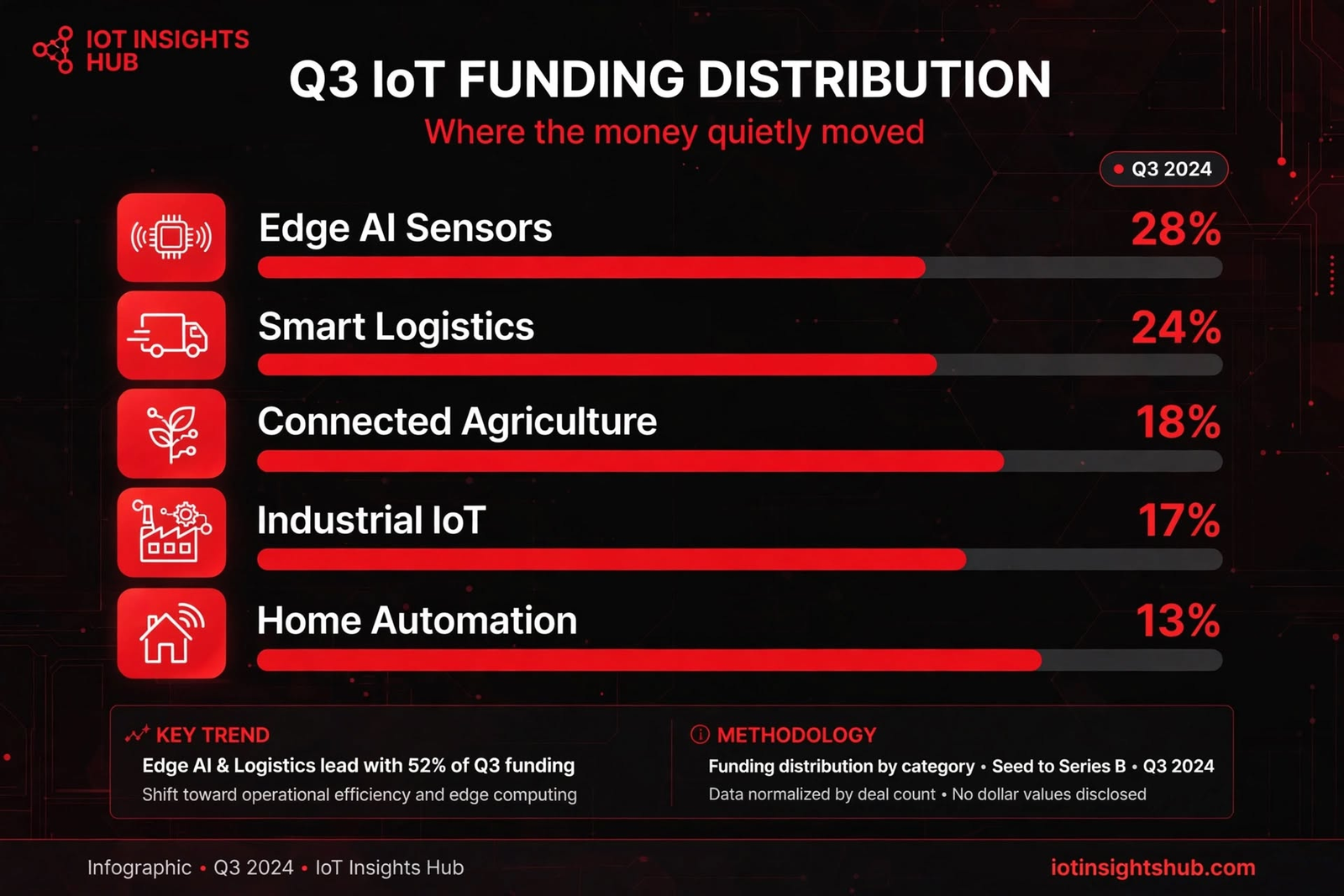
At the top, Crunchbase data published on 27 October shows robotics venture funding more than doubling year on year, with the US and China driving a physical AI push. FinSight Ventures estimates physical AI’s share of global venture financing grew from 0.8% in 2016 to 12% in 2025, with investment volume rising from $2 billion to $64.7 billion over the same period and reaching $72.2 billion in the first half of 2026 alone.
At the bottom, the picture inverts. Tech.eu’s hardware tracker recorded 26 European hardware companies raising a combined €306 million in H1 2026, down 53.4% versus the same period a year earlier. The UK led by capital raised, which tells you how thin the rest of the field was.
Carta’s Q1 2026 data offers a partial explanation and a partial reassurance: the down-round rate sat at 11.4%, roughly half its 2023 peak of 22% and back in line with 2019–20 levels. Founders are not being repriced en masse. They are simply being funded later, with more diligence and more proof of revenue required before the first institutional cheque.
What do critics say about the physical AI funding boom?
Start with the multiple gap. Flow Partners’ October 2026 analysis puts median revenue multiples across IoT venture rounds at around 12x over the trailing twelve months, while public IoT comparables trade near 2.8x EV/Revenue. That spread is not automatically a bubble — private marks often lag — but it means the next funding round, or an IPO, will test whether the 12x was real.
The second critique is concentration. The $469 billion venture figure sounds like abundance. It is not, for a company selling industrial sensors into a twelve-month sales cycle. Stormbreaker VC made the point bluntly in July: for edge compute, industrial IoT and connectivity founders, rounds take longer, diligence runs deeper, and proof-of-revenue requirements have hardened.
Third, some of this quarter’s headline numbers are marks, not cash. Onomondo’s deal is a control transaction that has not closed. Hubble’s $1.6 billion valuation assumes a 60-satellite constellation that does not exist yet. Exein’s round carries no series letter, which makes it harder to compare against a standard benchmark. None of that is improper. All of it means the numbers should be read as expectations rather than results.
The Business Perspective’s view: this is a strong quarter for a narrow slice of the market, and a difficult one for everyone else. Both things are true, and most coverage only reports one.
What does this quarter mean for your next raise?
Three practical reads, in order of usefulness.
Sell infrastructure if you can. Four of five winners sold something other companies depend on — security, connectivity, silicon. If your product is a device, you are competing for a smaller pool of capital at a worse multiple. That is not fatal, but it should shape how you pitch.
Expect the diligence to be about revenue, not vision. Exein’s fourfold ARR growth and Efficient’s volume production both came before the big cheque. The rounds that closed in Q3 were, without exception, companies that could show a commercial number.
Watch Europe for the gaps. European hardware funding fell by half while European companies took two of the five largest rounds. The market is bifurcating: fewer cheques, larger sizes, higher bar. Founders who clear that bar are raising at better terms than they would have in 2024.
The broader IoT startup funding benchmarks we maintain at The Business Perspective track these shifts quarter by quarter. If you are preparing a raise, the pattern from Q3 is clear: capital is available for infrastructure with proven revenue, and scarce for everything else.
What do founders ask most about IoT startup funding?
How much did IoT startups raise in Q3 2026?
The five largest disclosed IoT rounds in Q3 2026 totalled roughly $749 million: Exein at $270 million, Hubble Network at $200 million, Onomondo at just over €100 million, Efficient Computer at $97 million and Ultrahuman at $70 million. Smaller rounds below $70 million are excluded, so the true quarterly total is higher.
Who led Exein’s $270 million funding round?
Headline led the $270 million round announced on 15 September 2026. Sofina, Goldman Sachs, the European Investment Bank Group’s ETCI, KfW Capital and Balderton also participated, alongside existing backers including HV, Lakestar and Intrepid Growth Partners. The round was oversubscribed and valued Exein at $1.7 billion post-money.
What is Hubble Network’s valuation?
Hubble Network reached a $1.6 billion valuation with its $200 million Series C on 23 September 2026. The Seattle-based company has now raised $300 million in total, including a $70 million Series B closed roughly a year earlier. Smith Point Capital led the round.
Why did Aspirity take a majority stake in Onomondo?
Aspirity Partners bought a majority stake to back Onomondo’s connectivity infrastructure as physical AI raises demand for device orchestration. The combined investment exceeded €100 million, with Denmark’s EIFO increasing its position. Onomondo serves more than 500 customers across over 100 countries, and the deal is expected to close in early 2027.
Is IoT startup funding growing or shrinking in 2026?
Both, depending on the segment. Late-stage infrastructure and physical AI rounds are larger and more frequent: Crunchbase recorded $9.9 billion in global robotics venture funding in Q3 2026, up 185% year on year. Early-stage hardware is harder, with European hardware funding down 53.4% in H1 2026.
What round do most IoT startups fail to reach?
Seed is where the funnel narrows. Certification, tooling and inventory costs arrive before recurring revenue does, and European hardware raised only €306 million across 26 rounds in H1 2026, down 53.4% year on year. Founders who clear seed without contracted revenue rarely reach a priced Series B.
About The Author


