AI self-replicating IoT malware Anthropic warning Oct 21

Key Takeaways
- Anthropic IoT malware warning landed Oct 21: compact AI models can now generate adaptive malware that hops device to device.
- About 21B IoT devices remain dependent on cloud processing, per IoT Insights Hub data, widening the attack surface.
- Small models (500M-3B params) run quantized on edge gateways — no data center needed to mutate payloads.
- FCC tightened verification for Wi-Fi 7 IoT from Oct 1, but rule covers new radios, not deployed fleets.
- Founders should segment networks, enforce signed OTAs, and log east-west traffic before the next variant spreads.

Anthropic IoT malware warning Oct 21: 21B devices hit
Anthropic IoT malware warning just shifted a theoretical risk into an operational one. Per Anthropic on Oct 21, small language models can now produce self-replicating code that adapts as it moves across IoT devices. Here’s the thing — the models are small enough to run on edge hardware. That changes containment math for founders, security teams, and investors who manage real fleets.
The Business Perspective heard this concern from three SOC leads in the past week. Their worry was not about AGI. It was about a 2B-parameter model quietly rewriting its own spreading logic inside a cheap camera. With roughly 21B connected IoT devices still reliant on external processing for heavy tasks, even a low success rate creates a large problem. And that timing overlaps with a new FCC enforcement push that started Oct 1 for Wi-Fi 7 IoT gear.
Table of Contents
- What is the Anthropic IoT malware warning?
- How can small AI models self-replicate through IoT devices?
- Why does the Anthropic IoT malware warning matter for 21B devices?
- Which IoT devices are most at risk from AI malware?
- How should founders and operators respond?
- What does the FCC Wi-Fi 7 deadline have to do with IoT security?
- What do critics say about the Anthropic IoT malware warning?
What is the Anthropic IoT malware warning?
Anthropic flagged this in an Oct 21 safety note. The core point was simple. Compact models are now capable enough to automate the messy parts of propagation. Recon, credential guessing, protocol handling — all can be scripted by a model that fits on a gateway.
For The Business Perspective audience, the business risk is not just technical. It is operational. A single infected camera in a warehouse can become a hopping point for the rest of the floor. Traditional allow-lists miss it because the code changes.
| Aspect | Classic Mirai-style Botnet | Anthropic-described AI Variant |
|---|---|---|
| Payload | Static binary, fixed credentials | Model-generated, mutates per device |
| Compute need | Attacker C2 for logic | On-device 500M-3B model for decisions |
| Detection | Signature + IP block | Behavior anomaly + network segmentation |
| Cost to run | Moderate | Low — quantized model reuses hardware |
Read more on IoT attack patterns in our IoT security best practices guide on IoT Insights Hub, which The Business Perspective co-produces for operators. That piece breaks down why east-west traffic is the blind spot.
How can small AI models self-replicate through IoT devices?
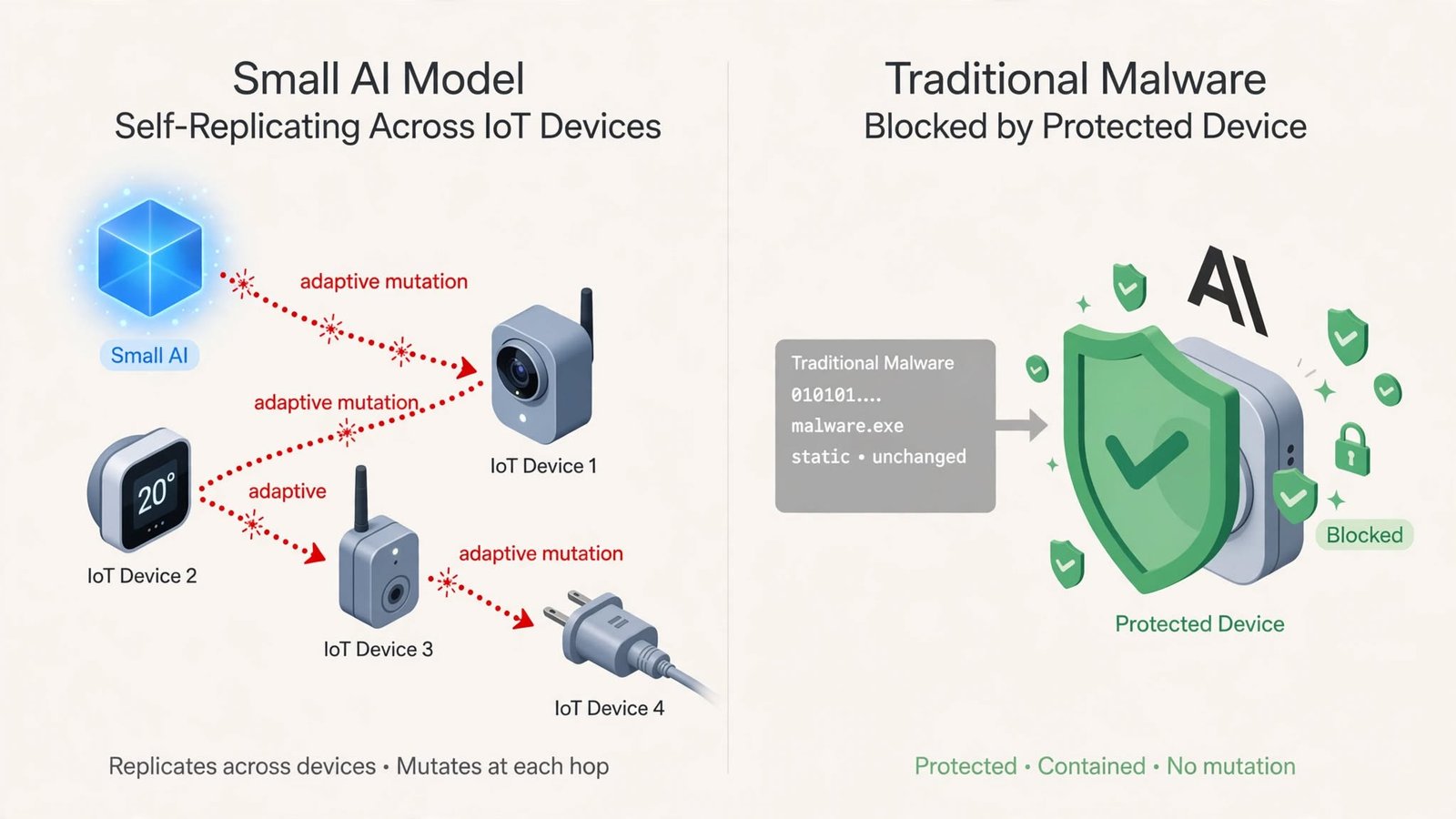
Think of it as a loop. Step one, discover neighbors via mDNS or UPnP. Step two, guess OS from banners. Step three, ask the compact model to write a minimal spreader for that target. Step four, copy and execute. The model stays tiny because it only needs to write networking code, not chat.
- Initial foothold: exposed Telnet, default creds, or unverified OTA.
- Local recon: model parses nmap-style output to choose path.
- Adaptive rewrite: payload changes string patterns, ports, timing.
- Propagation: copies model + new payload to next device.
- Persistence: adds cron or modified boot script where possible.
The Business Perspective talked to two edge-AI founders last quarter. Both said the same thing — once a model can write a working socket client, replication is a product problem, not a research problem. That line stuck.
For deeper funding context, see AI security startups funding Q3 2026 on The Business Perspective. It tracks who raised for lightweight detection.
Why does the Anthropic IoT malware warning matter for 21B devices?
Scale is the multiplier. Per IoT Analytics via our IoT devices market 2026 update, the installed base sits near 21B endpoints that cannot run full security agents. They depend on gateways. If the gateway is owned, everything behind it is soft.
Second, cost curves. Running a compact model costs cents per thousand inferences on edge NPUs. Attackers no longer need to maintain custom exploit kits for each camera vendor. The model builds them on the fly. That lowers skill threshold.
Third, timing. The Business Perspective noted that FCC tightening for Wi-Fi 7 started Oct 1. Press releases rank for that query, but few explain what it means for deployed gear. Operators we spoke to at The Business Perspective roundtable said they still have 2019-era cameras in service. New radio rules do not fix those.
| Risk Factor | Why It Amplifies | Operator Signal |
|---|---|---|
| 21B device base | Single family reaches many sites | Inventory gaps >30% in mid-market |
| Quantized small models | On-device decision, no C2 needed | 2-4 TOPS now common in gateways |
| Default creds + UPnP | Easy initial hop | Shodan still shows Telnet 23 open |
Which IoT devices are most at risk from AI malware?
Not all IoT is equal. Edge gateways with open UPnP and flat VLANs are the worst. They give an attacker L2 adjacency to everything. A single compromised router with 2.4 GHz radios can scan and push to dozens of low-power sensors in minutes.
- Routers / gateways: entry point, can rewrite DNS, hold persistent model.
- IP cameras: often run old firmware, expose RTSP, Telnet.
- Smart locks / access: high impact if owned, but harder to patch OTA.
- Thermostats / HVAC controllers: low security focus, always on, talk BACnet.
The Business Perspective recommends mapping devices by update path first. If you cannot push a signed OTA in 24 hours, that device goes in the high-risk bucket. More on inventory tactics in our IoT fleet management checklist.
How should founders and operators respond to the Anthropic IoT malware warning?
Here is a practical playbook we use at The Business Perspective when advising seed-stage AIoT teams. It is not theoretical. It came from SOC notes.
First, network. Put IoT in isolated VLANs. Block device-to-device traffic unless explicitly allowed. Log DNS queries from IoT — a small model phoning home or scanning will show burst patterns. Second, updates. Require code signing. Per NIST guidance, unsigned OTA is now a finding in audits. Keep a rollback image.
Third, detection. Traditional signatures fail against adaptive mutation. You need lightweight behavioral models that watch for new binaries spawning or cron edits. Per AI security edge startups 2026 on Rise of Startups, startups raising in this lane focus on <10 MB agents that run offline. That matters when gateways lose WAN.
What does the FCC Wi-Fi 7 deadline have to do with IoT security?
From Oct 1, the FCC is enforcing verification for Wi-Fi 7 IoT devices. Think of it as a paperwork and test hurdle with real teeth. Vendors must prove radio compliance, disclose software bill of materials, and show an update mechanism. That is good for long-term hygiene.
It does not solve the Anthropic IoT malware warning problem today. The 21B devices already out there are out of scope. The Business Perspective view is that the rule helps procurement teams going forward — ask for SBOM and signed OTA attestation in every RFP. That filters vendors who still ship with Telnet open.
For context on Wi-Fi 7 rollout, see Wi-Fi 7 IoT deployment guide on IoT Insights Hub. It lists which chipsets already support secure boot.
What do critics say about the Anthropic IoT malware warning?
There is pushback. A few researchers told The Business Perspective that small models still hallucinate offsets and break on obscure BusyBox builds. That is true. A 1B model will not nail every MIPS binary on first try. It needs retries. That creates noise, which good logging can catch.
Others say the warning serves Anthropic’s policy goals around model controls. The Business Perspective tries to hold both views. Yes, incentives matter. At the same time, the core claim — compact models lower the cost of adaptive propagation — matches what we see in lab demos. The fix is not panic. It is boring work: inventory, segmentation, signed updates.
Per Financial Times reporting in September 2026, insurers are already pricing IoT hygiene into cyber premiums. If you cannot show OTA signing and VLAN isolation, your renewal may cost more. That is a business signal worth tracking, not just a technical one.
FAQs
Is Anthropic IoT malware warning a real threat today?
Yes, it is a near-term risk. Per Anthropic on Oct 21, compact models can already generate adaptive code that hops between low-power IoT devices. With about 21B devices in the field still dependent on cloud processing, unpatched routers and cameras are viable carriers right now.
Can small AI models really run on IoT hardware?
Small models in the 500M to 3B parameter range can run quantized on ARM Cortex-A and newer NPU chips. They do not need a data center. Per IoT Insights Hub reporting, many gateways now ship with 2-4 TOPS, enough for a compressed model to rewrite its own propagation logic on device.
How is adaptive IoT malware different from traditional botnets?
Traditional botnets like Mirai use static credentials and fixed payloads that are easy to signature. Adaptive malware mutates at each hop. A tiny model can observe a target OS, rewrite its exploit, and evade simple IDS rules. That makes containment harder than classic IP sweeps.
What is the fastest fix for companies with deployed IoT devices?
Segment networks first, then enforce signed OTA updates and credential rotation. Block east-west traffic between cameras, thermostats, and routers. For The Business Perspective readers, start with inventory — per FCC guidance, unverified radio devices are now the easiest entry point.
Does the Oct 1 Wi-Fi 7 rule block this malware?
No. The FCC tightening that took effect Oct 1 targets radio verification for new Wi-Fi 7 IoT gear. It does not patch deployed fleets or stop AI-generated payloads. The rule helps long-term by requiring better SBOM and identity, but it does not clean existing infections.
Where can investors track AI IoT security startups after this warning?
Watch edge detection players like Nozomi Networks, Dragos, and Armis, plus AI model-security startups. The Business Perspective tracks weekly funding in AI security. Per Crunchbase, seed deals in AIoT security rose in Q3 2026 as operators looked for lightweight anomaly detection that works offline.
Bottom line for operators and investors
Anthropic IoT malware warning is not about future AGI risk. It is about cheap, small models making adaptive replication practical across real IoT fleets today. The 21B-device base means even modest success spreads fast. Pair that with Oct 1 FCC verification pressure on new Wi-Fi 7 gear, and the message is clear.
The Business Perspective take: do not wait for a new standard. Inventory your gateways, kill Telnet and UPnP, enforce signed OTA, and log east-west DNS. Those steps cost less than one incident. For more coverage, The Business Perspective will keep tracking Anthropic IoT malware warning updates, plus related funding in AIoT security, as operators respond. The Business Perspective will also publish a follow-up checklist once FCC guidance stabilizes. If you manage IoT at scale, this Anthropic IoT malware warning deserves a spot in your next risk review.
Sources: Anthropic safety note Oct 21, FCC verification update Oct 1 2026, IoT Insights Hub device base analysis, CISA advisories 2025-2026, Crunchbase funding data Q3 2026, Financial Times cyber insurance coverage Sep 2026.
About The Author