Blockchain for IoT: 7 Security Uses and Their Limits Today
Blockchain for IoT explained: seven security uses, what NIST, W3C and IETF sources support, where signed firmware or a database does the job, and the limits.
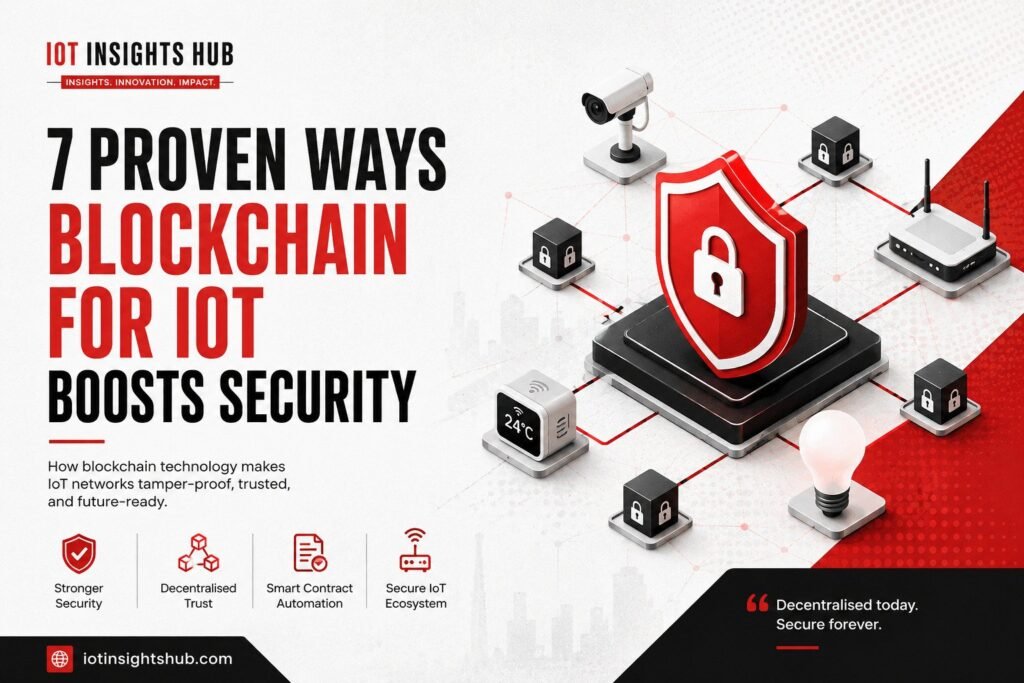
Blockchain for IoT links device identity, data records and updates to a shared ledger.
Blockchain for IoT can make device identities and data records harder to fake, but it is not a cure-all. NIST itself calls blockchain "not a silver bullet". This IoT Insights Hub guide explains seven security uses, shows what named sources support, points out where simpler tools do the job better, and lists what to check before you build.
Key Takeaways
- Blockchain for IoT fits shared, multi-party records and tamper-evident logs best.
- W3C Decentralized Identifiers let a thing prove its identity without a central registry.
- Signed firmware manifests (IETF RFC 9019) protect updates even without a blockchain.
- IoT Analytics counts 18.5 billion connected IoT devices in 2024.
- We removed unsourced numbers and a wrong Mirai claim from the earlier version.
Editorial note from IoT Insights Hub: the earlier version of this article quoted "76 billion IoT devices by 2025", a "$5.8 billion market by 2030" and "98.7% attack detection", none with a named source. It also said the Mirai botnet exploited insecure firmware updates. Cloudflare says Mirai logged in using default credentials, so we corrected that and removed the unsourced numbers.
Table of Contents
What is blockchain for IoT?
Blockchain for IoT means recording device identities, data or events on a ledger shared by several parties. NIST describes blockchains as tamper-evident, tamper-resistant digital ledgers, where each block is cryptographically linked to the previous one. Not every device runs a node; gateways or cloud services often act on its behalf.
Scale is why the idea attracts attention. IoT Analytics reports 18.5 billion connected IoT devices in 2024, 21.1 billion forecast by the end of 2025 and 39 billion in 2030. More devices mean more weak points, as our report on IoT security threats 2026 shows.
| Use | What a ledger adds | Simpler option to compare |
|---|---|---|
| Device identity | Identity not tied to one registry | Certificate authority (PKI) |
| Data records | Tamper-evident history shared by parties | Signed, append-only database |
| Firmware | Public audit log of releases | Signed manifests (RFC 9019) |
| Multi-party sharing | No single operator owns the record | Trusted third-party platform |
How can blockchain for IoT give devices an identity?
W3C's Decentralized Identifiers (DIDs), a Recommendation since 19 July 2022, let an identifier be decoupled from centralized registries and certificate authorities. A DID can refer to a thing, so a sensor or gateway can prove control of its identity without asking permission. DIDs can be anchored on different systems, so check the method.
Why do tamper-evident records matter for IoT data?
In a blockchain, changing an earlier block changes its hash, so altered blocks are easy to detect and reject, according to NIST. That makes sensor logs, cold-chain readings or maintenance records harder to rewrite quietly. It proves the record was not changed after writing; it cannot prove the sensor measured correctly in the first place.
Good sensing still comes first. See our guide to vibration sensor predictive maintenance for how a bad mount ruins data before any ledger sees it.
Can smart contracts enforce IoT security rules?
Smart contracts are programs stored on a ledger that run when set conditions are met, so a rule such as "revoke a device after repeated failed checks" can run without an administrator. The catch is that contracts only see data supplied to them, so a trusted oracle or gateway must report device behaviour. Test the rule off-chain first.
This section is IoT Insights Hub's engineering reading, not a named study.
Is blockchain needed for secure firmware updates?
Not necessarily. IETF RFC 9019 describes an update architecture where a signed manifest protects the firmware image, and the device verifies the signature before accepting an update. Authentication and integrity protection are required in a deployment. Blockchain can add a shared audit log of released versions, but signing is the core control.
RFC 9019 is an informational document from April 2021. Most real attacks start simpler: Cloudflare says Mirai infected devices by logging in with default credentials. Read our steps in how to secure a smart TV from hackers for the same lesson at home.
Can machines pay each other with blockchain for IoT?
In theory, a device or gateway can settle small payments on a ledger without a payment processor, for example an EV charger billing a car. We found no independent, large-scale deployment data for this, so treat it as pilot-stage. Latency, fees and device wallet security are likely hurdles before any production rollout.
How does blockchain for IoT help organisations share data?
In a permissioned blockchain only authorised users can publish blocks, and NIST notes some permissioned networks can selectively reveal transaction information. That suits logistics or smart-city consortia where partners need shared records without opening everything. In permissionless networks, all transactions are publicly visible.
For privacy proofs, read our zero-knowledge proofs explainer, and for business uses see how blockchain is transforming business security.
Can blockchain consensus detect attacks on IoT devices?
Not by itself. A ledger records what participants submit; it does not know whether a sensor is behaving strangely. Anomaly detection needs separate analytics, and the figure of 98.7% accuracy in our earlier version had no named source, so we removed it. Pair ledger audit trails with conventional monitoring.
What are the limits of blockchain for IoT?
NIST warns blockchain is "not a silver bullet", notes that changing recorded data is difficult, and lists risks such as 51% attacks and delayed finality, where a transaction is not confirmed until later blocks are added. Reyna et al. (2018) also treat IoT data reliability as a core open problem.
What do critics say about blockchain for IoT?
Critics say a signed database or standard PKI delivers most of the same security with less overhead, and that blockchain adds cost, latency and complexity. Supporters say a shared ledger helps when several organisations distrust a single operator. NIST's advice is to ask how blockchain could benefit you, not how to fit your problem to it.
This is IoT Insights Hub's editorial reading, not a named study. We think blockchain for IoT earns its place only in multi-party settings.
What else do people ask about blockchain for IoT?
What is blockchain for IoT?
Blockchain for IoT means recording device identities, data or events on a ledger shared by several parties. NIST describes blockchains as tamper-evident, tamper-resistant digital ledgers, where each block is cryptographically linked to the previous one.
Can blockchain stop IoT hacking?
No. NIST calls blockchain "not a silver bullet". It can make records tamper-evident, but the Mirai botnet spread through default passwords, per Cloudflare, which no ledger would have stopped. Change defaults and sign firmware first.
Do IoT devices need to run a blockchain node?
Not necessarily. Gateways or cloud services can write to a ledger on behalf of small sensors, and permissioned networks limit who can publish blocks. Check the node requirements and confirmation delay of any platform before you choose it.
How many IoT devices are connected?
IoT Analytics reports 18.5 billion connected IoT devices in 2024 and forecasts 21.1 billion by the end of 2025 and 39 billion in 2030.
What should you do next about blockchain for IoT?
Start by asking whether a signed database would solve your problem. Use blockchain for IoT only when several parties need a shared, tamper-evident record. Secure the basics first: unique passwords, signed firmware and network separation. Then pilot one use case and measure cost and delay.
IoT Insights Hub will update this guide as standards and independent deployment data appear. Thoughtful blockchain for IoT starts with the problem, not the technology.
Sources (IoT Insights Hub checked each page on 5 November 2026):
About The Author