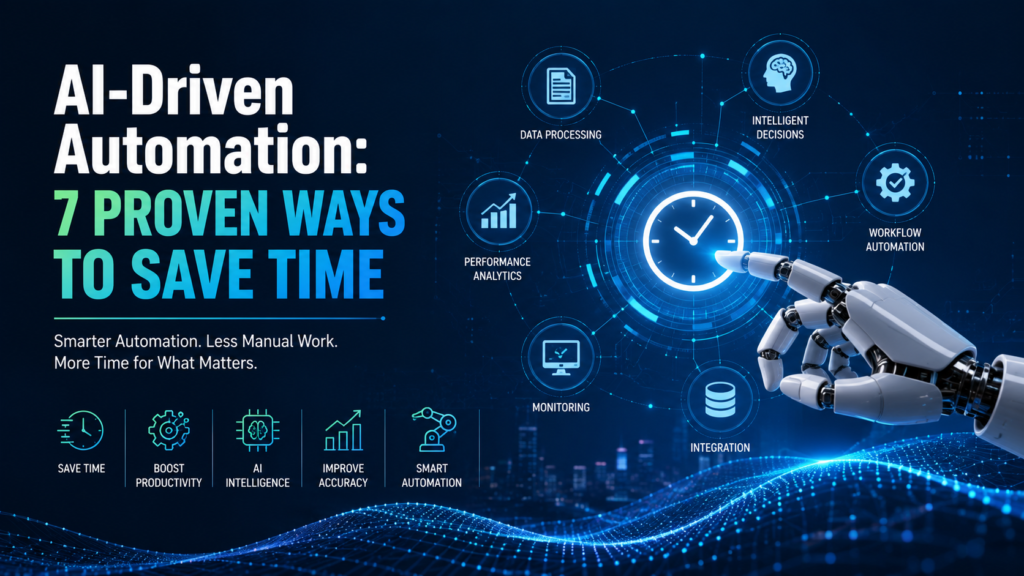
AI-Driven Automation: 7 Proven Ways to Save Time
What Is AI-Driven Automation?
AI-Driven Automation combines artificial intelligence with automated workflows to perform tasks with minimal human intervention.
Traditional automation follows fixed rules. AI-powered systems go much further.
They can:
- Analyse large amounts of data
- Learn from patterns
- Make predictions
- Support decision-making
- Improve over time
Because of these capabilities, businesses can automate complex processes that previously required human involvement.
Why AI-Driven Automation Is Growing So Fast
Organisations face increasing pressure to do more with fewer resources.
At the same time, customers expect faster responses and better experiences.
AI-Driven Automation helps businesses meet these expectations by:
- Reducing manual work
- Improving efficiency
- Enhancing accuracy
- Accelerating workflows
- Supporting scalability
Consequently, companies across manufacturing, healthcare, finance, logistics, and retail are investing heavily in AI-powered solutions.
1. Automate Repetitive Administrative Tasks
Many employees spend a large portion of their day performing routine activities.
Examples include:
- Data entry
- Invoice processing
- Document management
- Scheduling
- Email sorting
AI-Driven Automation handles these tasks quickly and accurately.
As a result, employees can focus on work that requires creativity, strategy, and problem-solving.
This shift often leads to higher productivity and better employee satisfaction.
2. Speed Up Customer Support Operations
Customers expect immediate assistance.
However, maintaining round-the-clock support can be expensive.
AI-powered chatbots and virtual assistants help organisations respond faster.
These systems can:
- Answer common questions
- Process requests
- Provide product information
- Route complex issues to human agents
Therefore, support teams save time while improving customer experiences.
Many businesses now resolve a significant percentage of customer inquiries through automated systems.
3. Improve Data Analysis and Reporting
Modern businesses generate enormous amounts of data every day.
Manually reviewing this information takes time and often delays decision-making.
AI-Driven Automation can process data in seconds.
It identifies trends, generates reports, and highlights important insights automatically.
Consequently, managers gain faster access to valuable information.
This enables quicker and more informed business decisions.
4. Streamline Manufacturing Operations
Manufacturing environments are becoming increasingly intelligent.
AI-powered systems monitor production lines, analyse equipment performance, and optimise workflows.
Benefits include:
- Faster production planning
- Reduced downtime
- Improved quality control
- Better resource utilisation
For example, AI can detect production anomalies before they affect output.
This proactive approach saves both time and money.
5. Enhance Predictive Maintenance
Unexpected equipment failures create costly delays.
Traditional maintenance schedules often fail to identify problems early enough.
AI-Driven Automation analyses data from sensors and connected devices to predict potential failures.
Maintenance teams receive alerts before issues become serious.
As a result:
- Downtime decreases
- Repairs become more efficient
- Equipment lasts longer
Many Industry 4.0 organisations now rely on predictive maintenance as a core operational strategy.
6. Optimise Supply Chain Management
Supply chains involve thousands of moving parts.
Managing inventory, shipments, suppliers, and demand forecasts manually can be challenging.
AI-Driven Automation improves visibility across the supply chain.
The technology helps organisations:
- Forecast demand accurately
- Reduce inventory shortages
- Improve logistics planning
- Optimise delivery routes
Consequently, businesses save time while improving operational efficiency.
7. Accelerate Business Decision-Making
One of the most valuable benefits of AI-Driven Automation is faster decision-making.
AI systems analyse information continuously.
They identify patterns, opportunities, and risks that may not be immediately visible.
Executives can access real-time insights instead of waiting for manual reports.
Therefore, organisations respond more quickly to changing market conditions.
Real-World Example of AI-Driven Automation
A logistics company managing hundreds of daily deliveries struggled with route planning.
The planning process required several employees and consumed hours each day.
After implementing AI-Driven Automation, the company used machine learning algorithms to optimise routes automatically.
The results were impressive:
- Faster route planning
- Lower fuel consumption
- Improved delivery times
- Increased customer satisfaction
Most importantly, employees spent less time on repetitive planning activities and more time improving operations.
Technologies Powering AI-Driven Automation
Several technologies work together to enable intelligent automation.
Artificial Intelligence
AI allows systems to analyse information and make decisions.
Machine Learning
Machine learning helps systems improve performance based on historical data.
Robotic Process Automation (RPA)
RPA automates repetitive digital tasks across applications.
Natural Language Processing
NLP enables systems to understand and respond to human language.
Cloud Computing
Cloud platforms provide scalable infrastructure for AI workloads.
Together, these technologies create powerful automation ecosystems.
Common Challenges and How to Overcome Them
While AI-Driven Automation offers significant benefits, organisations should prepare for implementation challenges.
Data Quality Issues
AI systems depend on accurate data.
Poor data quality can affect outcomes.
Regular data management practices help improve reliability.
Employee Concerns
Some employees worry that automation may replace jobs.
However, successful organisations use automation to support employees rather than replace them.
Integration Complexity
Existing systems may require updates before automation can be deployed effectively.
Careful planning helps reduce implementation challenges.
Frequently Asked Questions
What is AI-Driven Automation?
AI-Driven Automation combines artificial intelligence and automation technologies to perform tasks, analyse data, and improve business processes.
How does AI-Driven Automation save time?
It automates repetitive tasks, accelerates data analysis, improves workflows, and reduces manual effort.
Which industries benefit from AI-Driven Automation?
Manufacturing, healthcare, logistics, finance, retail, and customer service all benefit significantly.
Is AI-Driven Automation expensive?
Costs vary depending on project size. However, many organisations achieve strong returns through productivity gains and operational savings.
The Future Belongs to Smarter Workflows
Businesses no longer compete solely on products or services. They compete on speed, efficiency, and adaptability.
AI-Driven Automation helps organisations eliminate repetitive work, improve decision-making, and unlock valuable time for innovation. From customer service and manufacturing to supply chain management and predictive maintenance, intelligent automation is reshaping how work gets done.
Companies that embrace these technologies today will be better positioned for tomorrow’s challenges.
Want to learn more about emerging technologies transforming business operations? Explore our guide on Predictive Maintenance and discover how AI and IoT work together to create smarter, more efficient organisations. For additional research and industry insights, visit the World Economic Forum and explore the latest developments in AI adoption.
The question is no longer whether automation will shape the future. The real question is how quickly your organisation is ready to benefit from it.
About The Author