Apple HomeView vs Home Assistant: $299 Hub Beats Free?
Key Takeaways
- Apple HomeView vs Home Assistant is a choice between a finished $299 screen and free software you set up yourself.
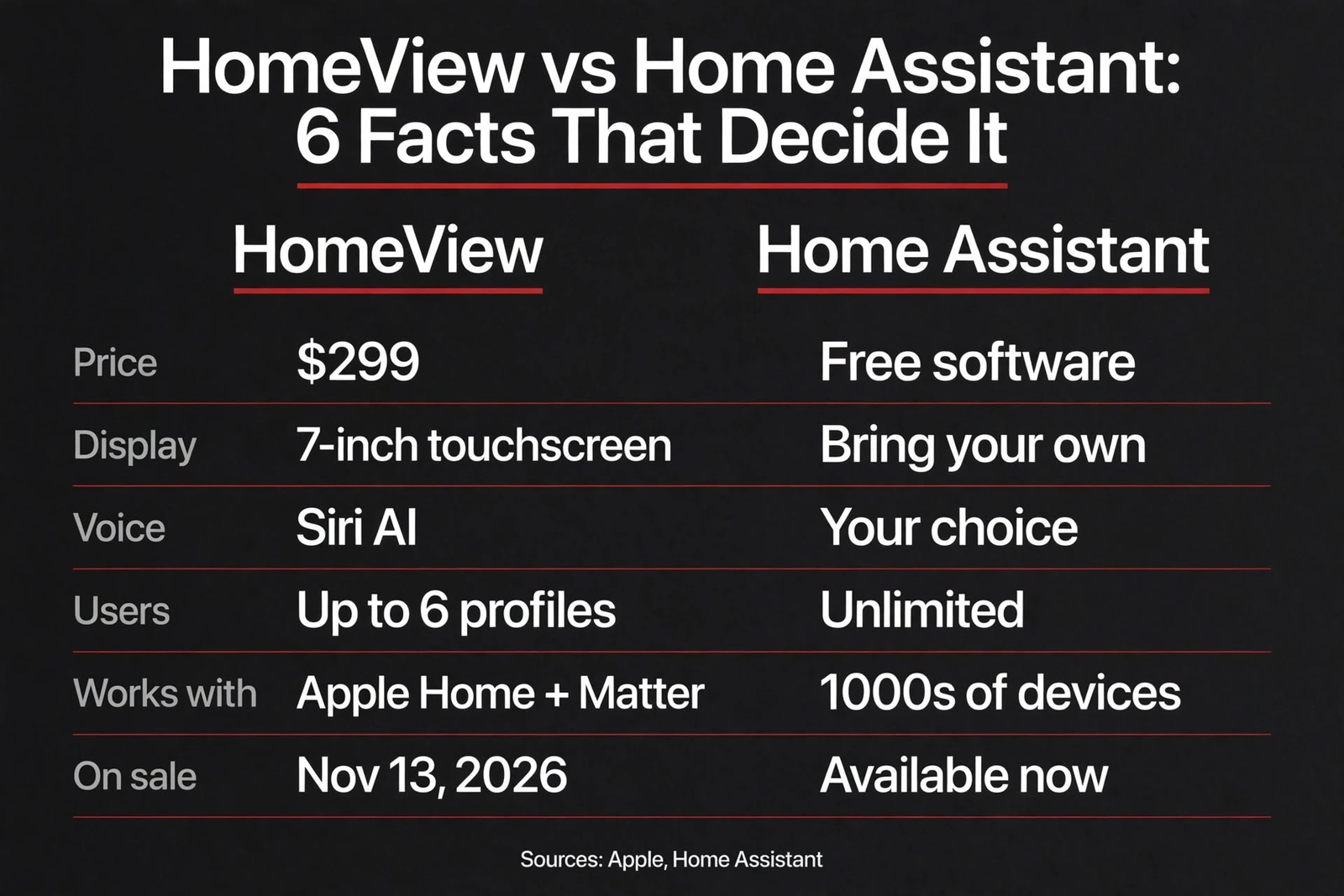
- HomeView costs $299, has a 7-inch display, runs Siri AI, and went on sale November 13, 2026, according to Apple.
- Home Assistant software is free, runs locally, and supports a much wider mix of brands and devices.
- HomeView supports up to 6 household profiles; Home Assistant has no built-in profile cap in the same way.
- If you already use Apple Home and Matter, HomeView feels instant. If your home is mixed-brand, Home Assistant is the safer long-term pick.
Apple HomeView vs Home Assistant: $299 Hub Beats Free?
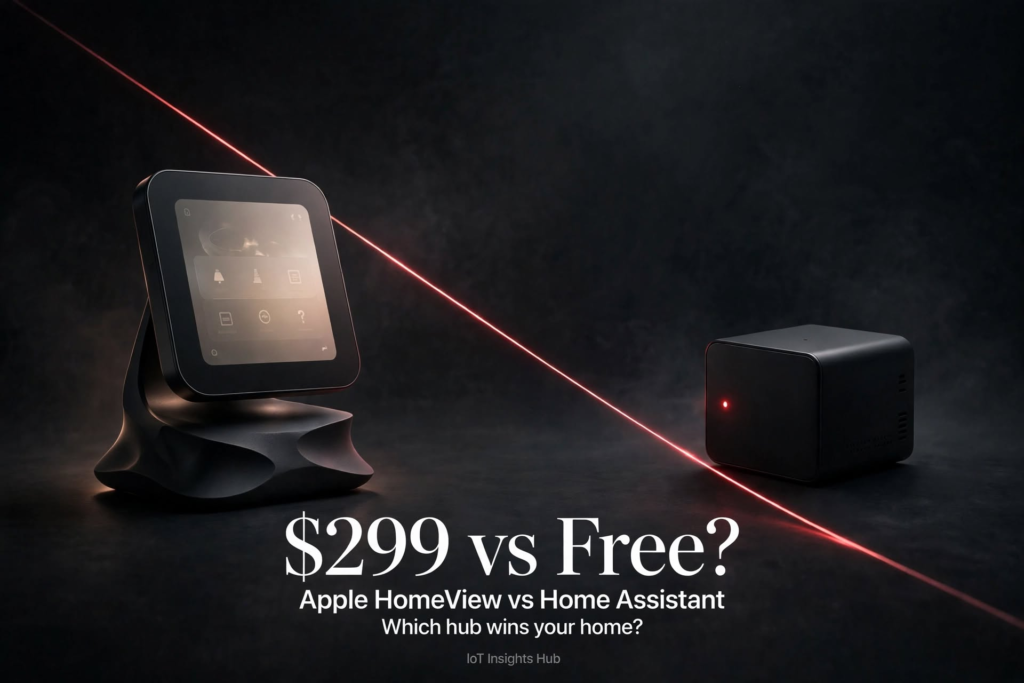
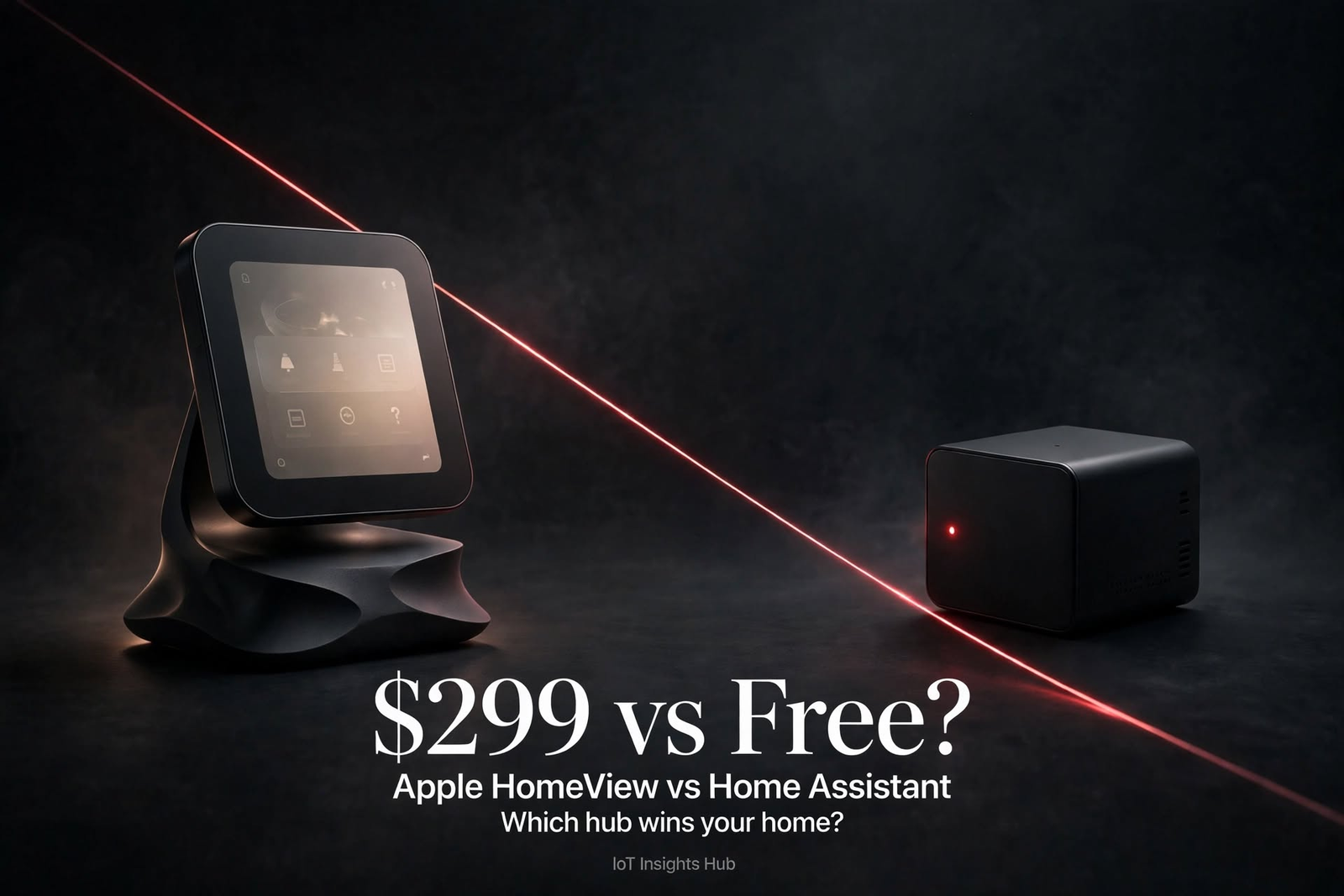
Apple HomeView vs Home Assistant sounds like a simple price fight. It is not. One side sells you a screen that works out of the box. The other gives you software for free and asks you to do the work. That difference matters more than the $299 price tag.
Here is the thing: most people do not buy a hub for the hub. They buy it for fewer taps, fewer apps, and fewer moments where the lights do not listen. So the real question is not which product is better in theory. It is which one fits your home, your patience, and the devices you already own.
At IoT Insights Hub, we cover this exact split every week — polished Apple gear on one side, open DIY systems on the other. This guide keeps both honest. No hype. Just what each hub does, where each one falls short, and who should buy which. If you want the short version first, jump to our 【entity-Apple HomeView¦canonical_name=Apple】 vs Home Assistant comparison for DIY setups.
Is Apple HomeView better than Home Assistant?
If you want to walk in, tap a screen, and see cameras, lights, and locks in one place, HomeView wins on day one. Apple designed it for that moment. The display is the remote. Siri AI is the voice layer. The setup is meant to feel like setting up an iPhone, not a server.
Home Assistant wins on day 100. Once it is running, it can tie together brands Apple would never put in the same room. It can run automations based on presence, time, sensors, weather, and device states — often without sending commands through the cloud. That is powerful. It is also work. You need hardware, updates, backups, and a plan for when something breaks.
Think of it this way: HomeView is a finished kitchen. Home Assistant is a workshop. One is ready to cook in tonight. The other lets you build exactly the kitchen you want, if you enjoy building.
What does each hub really cost?
Apple lists HomeView at $299 in the US for either the tabletop or wall-mounted model. Mounts start at $59.95. That is the honest sticker price. What it does not include is any 【entity-Apple¦canonical_name=Apple】 services you already pay for, like iCloud storage for camera clips. HomeView itself does not require an App Store purchase to work as a hub.
Home Assistant is free software. That phrase trips people up. Free does not mean zero cost. You still need something to run it on. Many readers at IoT Insights Hub start with a Raspberry Pi, a mini-PC, or an old computer. Add a Zigbee or Thread radio if you want those devices, plus storage and a backup plan. A simple setup can stay cheap. A serious setup can pass $299 fast.
| Cost item | Apple HomeView | Home Assistant |
|---|---|---|
| Software / hub | $299 for the display hub, per Apple | Free software |
| Hardware to run it | Included in the $299 device | Raspberry Pi, mini-PC, or similar — price varies |
| Mount / stand | Mounts from $59.95 | Optional, often a shelf or wall mount |
| Radios | Built-in Thread / Matter support for compatible accessories | May need Zigbee / Thread dongle |
| Remote access | Through Apple account and iCloud features | Free self-setup, or optional paid cloud |
Our take: if you only need one room and one screen, $299 is fair. If you plan to automate a whole house, price Home Assistant by the full system, not just the free download. For more on the DIY route, see our guide to Home Assistant on Raspberry Pi in 7 easy steps.
Which one is easier to set up and use every day?
HomeView gives you a screen. That matters. Guests do not need your phone. Kids do not need an account workaround. You tap the camera feed, you see the door. You tap the lock, it locks. Apple also says HomeView recognises up to six household members and can show personal content for each one. That is a real everyday win in a shared home.
Home Assistant gives you a dashboard. At first, that dashboard is blank. You add devices. You name rooms. You build cards for lights, climate, cameras, and sensors. It feels like work because it is work. But once it is done, the payoff is a screen that shows only what your family uses, in the order they use it.
Who will enjoy each one?
- Pick HomeView if: you want setup in minutes, you live in Apple Home, and you want a screen anyone can use.
- Pick Home Assistant if: you enjoy tweaking, you have mixed brands, and you want automations that run your home without you thinking about them.
- Pick both if: you want HomeView as a family screen and Home Assistant as the brain behind Matter devices.
That said, Home Assistant has improved a lot. The setup path on a Raspberry Pi is far less scary than it was five years ago. Still, if the words “backup,” “update,” and “restore” make you tense, HomeView is the calmer choice. For background on why open standards matter here, see our explainer on Matter 1.4 and what it changes for device makers.
【entity-Apple HomeView¦canonical_name=Apple】 vs Home Assistant: which hub works with more devices?
Apple says HomeView works with Apple Home and compatible Matter accessories. That covers a growing list of lights, plugs, locks, thermostats, blinds, sensors, and cameras. It does not cover every Zigbee gadget, every older Wi-Fi device, or every brand that never adopted Matter. That is the trade-off of a curated system.
Home Assistant takes the opposite approach. It connects to a huge range of integrations — Matter, Zigbee, Z-Wave, Wi-Fi, Bluetooth, and many cloud services. You can keep an old plug, a cheap sensor, and a premium lock in the same automation. You can also build automations that Apple Home does not offer, like “if the washing machine finishes and no one is home, send a message and flash the porch light.”
| What matters | Apple HomeView | Home Assistant |
|---|---|---|
| Device range | Apple Home + compatible Matter | Matter, Zigbee, Z-Wave, Wi-Fi, Bluetooth, and many integrations |
| Best for | Apple-first homes | Mixed-brand homes |
| Automation depth | Good for common scenes | Deep, condition-based automations |
| Screen | Built-in 7-inch display | Use a tablet, phone, or wall panel |
| Voice | Siri AI | Your choice, including local options |
One more point: Matter helps both sides. A Matter light can join a Matter fabric and show up in more than one system. That is why the smartest setup for some homes is not either/or. It is Home Assistant for the brain, HomeView for the family screen. If you want the standards view, our team at IoT Insights Hub also tracks the wider shift in IoT security threats in 2026, where device choice and updates matter as much as brand.
Apple HomeView vs Home Assistant: which hub is better for privacy?
Privacy is not a slogan. It is a set of choices. Home Assistant lets you keep more of those choices at home. Automations can run on your own hardware. Device states do not need to travel to a cloud server to turn on a light. You can also decide what, if anything, leaves your network.
Apple takes a different route. It says HomeView is built with privacy and security at its core, and 【entity-Apple¦canonical_name=Apple】 has a long record of on-device processing and permission controls. But HomeView is still part of 【entity-Apple¦canonical_name=Apple】’s ecosystem. Siri AI, FaceTime, camera feeds, and personal content all touch Apple services in ways you should review, not assume.
For a broader look at device risk, securing a smart TV uses the same habits: fewer permissions, fewer open features, and regular updates. The same logic applies to any hub. A related view from the wider startup and tech press is worth reading too: The Business Perspective covers how platform control and privacy promises shape buying decisions, and Rise of Startups tracks how open platforms challenge closed ecosystems.
What do critics say?
HomeView fans say the screen is the point. A hub you have to open on your phone is a hub you forget to use. A screen on the counter gets used. Critics of HomeView say $299 buys you a screen, not a system. If Apple changes what it supports, or if you move away from Apple, the value drops.
Home Assistant fans say freedom is the point. You own the data. You own the automations. You are not waiting for a company to approve your light bulb. Critics of Home Assistant say freedom has a cost: time. A bad update, a failed SD card, or a misconfigured remote-access setup can break a home in ways a $299 Apple screen will not.
Both sides are right. That is why the best advice is not “buy the winner.” It is “buy the system you will actually maintain.” A hub you maintain beats a hub you abandon, even if the abandoned one looked better in the store. For a second view on open versus closed platforms, see IoT Mail Bridge, which covers how messaging and device ecosystems connect in real homes.
Frequently asked questions
Is 【entity-Apple HomeView¦canonical_name=Apple】 better than Home Assistant?
It depends on what you value. 【entity-Apple HomeView¦canonical_name=Apple】 vs Home Assistant comes down to ease against control. HomeView is simpler, with a built-in screen and Siri AI. Home Assistant gives you wider device support, local control, and deeper automation if you are willing to set it up.
Does Apple HomeView work with Home Assistant?
Not directly as one hub. 【entity-Apple HomeView¦canonical_name=Apple】 controls 【entity-Apple Home¦canonical_name=Apple】 and compatible Matter accessories. Home Assistant can also join the same Matter fabric for many devices. That means some Matter lights, plugs, locks, and sensors can appear in both systems, but HomeView itself is not a Home Assistant dashboard.
How much does Apple HomeView cost?
Apple HomeView costs $299 in the US for either the tabletop or wall-mounted model, according to Apple. Mounts start at $59.95. It went on sale November 13, 2026. Home Assistant software is free, though you still pay for hardware such as a mini-PC, Raspberry Pi, or hub.
Does Home Assistant need a subscription?
No. The core Home Assistant software is free and runs locally. An optional Home Assistant Cloud subscription adds remote access and voice assistant features, but it is not required. You can also set up remote access yourself if you are comfortable with networking and security settings.
Which hub is better for privacy?
Home Assistant has the stronger privacy story because automations and device control can run locally, so less data needs to leave your home. 【entity-Apple¦canonical_name=Apple】 says HomeView is built with privacy and security at its core. Still, Apple users should check what Siri AI, camera, and iCloud features send or store.
Should I buy 【entity-Apple HomeView¦canonical_name=Apple】 or build Home Assistant in 2026?
Buy HomeView if you want a finished screen, simple setup, and you already live in Apple Home. Build Home Assistant if you have mixed brands, want local control, or want automations Apple does not offer. If you are unsure, start with Home Assistant on hardware you already own before spending $299.
The verdict
Apple HomeView vs Home Assistant is not a tie, and it is not a knockout. It is a fit question. HomeView wins if you want a clean screen, fast setup, and an Apple-first home. Home Assistant wins if you want control, mixed-brand support, and automations that run locally.
If you are still stuck, do this: list your devices. Count how many are Apple Home or Matter. Count how many are not. If the first list is longer, buy HomeView and enjoy it. If the second list is longer, build Home Assistant and take your time. Either way, IoT Insights Hub will keep testing both, so you do not have to guess alone.
Sources: Apple HomeView product and press information for $299 price, 7-inch display, Siri AI, up to six profiles, and November 13, 2026 on-sale date; Home Assistant documentation for free local software and Matter support. Prices and availability can change — check 【entity-Apple¦canonical_name=Apple】 and Home Assistant before you buy.
About The Author