Illustrative values. Replace them in the CONFIG block with your article data.
Power draw under load
Power meter0.00 W
4G LTE Cat-1
5G RedCap
Illustrative values. Replace them in the CONFIG block with your article data.
So, does LTE still win?
Lower cost
Lower power
IoT Insights Hub
/* ===== CONFIG: replace with your article’s real numbers =====
cost = price per module in USD, power = watts.
4.82 and 1.18 are the values shown in the cover image; the RedCap ones are placeholders. */
const CONFIG = {
items: [“4G LTE Cat-1”, “5G RedCap”],
cost: [4.82, 6.40],
power: [1.18, 0.95],
sceneMs: [3600, 3800, 4200, 4600, 4600]
};const $ = (s, r = document) => r.querySelector(s);
const $$ = (s, r = document) => […r.querySelectorAll(s)];
const scenes = $$(“.scene”);
const reduce = matchMedia(“(prefers-reduced-motion: reduce)”).matches;
const fmt = {
cost0: v => “$” + v.toFixed(2), cost1: v => “$” + v.toFixed(2),
pow0: v => v.toFixed(2) + ” W”, pow1: v => v.toFixed(2) + ” W”
};
const data = { cost0: CONFIG.cost[0], cost1: CONFIG.cost[1], pow0: CONFIG.power[0], pow1: CONFIG.power[1] };
const maxCost = Math.max(…CONFIG.cost), maxPow = Math.max(…CONFIG.power);
const scale = k => k.startsWith(“cost”) ? maxCost : maxPow;let timers = [], raf;
function clearAll(){ timers.forEach(clearTimeout); timers = []; cancelAnimationFrame(raf); }function countUp(el, key, ms){
const end = data[key], t0 = performance.now();
const step = now => {
const p = reduce ? 1 : Math.min((now – t0) / ms, 1);
el.textContent = fmt[key](end * (1 – Math.pow(1 – p, 3)));
if (p s.classList.toggle(“on”, n === i));
const s = scenes[i];
$$(“[data-count]”, s).forEach(el => countUp(el, el.dataset.count, 1600));
$$(“[data-bar]”, s).forEach(el => {
el.style.width = “0”;
requestAnimationFrame(() => requestAnimationFrame(() => {
el.style.width = (data[el.dataset.bar] / scale(el.dataset.bar) * 100) + “%”;
}));
});
if (s.id === “s4”) dialSweep();
}/* The power meter flickers, then settles on the first module’s reading */
function dialSweep(){
const out = $(“#dialOut”), end = data.pow0, t0 = performance.now();
const step = now => {
const p = Math.min((now – t0) / 1800, 1);
const wobble = p < 1 ? (Math.sin(p * 30) * 0.25 * (1 – p)) : 0;
out.textContent = Math.max(0, end * p + wobble).toFixed(2) + " W";
if (p a[0] a + b, 0);
const prog = $(“#prog”);
prog.style.transition = “none”; prog.style.width = “0”;
requestAnimationFrame(() => { prog.style.transition = `width ${total}ms linear`; prog.style.width = “100%”; });
let at = 0;
CONFIG.sceneMs.forEach((ms, i) => { timers.push(setTimeout(() => enter(i), at)); at += ms; });
}$(“#replay”).addEventListener(“click”, play);
play();{
“@context”: “https://schema.org”,
“@type”: “NewsArticle”,
“headline”: “4G IoT modules vs 5G RedCap 2026: 65% power trap fails”,
“description”: “4G IoT modules vs 5G RedCap 2026 costs 25% more than Cat-1 but uses 65% less power than Cat-4. Why LTE still wins mid-tier IoT and when RedCap takes over. Full breakdown”,
“image”: [“https://iotinsightshub.com/wp-content/uploads/2026/10/image_4G-IoT-modules-vs-5G-RedCap-202620261030_001405.png”,”https://iotinsightshub.com/wp-content/uploads/2026/10/image4G-IoT-modules-_20261030_001421.png”],
“datePublished”: “2026-10-30T08:00:00+05:30”,
“dateModified”: “2026-10-30T08:00:00+05:30”,
“author”: { “@type”: “Organization”, “name”: “IoT Insights Hub” },
“publisher”: { “@type”: “Organization”, “name”: “IoT Insights Hub”, “logo”: { “@type”: “ImageObject”, “url”: “https://iotinsightshub.com/wp-content/uploads/logo.png” } },
“mainEntityOfPage”: { “@type”: “WebPage”, “@id”: “https://iotinsightshub.com/4g-iot-modules-vs-5g-redcap-2026/” },
“keywords”: “4G IoT modules vs 5G RedCap 2026, RedCap, LTE Cat-1, IoT modules, eRedCap”
}{
“@context”:”https://schema.org”,
“@type”:”FAQPage”,
“mainEntity”:[
{“@type”:”Question”,”name”:”What is the real cost difference between 4G IoT modules vs 5G RedCap 2026?”,”acceptedAnswer”:{“@type”:”Answer”,”text”:”eRedCap modules in 2026 are about 25% higher than LTE Cat-1, per ABI Research. Routers run $140-$160 for RedCap vs $180-$220 for full 5G. The upfront gap is narrowing, but total cost still favors LTE where coverage and EPC are already paid for.”}},
{“@type”:”Question”,”name”:”How much power does 5G RedCap save vs 4G Cat-4?”,”acceptedAnswer”:{“@type”:”Answer”,”text”:”RedCap cuts power by up to 65% versus LTE Cat-4, per Quectel and MediaTek data, and up to 60% versus older 4G IoT modules. With Release 17 power saving features, you get another ~10% saving, which matters for battery-powered industrial sensors.”}},
{“@type”:”Question”,”name”:”When does LTE still win over RedCap in 2026?”,”acceptedAnswer”:{“@type”:”Answer”,”text”:”LTE wins for massive, low-data IoT – meters, asset trackers, environmental sensors – where Cat-1 bis is proven, cheap, and globally roaming. If you need under 10 Mbps, EPC core, and decade-long battery life, LTE is the safe 2026 bet.”}},
{“@type”:”Question”,”name”:”When should you choose 5G RedCap over 4G?”,”acceptedAnswer”:{“@type”:”Answer”,”text”:”Choose RedCap for mid-tier jobs needing 10-100 Mbps uplink, sub-20 ms latency, network slicing, or precise timing: video surveillance, AGVs, industrial gateways, and real-time vehicle diagnostics that need 5G core features.”}},
{“@type”:”Question”,”name”:”Is 5G RedCap replacing NB-IoT and LTE-M?”,”acceptedAnswer”:{“@type”:”Answer”,”text”:”No. RedCap sits between LPWAN and eMBB. NB-IoT and LTE-M stay king for ultra-low-power, sub-Mbps use. RedCap fills the gap for devices that need more throughput than LPWAN but not full gigabit 5G.”}},
{“@type”:”Question”,”name”:”What is eRedCap and why does it matter in 2026?”,”acceptedAnswer”:{“@type”:”Answer”,”text”:”eRedCap is the enhanced RedCap from 3GPP Release 18. It further trims bandwidth and complexity, pushing module price to within ~25% of Cat-1. Second-gen chipsets from 【entity-Qualcomm¦canonical_name=Qualcomm】 and MediaTek make eRedCap the volume driver for cost-sensitive RedCap in 2026.”}}
]
}
Key Takeaways — IoT Insights Hub Analysis
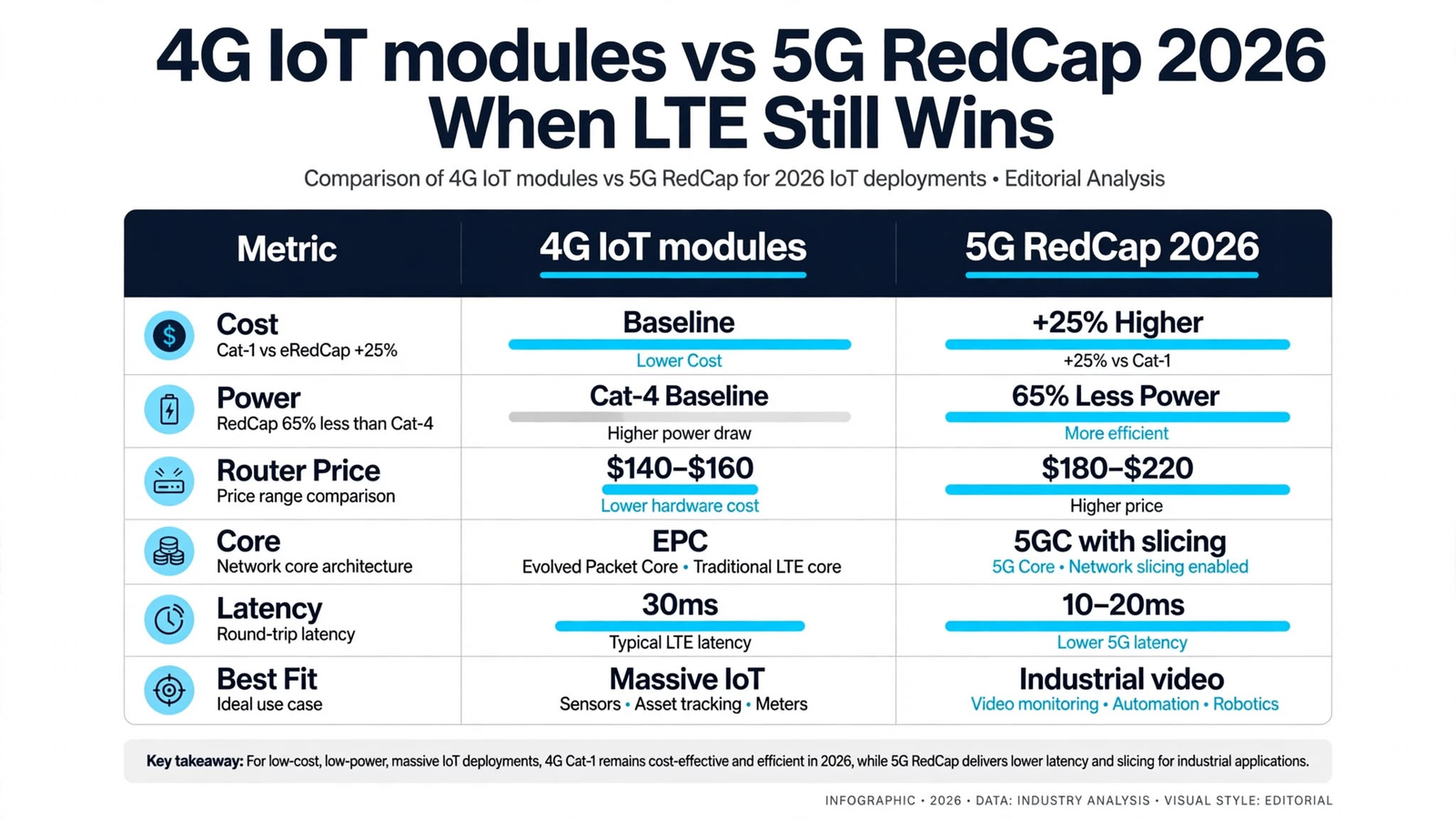
4G IoT modules vs 5G RedCap 2026 cost gap: eRedCap now only ~25% above LTE Cat-1, but routers still $140-$160 vs $180-$220 for full 5G.
Power win: RedCap uses 65% less than LTE Cat-4 and 60% less than older 4G IoT modules, per Quectel Rx255G data.
LTE still wins 70%+ of massive IoT: Meters, trackers, and sensors don’t need slicing or 10 ms latency.
RedCap wins where 5G core matters: Video, AGVs, industrial gateways needing slicing, high uplink, and timing.
Trap to avoid: Buying full 5G for mid-tier jobs — you pay 40% more for throughput you won’t use.
4G IoT modules vs 5G RedCap 2026: 65% power trap fails
4G IoT modules vs 5G RedCap 2026 is the decision most mid-tier deployments face right now. Not NB-IoT, not full gigabit 5G, but that messy middle where most real products live. At IoT Insights Hub, we tracked pricing, power, and rollouts across Quectel, Qualcomm, and carrier trials to see where LTE still holds.
Here’s the thing: RedCap is better on paper — 5G core, slicing, lower latency. But for a huge chunk of the market, 4G Cat-1 and Cat-1 bis remain cheaper, globally certified, and good enough. The trap is assuming newer always wins.
What is the real cost difference between 4G IoT modules vs 5G RedCap 2026?
eRedCap modules in 2026 are about 25% higher than LTE Cat-1, per ABI Research. Routers run $140-$160 for RedCap vs $180-$220 for full 5G. The upfront gap is narrowing, but total cost still favors LTE where coverage and EPC are already paid for.
Per ABI Research’s 2026 outlook, second-generation chipsets are pushing RedCap price parity closer. First-gen RedCap carried a 40-50% premium. Now, eRedCap — defined in 3GPP Release 18 — trims bandwidth to 5 MHz and single antenna, dropping BoM. Quectel’s Rx255G series using MediaTek T300 shows how UltraSave cuts RF chains and power amplifiers.
That said, module price is only part of TCO. If your deployment already runs on EPC with global Cat-1 certs, staying put saves re-certification, carrier testing, and 5G core integration. IoT Insights Hub sees this in logistics trackers and smart meters — why pay for slicing when you just need a heartbeat every hour?
Dimension
4G IoT modules (Cat-1 / Cat-1 bis / Cat-4)
5G RedCap 2026 / eRedCap
Module Price (2026)
Baseline — cheapest at volume
+25% vs Cat-1 (ABI Research)
Router / Gateway
$80-$130 for Cat-4 industrial
$140-$160 RedCap, $180-$220 full 5G — CertainlyBlog pricing
Certification
Global, mature, 10+ years
Growing, carrier-by-carrier in 2026
For context on lightweight protocols running over either, see our guide on What is MQTT? Ultimate Guide — still the go-to for both LTE and RedCap uplinks.
How much power does 5G RedCap save vs 4G Cat-4?
RedCap cuts power by up to 65% versus LTE Cat-4, per Quectel and MediaTek data, and up to 60% versus older 4G IoT modules. With Release 17 power saving features, you get another ~10% saving for battery-powered industrial sensors.
According to Quectel’s Rx255G datasheet, the MediaTek T300 platform reduces modem power by 60% vs existing 4G IoT modules, and 70% vs eMBB modems. Add R17 eDRX and wake-up signal, you get that extra ~10%. 【entity-Hyundai¦canonical_name=Hyundai】’s 2026 factory trial — covered by Hologram — reported lower power draw for its Diagnostic Scan system after swapping from Wi-Fi to Snapdragon X35 RedCap, with better uplink stability.
Where does that matter? Battery-powered cameras, environmental sensors with LTE-M fallback, and mobile gateways. But if you’re mains-powered, the power win alone rarely justifies the switch from Cat-1.
LTE wins for massive, low-data IoT – meters, asset trackers, environmental sensors – where Cat-1 bis is proven, cheap, and globally roaming. If you need under 10 Mbps, EPC core, and decade-long battery life, LTE is the safe 2026 bet.
IoT Insights Hub tracks deployments and the pattern is clear. LTE Cat-1 bis dominates where:
Throughput <10 Mbps: Smart meters, soil sensors, parking sensors. They send 100KB/day, not video.
Global roaming: Asset trackers need 400+ networks. LTE roaming agreements exist. RedCap roaming is still patchy in 2026.
Long lifecycle: Utilities plan 10-year hardware cycles. LTE networks will be supported longer than many expect, while RedCap needs 5G SA core — not yet universal.
Cost at scale: At 50k units, that 25% delta is $75k-$120k. Real money for a startup.
What’s notable, per Dataintelo, 4G LTE IoT connectivity was $7.2B in 2025 with slow growth, while 5G/RedCap was $2.3B but growing 24.7% CAGR to $17.3B by 2034. LTE isn’t dead — it’s just flat. RedCap is where growth is.
Choose RedCap for mid-tier jobs needing 10-100 Mbps uplink, sub-20 ms latency, network slicing, or precise timing: video surveillance, AGVs, industrial gateways, and Hyundai-style real-time vehicle diagnostics needing 5G core features.
If your product story includes video, robotics, or guaranteed QoS, RedCap earns its keep. Three buckets where IoT Insights Hub recommends RedCap in 2026:
Industrial video and safety: 1080p cameras needing 5-15 Mbps sustained uplink. RedCap’s improved uplink capacity — per Hologram’s Hyundai case — beats Cat-4 in congested factories.
Mobile robots and AGVs: Need 10-20 ms latency and 5G positioning. EPC can’t do that reliably.
Future-proofing with slicing: If your customer asks for private 5G or SLA-backed slices, you need 5GC. LTE won’t get slicing.
External ecosystem view: Semtech’s 2026 RedCap routers — per AInvest — pair LoRaWAN expertise with RedCap for hybrid sites. For business model impact, see analysis on 5G IoT deployment costs and ROI.
Also, for smart home alignment, RedCap gateways will soon bridge to Matter 1.4 mandatory EU 2026 requirements — another reason industrial hubs choose 5G core.
What about the protocol and core stack — EPC vs 5GC?
4G uses EPC core, no slicing, coarser QoS. RedCap uses 5G SA core with slicing, better timing, and lower latency. If your stack already uses MQTT or LoRaWAN at the edge, both work, but 5GC gives you policy control EPC can’t.
Think of it as plumbing. LTE’s EPC is a single pipe. 5GC is a building with separate pipes you can reserve. For a simple sensor, one pipe is fine. For a factory with robots, cameras, and handsets sharing a private network, you need that reservation.
For LPWAN comparison, see our deep dive What Is LoRaWAN? Complete Guide — many teams pair LoRaWAN for deep indoor with RedCap for video backhaul.
What do critics say — is RedCap overhyped?
Critics say RedCap is a stopgap before full low-cost 5G NR. Carriers worry about SA core rollout delays, and some OEMs note module supply is still tight outside Asia. IoT Insights Hub view: valid concerns, but second-gen chips fix supply in late 2026.
Fair counterpoints exist. Some operators, per Telecom Review Africa, haven’t launched 5G SA at scale, which RedCap needs. Without SA, you fall back to NSA and lose slicing. Second, certification lag — in LATAM and parts of Africa, Cat-1 certs exist, RedCap doesn’t yet. Third, power claims depend on workload; continuous video streaming still drains batteries.
That said, per ZedIoT technical breakdown, RedCap was designed in 3GPP R17 exactly to fill this mid-tier void. eRedCap in R18 makes it cheaper. For IoT Insights Hub readers, the smart move is dual-strategy: keep Cat-1 bis for massive IoT SKUs, pilot eRedCap for industrial SKUs. Don’t bet everything on one modem in 2026.
IoT Insights Hub take: 4G IoT modules vs 5G RedCap 2026 isn’t winner-take-all. Use LTE for cost and reach, RedCap for 5GC features. Audit your uplink, latency, and core needs before you spec a module.
FAQ: 4G IoT modules vs 5G RedCap 2026
What is the real cost difference between 4G IoT modules vs 5G RedCap 2026?
eRedCap modules in 2026 are about 25% higher than LTE Cat-1, per ABI Research. Routers run $140-$160 for RedCap vs $180-$220 for full 5G. The upfront gap is narrowing, but total cost still favors LTE where coverage and EPC are already paid for.
How much power does 5G RedCap save vs 4G Cat-4?
RedCap cuts power by up to 65% versus LTE Cat-4, per Quectel and MediaTek data, and up to 60% versus older 4G IoT modules. With Release 17 power saving features, you get another ~10% saving, which matters for battery-powered industrial sensors.
When does LTE still win over RedCap in 2026?
LTE wins for massive, low-data IoT – meters, asset trackers, environmental sensors – where Cat-1 bis is proven, cheap, and globally roaming. If you need under 10 Mbps, EPC core, and decade-long battery life, LTE is the safe 2026 bet.
When should you choose 5G RedCap over 4G?
Choose RedCap for mid-tier jobs needing 10-100 Mbps uplink, sub-20 ms latency, network slicing, or precise timing: video surveillance, AGVs, industrial gateways, and 【entity-Hyundai¦canonical_name=Hyundai】-style real-time vehicle diagnostics that need 5G core features.
Is 5G RedCap replacing NB-IoT and LTE-M?
No. RedCap sits between LPWAN and eMBB. NB-IoT and LTE-M stay king for ultra-low-power, sub-Mbps use. RedCap fills the gap for devices that need more throughput than LPWAN but not full gigabit 5G.
What is eRedCap and why does it matter in 2026?
eRedCap is the enhanced RedCap from 3GPP Release 18. It further trims bandwidth and complexity, pushing module price to within ~25% of Cat-1. Second-gen chipsets from Qualcomm and MediaTek make eRedCap the volume driver for cost-sensitive RedCap in 2026.
Conclusion
4G IoT modules vs 5G RedCap 2026 comes down to a practical filter: do you need 5G core? If your 2026 product needs network slicing, 10-20 ms latency, or 30+ Mbps uplink for video, RedCap and eRedCap are worth the 25% premium — and that 65% power saving over Cat-4 helps your battery case. If you need global reach, proven certs, and sub-$5 modules at 50k scale, LTE Cat-1 bis still wins, and IoT Insights Hub expects it to hold massive IoT through 2027.
At IoT Insights Hub, our advice is simple: don’t chase the logo. Map your throughput, latency, and core policy, then pick the cheapest modem that meets it. That’s how you avoid the power trap and keep margins intact. IoT Insights Hub will keep tracking RedCap module pricing and carrier SA rollouts — check back for our Q1 2027 update.