Manufacturing IoT: 7 Proven Ways to Boost Efficiency
What is Manufacturing IoT?
Manufacturing IoT refers to an interconnected ecosystem of industrial machinery, smart sensors, and software platforms that collect and share data across the factory floor. Unlike consumer smart devices, industrial networks require exceptional reliability, secure connectivity, and low latency to manage heavy machinery safely.
By capturing real-time metrics like vibration patterns, temperature fluctuations, and processing speeds, these connected systems create a clear picture of plant health. Instead of guessing machine performance, operators use precise digital records to identify bottlenecks, eliminate material waste, and streamline daily production schedules.
7 Ways Manufacturing IoT Boosts Factory Efficiency
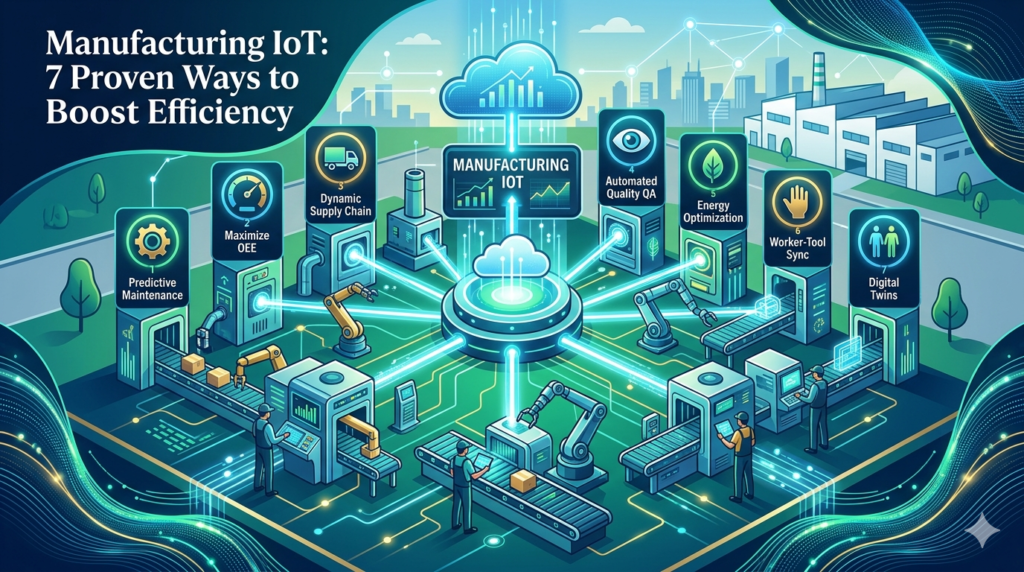
Implementing smart sensors goes beyond simply gathering data; it focuses on turning those insights into measurable operational improvements. Here are seven field-proven methods where a robust Manufacturing IoT strategy helps modern plants maximize their throughput and reduce unnecessary overhead costs.
1. Deploying AI-Powered Predictive Maintenance
Unplanned downtime remains one of the most expensive challenges in manufacturing, with emergency asset breakdowns costing some large enterprises up to $260,000 per hour. Conventional factories follow calendar-based maintenance schedules, which frequently lead to over-servicing functioning machines or missing hidden component wear.
Smart IoT acoustic and vibration sensors solve this issue by continuously monitoring equipment signatures. For instance, sensors attached to a CNC machine spindle cartridge can detect tiny misalignments or bearing degradation weeks before a physical failure occurs. According to manufacturing studies, shifting to predictive maintenance reduces unexpected breakdowns by 50% to 70% and lowers overall repair costs by 30%.
2. Maximizing Overall Equipment Effectiveness (OEE)
Many plant managers believe their production lines run at maximum capacity, but hidden micro-stoppages and minor cycle slowdowns quietly erode daily profitability. IoT monitoring tools calculate Overall Equipment Effectiveness (OEE) automatically by tracking three core pillars in real time:
- Availability: Tracking the exact minutes a machine actively runs versus its scheduled operating time.
- Performance: Measuring actual production speed against the machine’s theoretical ideal cycle runtime.
- Quality: Identifying the ratio of good parts produced versus units requiring scrap or rework.
When operators view live OEE dashboards, they spot minor speed drops immediately. Correcting these tiny process lags helps facilities boost asset utilization and recover lost operational capacity without purchasing expensive new machinery.
3. Creating a Dynamic, “Living” Supply Chain
Linear supply chains often struggle to handle sudden material shortages or logistics delays. Integrating IoT devices transforms standard logistics into a self-adjusting network by linking factory inventory directly with transit data.
For example, tracking incoming raw materials with active RFID tags allows production software to adjust factory schedules automatically based on real-time arrival times. If a key component delivery gets delayed at a port, the system updates assembly queues instantly to prevent worker idle time. Major enterprises like Unilever utilize this automated synchronization to optimize their work-in-progress (WIP) inventory, reducing holding costs while keeping order fulfillment on track.
4. Automated Quality Assurance and Inline Inspections
Traditional quality control relies on manual batch testing at the end of the production line. Unfortunately, if a machine calibration shifts early in the day, inspectors discover the defect only after hundreds of faulty units have already been produced.5. Optimizing Energy Consumption for Sustainable Production
Industrial facilities consume massive amounts of electricity, gas, and compressed air, which directly impacts bottom-line margins. Smart energy meters connected to individual production assets isolate exactly where power waste happens.
These sensors identify compressed air systems leaking pressure or heavy motors running unnecessarily during worker shift changes. Real-world case studies show that tying machine activity data to an automated energy management system reduces factory utility costs by 20% to 30%. This optimization lowers operational overhead while helping enterprises automate their environmental compliance reporting.
6. Synchronizing Human Workflows with Automated Tools
A smart factory floor coordinates human expertise alongside automated data. IoT-connected assembly tools, such as smart torque drivers, sync directly with digital manufacturing execution systems (MES) to guide technicians through complex assemblies.
When a worker starts a specific assembly task, the connected tool downloads the exact torque specifications automatically. The tool confirms the correct tightness for that specific part number and logs the completion data to the cloud registry. This automated assistance speeds up worker training, minimizes human error, and ensures consistent assembly quality across every single shift.
7. Utilizing Physics-Based Digital Twins
A digital twin acts as a highly accurate virtual replica of a physical production plant. By continuously feeding live sensor data into this virtual model, process engineers can simulate experimental workflow adjustments without disrupting active shop operations.
Engineers use these digital twins to test different manufacturing speeds, reconfigure floor layouts virtually, or model how an asset handles extreme thermal stress. This safe simulation environment allows companies to discover hidden process improvements, reduce engineering risks, and accelerate product development cycles.
Overcoming Common Implementation Challenges
While the operational benefits of an interconnected plant are clear, scaling these systems requires navigating a few initial industrial hurdles.
- Data Overload: Thousands of factory sensors generate massive streams of raw information every minute. To prevent network congestion, manufacturers use edge computing hardware to process data locally on the shop floor, filtering out normal readings and sending only critical anomalies to the main cloud servers.
- Legacy Machine Integration: Many factories rely on older, reliable machinery built before the internet era. Instead of replacing these costly assets, businesses retrofit older machines using external plug-and-play sensor kits to collect thermal and vibration data affordably.
- Industrial Cybersecurity: Connecting local operational technology (OT) to web-based cloud networks introduces new data security risks. Safe deployments use strict data encryption, secure MQTT communication protocols, and segmented networks to protect intellectual property from external threats.
Realizing Long-Term Value
Investing in digital factory upgrades provides measurable returns within a relatively short timeframe. Most industrial facilities achieve full return on investment (ROI) within 12 to 24 months by focusing on downtime reduction, material savings, and lower utility expenses.
Beyond immediate cost reductions, connecting your plant floor provides the operational agility required to handle changing market demands. Eliminating data silos gives business leaders the clear insights needed to scale production efficiently, maintain high quality standards, and stay ahead of global competition.
Transform Your Production Efficiency Today
Ready to eliminate operational blind spots and maximize your plant’s output? Our experienced team helps manufacturers integrate secure, scalable IoT sensor networks tailored to their unique production needs.
About The Author