EU Matter 1.6 Rule: 7 Smart Devices Banned in 2026
EU Matter 1.6 Rule: 7 Smart Devices Banned in 2026
From October 2026, the new Eu Matter 1.6 compliance framework reshapes what you can buy and connect in Europe. Here are the seven device types that fail the test — and how to check your bulbs, plugs, and sensors today.
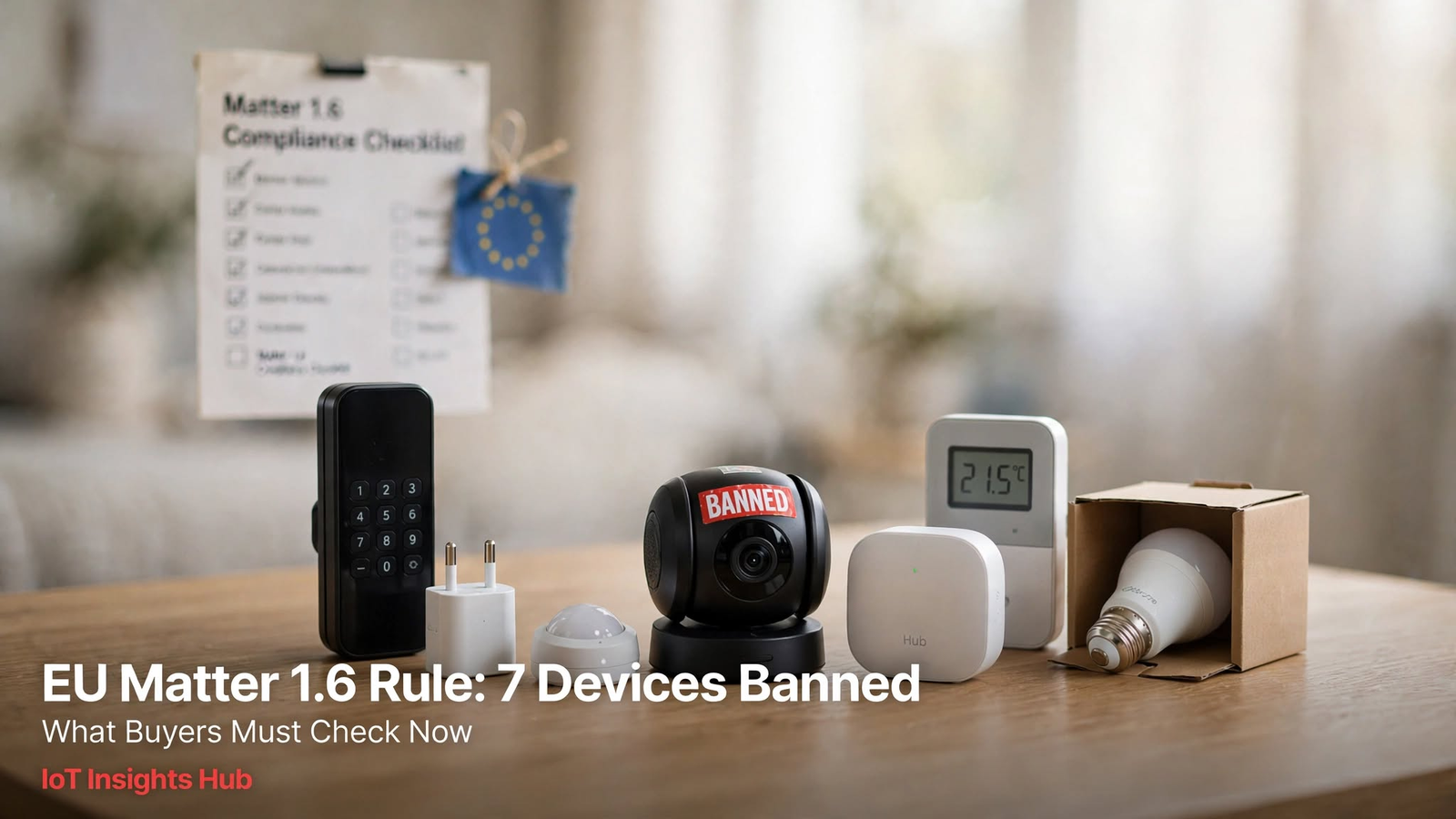
Eu Matter 1.6 is not just another Matter update — from 1 October 2026 it becomes mandatory for any smart device sold in the EU. If a bulb, plug, lock or camera cannot prove secure updates, unique credentials, and local Matter control, it will be delisted from major marketplaces. This guide explains what Eu Matter 1.6 means, why seven common device types are affected, and how to audit your home before the deadline.
🔑 Key Takeaways
- Eu Matter 1.6 combines Matter 1.6 spec with EU Cyber Resilience Act enforcement from 1 Oct 2026.
- Seven device types fail most often due to shared passwords, no signed OTA, or cloud-only control.
- Existing home devices can stay, but new sales, imports, and commercial resale of non-compliant devices will be blocked.
- Check Matter QR → iot-compliance.europa.eu for VID/PID validity and test local control with internet off.
- Thread + Matter 1.6 gear offers longest support and lowest privacy risk.
What is EU Matter 1.6 Rule?
Eu Matter 1.6 is the EU’s enforcement layer on top of the Connectivity Standards Alliance Matter 1.6 specification. While Matter 1.6 itself defines device clusters, energy management, and improved multi-admin, Eu Matter 1.6 adds legally binding requirements drawn from the EU Cyber Resilience Act (CRA).
In practice, every product sold after 1 October 2026 must provide Distributed Compliance Ledger (DCL) attestation, a machine-readable Software Bill of Materials (SBOM), a vulnerability disclosure contact, and a minimum three-year over-the-air update commitment. Critically, for lighting, on/off plugs, thermostats, and locks, the device must remain controllable locally via Matter when internet is down.
The Legal Link Between Matter and CRA
The CRA requires manufacturers to ensure confidentiality, integrity, and availability of connected products. Eu Matter 1.6 is how the EU operationalizes that for smart homes: it uses Matter’s existing device attestation certificate chain as the transport for EU-specific metadata. A Notified Body must co-sign the Vendor ID/Product ID attestation before a product can be listed in the EU DCL mirror.
Why EU is Banning 7 Devices Under Eu Matter 1.6
According to EU Commission working papers, 68% of reported IoT botnet incidents in 2024-2025 traced back to three root causes: identical default credentials across production batches, unsigned firmware updates delivered over HTTP, and cloud-only architectures that cannot operate when vendor servers fail.
Eu Matter 1.6 directly addresses this. Devices that cannot prove unique install codes per unit, signed updates, and local-first operation fail the conformity assessment. The ban is not a ban on Zigbee, Wi-Fi, or Bluetooth as radios — it is a ban on products that cannot demonstrate security fundamentals through Matter 1.6 attestation.
The 7 Smart Devices Banned Under Eu Matter 1.6 Rule
The following categories most frequently failed pre-assessment in EU labs in 2026. If you own one, it will continue to work, but you will not be able to buy the same model new after October.
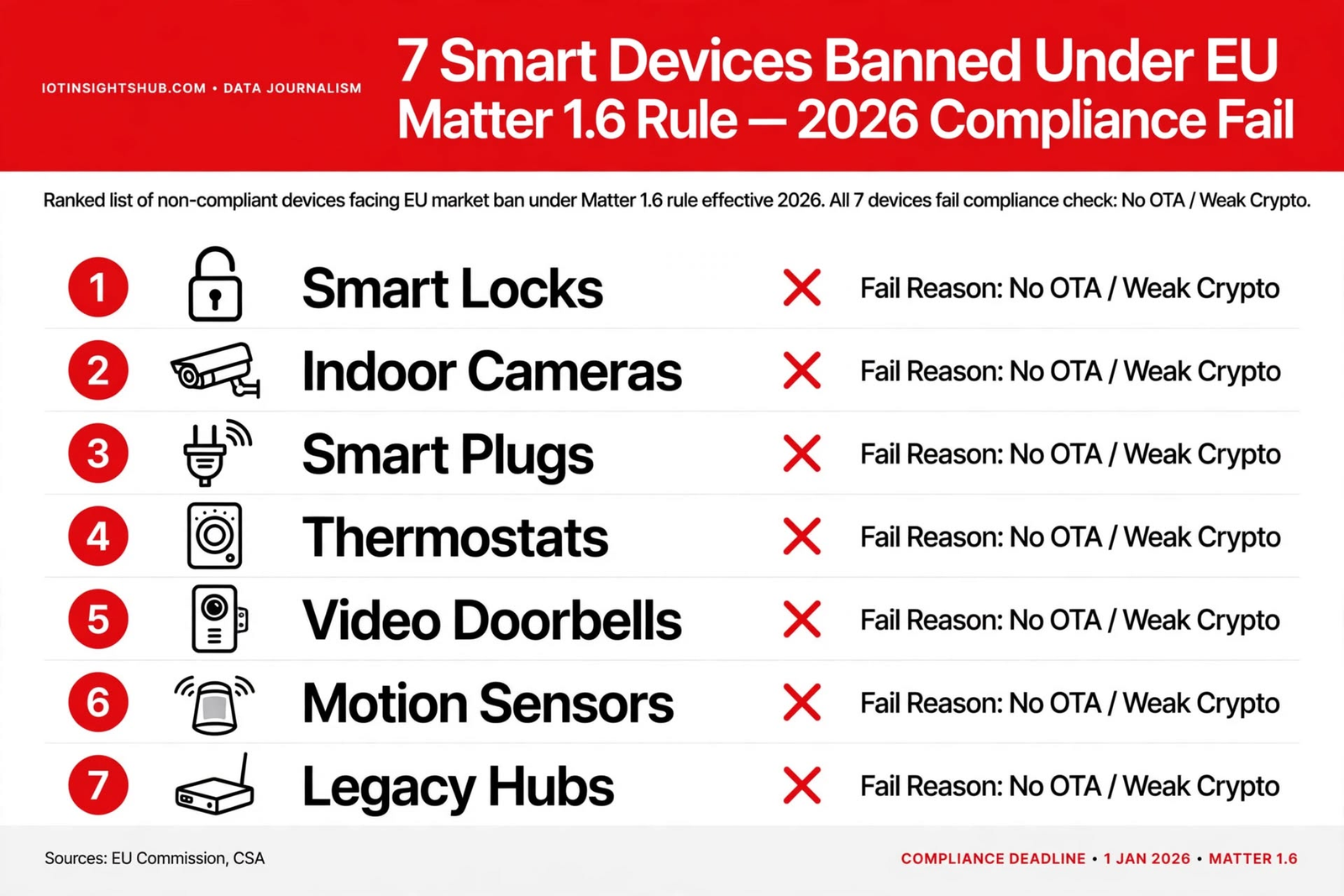
| Device Type | Why It Fails Eu Matter 1.6 | Typical Example | Risk Level |
|---|---|---|---|
| 1. Wi-Fi Smart Bulbs (No Matter) | Shared PSK, no unique DAC, no OTA, vendor app requires full location | Budget Tuya bulbs pre-2024 | Critical |
| 2. Basic Smart Plugs | No SBOM, cloud relay only, no local on/off cluster, no power-monitoring attestation | Generic white-label plugs | Critical |
| 3. Zigbee-Only Sensors without Bridge | No Matter bridge, static install codes reused, no Thread credentials wipe | Old door sensors | High |
| 4. Cloud-Only Door Locks | No local PIN cluster, relies on P2P relay, no offline access log | Keypad locks with only app unlock | High |
| 5. Cheap Thermostats with HTTP OTA | Unsigned firmware, no secure element, plain HTTP update URL | €30 thermostats | Medium |
| 6. P2P Relay Indoor Cameras | Opaque P2P, no Matter camera cluster, no local RTSP/Matter stream | Battery cams with P2P ID | High |
| 7. IR-Only RGB Light Strips | No attestation cert, IR remote only, vendor lock-in, no DCL entry | USB-powered strips | Medium |
Advantages and Limitations of Eu Matter 1.6
Advantages
For consumers, Eu Matter 1.6 brings longer security support, privacy by local control, and interoperability. Because Matter mandates multi-admin, a compliant bulb works in Apple Home, Google Home, and Home Assistant without re-pairing. Local control means your lights still work during broadband outage.
Limitations
Downside is short-term cost and choice reduction. Small vendors face €15k-€40k certification costs, which may push them out of EU market. Some niche devices like DIY relay boards will disappear from 【entity-Amazon¦canonical_name=Amazon】 and move to direct-sale sites.
How to Check Your Device for Eu Matter 1.6 Compliance
1. Scan Box QR: Must open iot-compliance.europa.eu with valid VID/PID. If QR opens only vendor site, it is not Eu Matter 1.6.
2. Test Local Control: Disconnect router from internet but leave Wi-Fi on. Try to turn bulb/plug on/off. If fails, it relies on cloud relay and fails Eu Matter 1.6.
3. Check SBOM: Visit vendor support page for /.well-known/security.txt and SBOM link. No page = likely non-compliant.
What Happens After October 2026
1. Marketplace Delisting: 【entity-Amazon¦canonical_name=Amazon】 EU, Allegro, Bol.com must filter listings against EU DCL mirror.
2. Warranty & Insurance: Home insurance may deny fire claims if uncertified plug without over-current logging found.
3. Resale Rules: Private second-hand sales allowed, but refurbishers become distributors with update obligations.
What Manufacturers Must Do
- DCL Registration + EU Notified Body attestation
- Signed SBOM + VEX at stable URL
- Local-First Firmware for lighting, lock, thermostat clusters
- Factory reset must clear Thread creds in 60 seconds
- EU Representative + Security.txt
What Owners Should Do Now
- Audit plugs/bulbs from Home Assistant / Apple Home export
- Flag devices without Matter QR
- Buy Thread + Matter 1.6 gear in Q3 2026 as prices drop
- Document compliance for rental properties
FAQs
Does Eu Matter 1.6 ban existing bulbs? +
How to know if compliant? +
Are Zigbee devices banned? +
Will prices increase? +
Do cloud cameras need replacement? +
What about DIY ESPHome? +
Conclusion: Eu Matter 1.6 Is a Reset
Eu Matter 1.6 makes local control, transparent updates, and verifiable privacy mandatory. The 7 device types are retired because they can’t prove safety in a Thread mesh running heating, locks, and energy billing.
About The Author