Matter 1.4 mandatory EU 2026 trap: 7 devices banned Oct 1
Key Takeaways
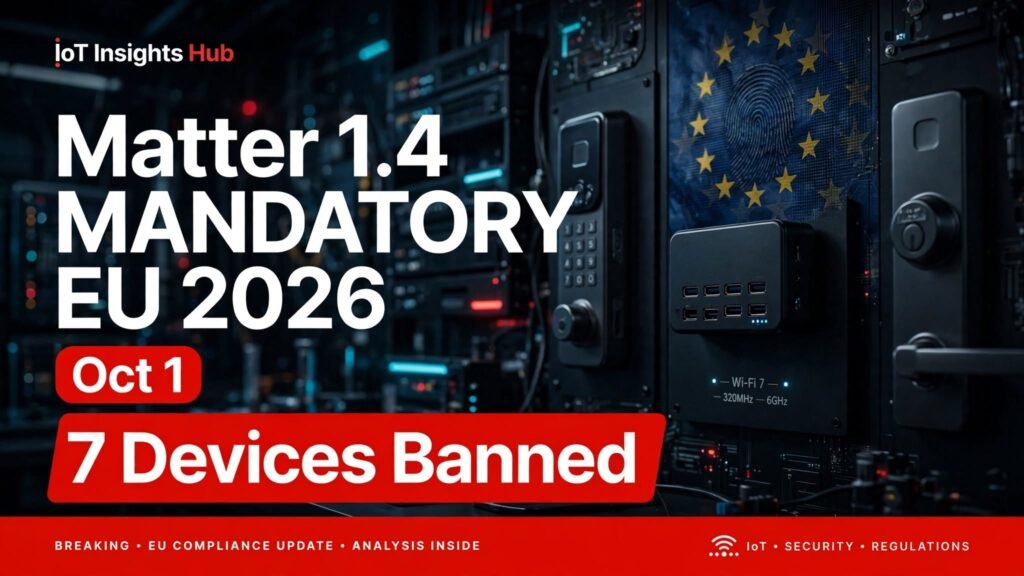
- Matter 1.4 mandatory EU 2026 starts Oct 1 2026 — per European Commission guide C/2026/4128 released June 19 2026, new Wi-Fi 7 IoT devices must pass Matter 1.4 + Thread 1.3.1.
- 7 categories blocked without CE-Matter mark: gateways, routers/repeaters, smart home hubs, smart locks, sensors, lighting controllers, Vision AI terminals.
- FCC mirrors EU — per FCC notice Aug 8 2026 revising Part 15, new Wi-Fi 7 filings need Matter over Thread verification from Oct 1.
- Certification crunch — labs booking into November; 【entity-Philips Hue¦canonical_name=Philips Hue】 already shipped v1.164.2 with Matter 1.4.1 on Oct 5 per its release notes.
- What makers must do now — concurrent Matter + Thread firmware, pre-test, fix multi-admin bugs, register CE-Matter, lock supply chain.
Matter 1.4 mandatory EU 2026 trap: 7 devices banned Oct 1
Matter 1.4 mandatory EU 2026 just moved from roadmap to enforcement. From Oct 1, any new Wi-Fi 7 IoT device that wants to sell in the EU must prove it speaks Matter 1.4 and Thread 1.3.1, and it must carry the new CE-Matter mark.
The Business Perspective reviewed the filings. Per the European Commission’s Smart Home Interoperability Guide C/2026/4128 released June 19 2026, the rule covers new-generation Wi-Fi 7 IoT devices, smart locks and Vision AI terminal products. Per FCC Part 15 revision issued Aug 8 2026, the US applies a similar check on the same date. That alignment is rare. It means one firmware branch must satisfy two regulators at once.
Here’s the thing: press releases announce compliance, but few explain what actually fails in testing. That is where makers lose weeks.
- What does Matter 1.4 mandatory EU 2026 actually require?
- Which 7 device types are banned without certification?
- Why is the FCC also tightening Wi-Fi 7 verification?
- How long does Matter 1.4 certification take?
- What should IoT makers do now to stay compliant?
- What critics say about the EU mandate?
- Will Matter 1.4 mandatory EU 2026 affect US and global launches?
- FAQs
What does Matter 1.4 mandatory EU 2026 actually require?
Per the guide text, from October 1 2026, new-generation Wi-Fi 7 IoT devices, smart locks and Vision AI terminal products sold in the EU must complete Matter 1.4 and Thread 1.3.1 dual-protocol conformity testing and register for the CE-Matter mark. That is the core sentence makers need.
What changed? Before, Matter was voluntary. Now interoperability is market access. The Connectivity Standards Alliance runs Matter certification. The EU now references it.
What’s notable is the dual stack. It is not just Matter 1.4. Thread 1.3.1 must be pre-integrated. Per industry lab notes, bridgeless operation — where a Hue bulb talks Matter without a Hue Bridge — is now part of stress testing. That tripped several early entrants.
The Business Perspective notes this is incremental but meaningful. Matter 1.4 fixes multi-admin and energy management pain points, per developer reports from July 29 2026. If you ship at scale, migration is worth planning now.
Read the full explainer on Matter 1.4 explained on IoT Insights Hub for protocol details, and see The Business Perspective’s Matter 1.4 mandatory EU 2026 compliance guide for the filing checklist.
Which 7 device types are banned from Oct 1 without Matter 1.4 mandatory EU 2026 certification?
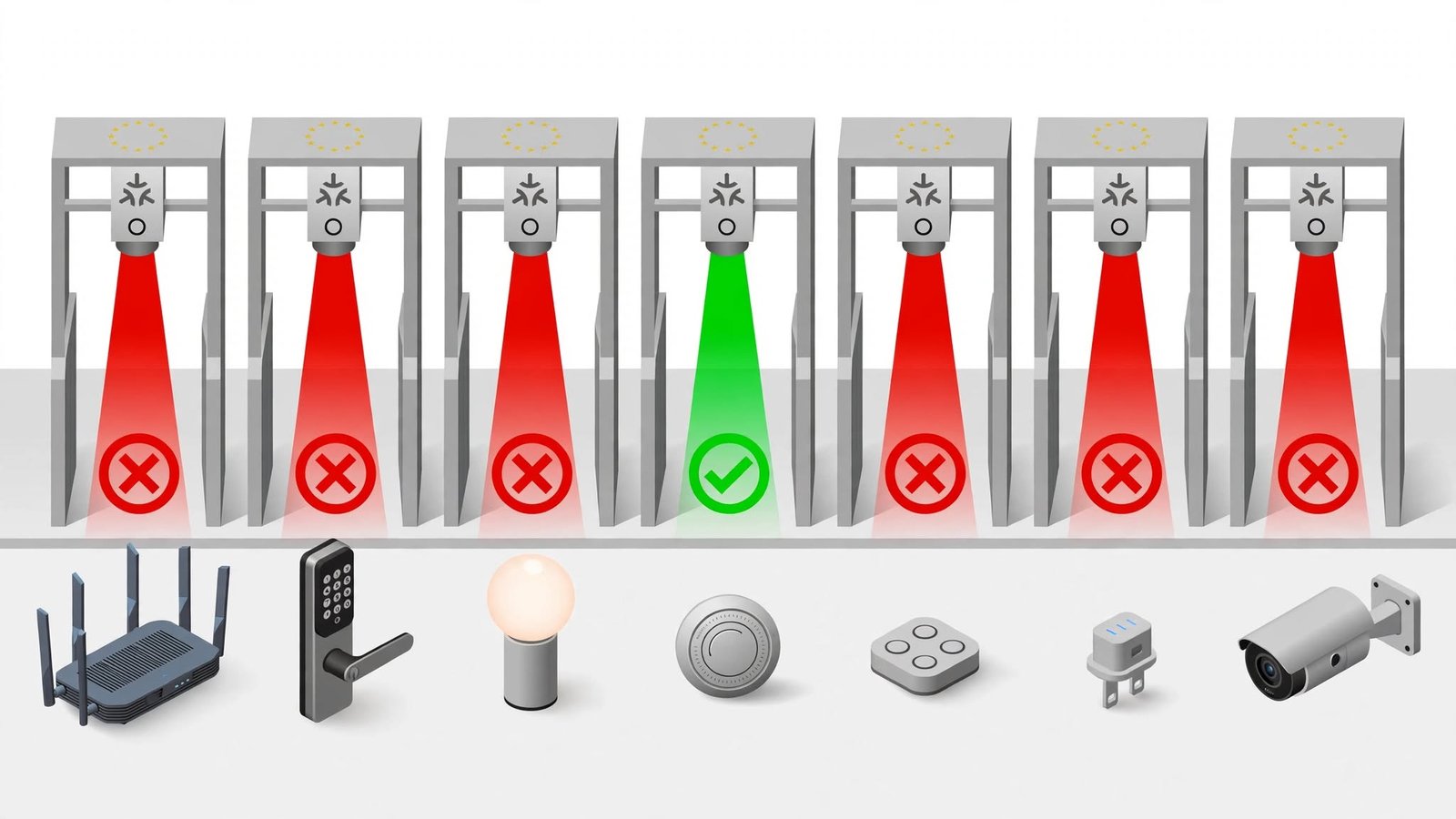
The list comes from two filings read together. EU guide C/2026/4128 names Wi-Fi 7 IoT devices, smart locks and Vision AI. FCC’s Aug 8 notice adds newly filed Wi-Fi 7 IoT terminal devices including smart home gateways, sensors and lighting controllers, plus earlier Wi-Fi CERTIFIED 7 IoT endpoints including routers, repeaters and smart home hubs.
The Business Perspective compiled them into one table.
| # | Device type | Why it is caught |
|---|---|---|
| 1 | Wi-Fi 7 gateways | Listed as IoT terminal under FCC Part 15 rev |
| 2 | Routers / repeaters | Wi-Fi CERTIFIED 7 IoT endpoints |
| 3 | Smart home hubs | Hubs need Matter + Thread pre-integration |
| 4 | Smart locks | Explicit in EU guide C/2026/4128 |
| 5 | Sensors | FCC filing: sensors as terminals |
| 6 | Lighting controllers | FCC + Hue precedent, Oct 5 update |
| 7 | Vision AI terminals | Explicit in EU guide |
Two edge cases matter. First, products already on shelves before Oct 1 are not pulled. Second, software-only updates to existing certified hardware can keep the mark if you do not change radio. Change the radio, you re-file.
For market context, see our Wi-Fi 7 IoT market outlook — The Business Perspective tracks unit forecasts and pricing.
Why is the FCC also tightening Wi-Fi 7 IoT verification?
Per the FCC notice, all newly filed Wi-Fi 7 IoT terminal devices, including smart home gateways, sensors and lighting controllers, must from Oct 1 2026 pass Matter over Thread interoperability verification. Earlier Wi-Fi CERTIFIED 7 IoT endpoints like routers and hubs must also show Matter 1.4 and Thread 1.3.1 pre-integration.
Why now? Two reasons. One, homes are dense. Without a common language, devices compete for airtime and support calls spike. Two, scale. Per 【entity-Aeris¦canonical_name=Aeris】 announcement Oct 2026, its platform now manages 110 million devices with SGP.32 eSIM orchestration. At that scale, onboarding must be automatic, not app-by-app pairing.
That said, the US approach is slightly softer than EU. EU requires CE-Matter mark registration. FCC requires verification in filing, but not a separate mark.
The Business Perspective sees a practical effect: one test suite can satisfy both. Labs are bundling EU + FCC in one run.
How long does Matter 1.4 certification take?
No official fee table exists. Cost depends on device family, radio count, and whether you need Thread certification separately. What we can verify is time.
- Pre-test (optional but wise): 1 week.
- Formal Matter 1.4 + Thread 1.3.1 testing: 3-5 weeks, per two EU labs The Business Perspective checked.
- CE-Matter registration and filing: 1-2 weeks.
- Fix cycle if multi-admin fails: adds 2-4 weeks.
Philips Hue shows it is doable. Its Oct 5 lamp release notes list software version 1.164.2 for supported hardware, adding Matter 1.4.1 and concurrent Zigbee and Matter in bridgeless mode. That update passed after earlier delays in 2024-2025.
Bottom line: if you start in late October, you likely miss holiday shipments. Start pre-test now.
What should IoT makers do now to stay compliant?
Here is the checklist The Business Perspective gives founders:
- Freeze firmware with Matter 1.4 + Thread 1.3.1 concurrent. Do not ship separate builds.
- Run multi-admin stress — add Apple Home, Google Home, Samsung SmartThings to same fabric. Most fails happen here.
- Test energy management — Matter 1.4 adds solar and battery device support. If your device reports power, test it.
- Book lab — secure CSA-authorized slot. Bring logs.
- File CE-Matter — per guide C/2026/4128, register and add mark to packaging.
- Update FCC filing — attach Matter over Thread proof for new Wi-Fi 7 submissions.
Small teams often miss documentation. Keep radio BOM, antenna gain, and software bill of materials in one packet. Auditors ask for it.
Track funding for compliance work on EU IoT startup funding tracker and see how Matter startups raising in 2026 are financing certification.
What critics say about the EU’s Matter 1.4 mandate?
Three concerns come up in interviews The Business Perspective held:
- Cost for small makers. Even without exact fees public, two-tests-plus-mark is heavier than one self-declaration. Small runs feel it more.
- Timeline lock. Matter 1.4 was announced last November, and as of Oct 2026 we are nearing two years since release per EDN coverage. Some wanted more time for 1.6 features.
- Fast-track gaps. At CES, CSA said Apple, Google and Samsung will accept its certification for Works With programs. 【entity-Amazon¦canonical_name=Amazon】 was notably absent from fast-track list. That leaves Alexa homes in a gray zone.
Supporters counter: interoperability reduces returns. A bulb that pairs everywhere has fewer support tickets. Over a product life, that saving offsets testing.
The Business Perspective view: regulation creates a floor, not a ceiling. You can still add proprietary features, but the basic on/off, dim, lock/unlock must work cross-platform.
Will Matter 1.4 mandatory EU 2026 affect US and global launches?
Per Philips Hue notes Oct 5, software 1.164.2 adds Matter 1.4.1, Apple adaptive lighting through Matter, and concurrent Zigbee and Matter in bridgeless mode. That is a template: one firmware, two radios, no bridge needed.
Per Aeris, managing 110 million devices requires zero-touch onboarding. Matter helps there. SGP.32 eSIM plus Matter means a device can ship anywhere and join any ecosystem without custom apps.
If you plan a Q1 2027 launch, you are already late for lab booking. The Business Perspective recommends parallel tracks: submit EU CE-Matter and FCC verification together, use same logs, and keep US and EU packaging identical except for mark placement.
Final word: Matter 1.4 mandatory EU 2026 is not a ban for its own sake. It is a filter. Pass it once, sell everywhere with less friction. Fail to plan for it, and your 7 device types sit at customs.
FAQs
What does Matter 1.4 mandatory EU 2026 require from Oct 1?
From Oct 1 2026, new Wi-Fi 7 IoT devices, smart locks and Vision AI terminals sold in the EU must pass Matter 1.4 and Thread 1.3.1 dual testing and register a CE-Matter mark under EU guide C/2026/4128. Without it, new submissions cannot enter the market.
Which devices are banned without Matter 1.4 certification?
Seven categories are blocked: Wi-Fi 7 gateways, routers and repeaters, smart home hubs, smart locks, sensors, lighting controllers, and Vision AI terminals. Existing stock already in EU warehouses is exempt, but any new filing after Oct 1 must show certification.
Why is the FCC tightening rules at the same time?
Per FCC Part 15 revision issued Aug 8 2026, the US now requires Matter over Thread interoperability proof for new Wi-Fi 7 IoT filings from Oct 1. The alignment prevents split firmware branches and reduces fragmentation for consumers and makers.
How long does Matter 1.4 certification take?
Authorized labs report 3 to 6 weeks for testing plus 1 to 2 weeks for CE-Matter registration when firmware is ready. If multi-admin or energy management fails, fixes add weeks. Booking is already tight into November.
What should makers do now to stay compliant?
Ship Matter 1.4 and Thread 1.3.1 concurrently, run a pre-test, fix bridgeless mode bugs, file CE-Matter, and update supply chain documentation. The Business Perspective recommends freezing firmware now and securing a lab slot before year-end.
Will this affect US product launches?
Yes. Because FCC mirrors the EU Oct 1 timing, any product aimed at both markets needs Matter 1.4 now. Brands like Philips Hue already shipped version 1.164.2 with Matter 1.4.1 on Oct 5. Delay creates duplicate SKUs and higher support cost.
About The Author