IoT in Healthcare: What’s Powering Smarter Hospitals Now
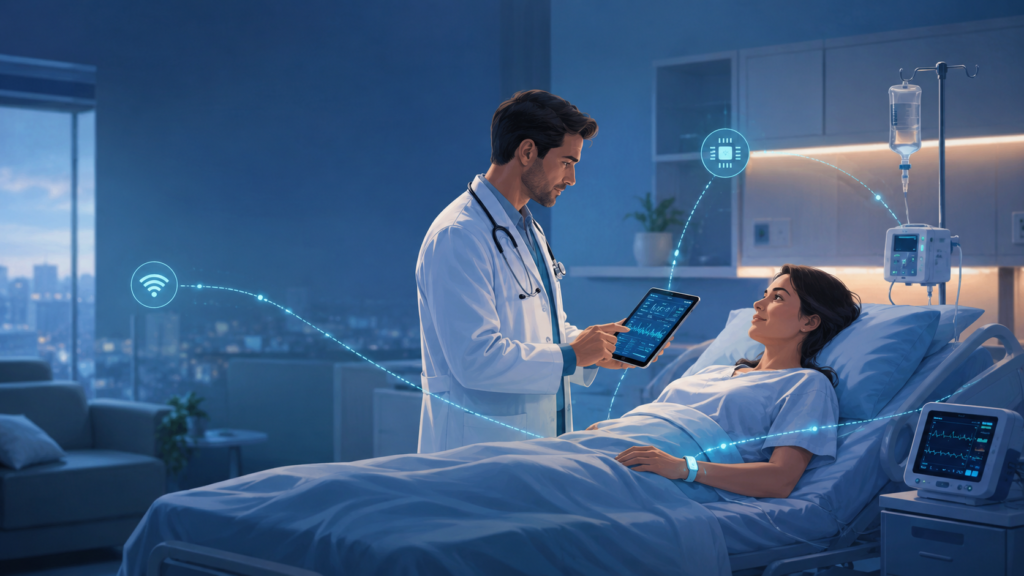
IoT in Healthcare: What's Powering Smarter Hospitals Now
A nurse glances at her phone instead of running down the corridor to check a heart monitor. A hospital bed quietly reports that it needs cleaning before anyone walks past it. This is just Tuesday on most hospital floors now.
This shift has a name: IoT in healthcare. It means connecting medical devices, wearables, and hospital equipment to the internet so they share data without a person manually checking each one.
Quick takeaways
- IoT in healthcare connects monitors, wearables, and hospital equipment into one live data stream.
- It is already cutting hospital readmissions and catching problems before they become emergencies.
- Security and integration are real challenges, not reasons to wait.
What is IoT in healthcare, really?
Strip away the buzzwords and it is simply a network of connected devices that talk to each other and to hospital systems. A glucose monitor sends readings straight to a doctor's dashboard. A smart pill bottle logs when a patient actually takes their medicine. A hospital bed tracks how long someone has been lying still and flags the risk of bedsores.
None of these devices are flashy on their own. What makes the difference is the constant stream of data flowing between them, building a fuller picture of patient health than any single visit ever could.
Why hospitals are moving fast on this
Healthcare systems everywhere are under pressure. Staff shortages are real, costs keep rising, and patients are not always near a hospital when something goes wrong. IoT in healthcare offers a practical answer to several of these problems at once.
Source: American Heart Association readmission data; healthcare IoT market research, 2026.
These are not small pilot projects anymore. This is how mainstream hospitals are starting to operate.
Where IoT in healthcare shows up day to day
Remote patient monitoring
A patient with diabetes or heart disease wears a sensor at home that sends readings to their care team all day, not just at a scheduled visit.
Smart hospital equipment
Infusion pumps track dosage in real time. Beds alert staff if a patient tries to get up unattended. Asset tags stop equipment from going missing.
Wearable health trackers
Smartwatches now include clinically validated ECG and blood oxygen tracking, and doctors are starting to treat that data as real medical history.
Medication management
Smart pill dispensers and connected inhalers send reminders, log doses, and flag patterns that suggest a treatment change is needed.
If something looks off through any of these, a nurse can call before a small issue turns into an emergency room visit. For patients in rural areas, that early call can make all the difference.
The honest challenges nobody skips past
It would be misleading to pretend IoT in healthcare comes without friction. A few issues keep coming up, and any hospital adopting this technology needs to plan around them.
- Security risks are real. Connected medical devices are a tempting target for attackers, and a breach involving patient data is far more damaging than a leaked email list.
- Integration is messy. Many hospitals run older systems that were never built to talk to newer IoT devices, so connecting everything takes real engineering work.
- Costs add up. Smaller clinics, especially outside major cities, often cannot afford the same IoT infrastructure as large hospital networks.
- Data overload is genuine. More sensors mean more alerts, and tired staff sorting through false alarms is its own kind of risk.
None of these issues are reasons to avoid the technology. They are reasons to plan properly before rolling it out at scale.
A quick real-world example
Consider a mid-sized cardiac care unit that started using connected wearables for patients recovering from heart surgery. Instead of bringing every patient back every two weeks, doctors reviewed daily vitals sent directly from home.
Patients showing early warning signs were called in immediately. Everyone else avoided an unnecessary trip to the hospital, and readmission rates dropped as a result.
IoT in healthcare is not about flashy gadgets. It is about closing the gap between checkups, so problems get caught while they are still small.
What this means for the next few years
Hospitals are not going to slow down here. As 5G networks and AI-driven analysis become standard in IoT setups, the data these devices collect will get faster and smarter at flagging real problems instead of just logging numbers.
Common questions about IoT in healthcare
Is IoT in healthcare safe for patient data?
It can be, but only with proper encryption and strict access controls. Hospitals that treat security as an afterthought are the ones that end up in breach headlines.
Do patients need to buy their own devices?
Often the hospital or insurance provider supplies the sensor or wearable as part of a remote monitoring programme, especially for chronic disease management.
Will this replace doctors?
No. It gives doctors better information faster. The decisions still rest with trained clinicians, not the devices themselves.
Bringing IoT into your hospital or clinic?
Get a practical walkthrough of what actually fits your setup, not just what's trending in 2026.
Talk to our team