IoT Edge Computing Explained: Benefits You Should Know
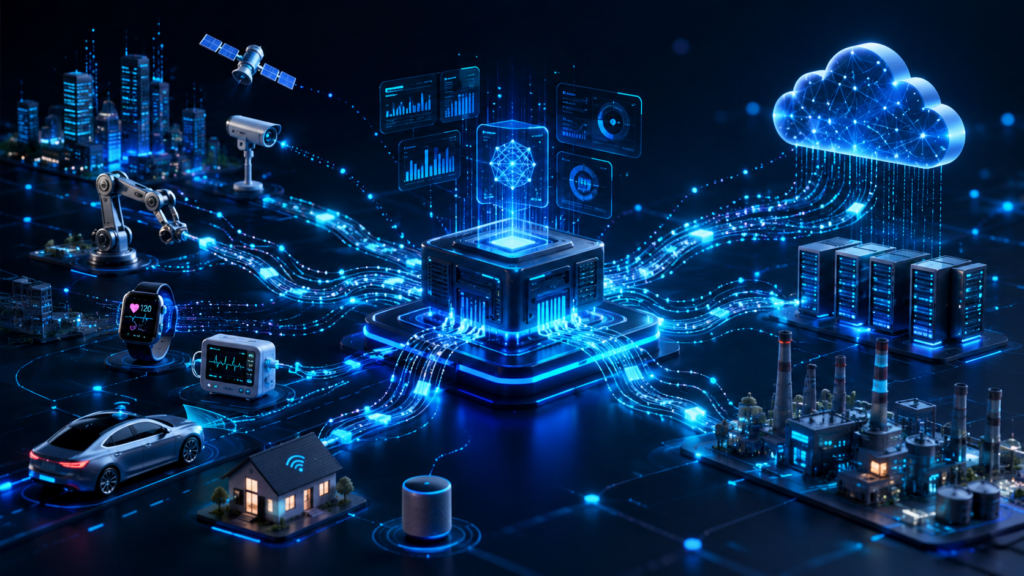
IoT edge computing explained simply means: instead of sending all your device data to a far-off cloud server, the processing happens right where the data is born — on or near the device itself. It is faster, smarter, and far more practical for the connected world we live in today.
So, if you have been wondering why edge computing is suddenly everywhere — in hospitals, factories, smart cities, and even your home — you are in the right place. Let us get into it.
What Exactly Is IoT Edge Computing?
Most people assume IoT devices automatically send their data to the cloud. That used to be true. But as billions of devices came online, that approach started showing cracks — slow response times, high bandwidth costs, and serious privacy concerns.
IoT edge computing shifts the intelligence closer to the device. Think of it as giving your IoT network a local brain.
Instead of this path: Device → Cloud → Action
Edge computing works like this: Device → Edge Node → Instant Action → Cloud (for storage/long-term analysis)
The edge node could be a local gateway, a router, or even a small on-site server. It processes the data in real time, makes a decision, and only sends what is truly necessary to the cloud. Simple, efficient, and much faster.
Why Does This Actually Matter in 2026?
<invoke name=”web_search” placeholder – data already fetched>
Here is the reality: the global IoT market is projected to cross USD 1 trillion by 2026, and the volume of data being generated by connected devices is growing at a pace that centralised cloud systems simply cannot handle alone.
Global investment in edge computing reached $261 billion in 2025 and is projected to grow at a compound annual growth rate of 13.8%, reaching $380 billion by 2028.
That is not a niche technology trend. That is a fundamental shift in how the internet works.
Key Benefits of IoT Edge Computing You Should Know
1. Faster Response Times (Low Latency)
When a self-driving car detects an obstacle, it cannot wait for a cloud server to respond. It needs to act in milliseconds.
Edge computing in IoT allows the system to respond locally in seconds or milliseconds — not after a round trip to the cloud. For time-sensitive applications, this is not a nice-to-have. It is the whole point.
Similarly, in a smart factory, a machine stops automatically the moment sensors detect a failure risk — before the damage even begins.
2. Lower Bandwidth Costs
Every byte of data you send to the cloud costs money. When you have thousands of sensors running 24/7, those costs add up fast.
Edge filtering reduces traffic by sending only relevant insights to the cloud instead of raw data. This alone can cut a company’s data transfer bills significantly — without losing any meaningful information.
3. Better Data Privacy and Security
Here is something many people overlook. The more data you send over the internet, the more exposure you create.
By processing sensitive data locally rather than sending raw data to a remote cloud, there are fewer transmissions over potentially insecure networks, reducing interception risk.
This is especially important in healthcare, where patient data must stay protected at all times.
4. Works Even Without Internet
Cloud-dependent systems go blind the moment the internet drops. Edge systems do not.
Because processing happens locally, your IoT devices can continue functioning even during a network outage. For industries like mining, oil and gas, or remote agriculture — where connectivity is unreliable — this reliability is invaluable.
5. Predictive Maintenance Before Things Break
Bosch uses edge-enabled IoT solutions to predict machine failures days in advance, cutting unplanned downtime by up to 25%.
That is not just impressive — that is a direct saving on maintenance costs, equipment lifespan, and production efficiency. Edge computing makes it possible because AI models run directly on-site, analysing data in real time without cloud dependency.
Real-World Examples That Show the Difference
Healthcare
GE Healthcare’s Edison HealthLink platform uses edge computing to run AI algorithms on-site in hospitals, supporting real-time diagnostics from imaging equipment like MRIs and CT scans — eliminating the need to send data to cloud servers, cutting response time and improving patient outcomes.
Smart Manufacturing
By running AI models directly on the gateway, manufacturers can perform real-time visual quality inspections on high-speed production lines and enable predictive maintenance — detecting mechanical anomalies weeks before a catastrophic failure, without clogging the cloud with raw noise.
Smart Cities
Traffic cameras, pollution monitors, and emergency systems all need to act instantly. Edge computing allows city infrastructure to make local decisions — rerouting traffic, detecting accidents, or adjusting street lighting — without waiting for a distant data centre.
Cloud vs Edge Computing: Are They Competing?
Not at all. This is one of the most common misconceptions.
In most real deployments, the edge and cloud work together: the edge handles time-sensitive processing while the cloud supports long-term analytics, centralised reporting, and fleet-wide insights.
Think of it this way — edge computing is your local branch office. The cloud is your headquarters. Both have a role. Together, they are far more powerful than either one alone.
What Should You Look for in an IoT Edge Platform?
If you are considering edge computing for your business or project, here are a few things to keep in mind:
- Low latency support — Can it process data in real time?
- Security features — Does it encrypt data locally before any transmission?
- Offline capability — Will it still work when connectivity drops?
- Scalability — Can it handle more devices as you grow?
- Cloud integration — How smoothly does it connect with your existing cloud setup?
In 2026, containerisation support is considered non-negotiable for serious IoT edge deployments — it lets you deploy and manage complex applications across your entire device fleet from a single command.
The Road Ahead for IoT Edge Computing
IoT in 2026 is no longer about connectivity — it is about intelligence. AI-powered devices do not just collect data; they analyse, predict, and act in real time.
Edge computing is the engine behind that intelligence. As 5G networks expand and AI chips get smaller and cheaper, edge devices will become even more capable — handling complex decisions locally that would have required an entire data centre just five years ago.
The focus has shifted from hardware-heavy experimentation to location intelligence, operational clarity, and measurable outcomes. Businesses that adopt this early will have a clear advantage over those that wait.
Wrapping Up — But Not Really the End
IoT edge computing is not a future concept. It is already running in hospitals that diagnose patients faster, factories that prevent costly breakdowns, and cities that manage traffic without human intervention.
About The Author