AI in Healthcare: Essential Advances Driving Better Care
Signature: qmpKZw4TgZeBEir0HpRvns6lTnopK5J8+uGjlzEiVYz0+qpDDcsdoUQKCrcDQYmouErvaIsRXatqpGiLIFGkLvSSU9ukyOPJiQMz+i6QzgUoqCIFBqzrf/0iz7ieLDnLvexlwnrOTEd6FZG/yxGc9gxXoeYCSffzQ43/nFWQXrUyIhWOQyn+Y1Du/Mdd28EL0Ld2ECh/0E5rjHRQpnVCbz8n4s3b7BIoVBWfmsNjLLSH72MpzzxivIcbKuryljwrLd2mkcs4qOLr5QicvfnB1wv13SusJJGpPfGwKuuua68LRofNKW9o6qBxlt+XNStkI1yAxyAtwYZssiUbx3vWiXvmvR4NXHyoVwL2nyPQjxfda6IPlXexg3xvUr2DmsPCmGjkx5OlYx8J32x2J0uKjJuXLi33Q3K7SKnMzOUhcoS+6WT/wIGJ5pSCTmzCXs5pgmKv/gYRT/WcD24gZaEDiWGWTAgf/KX1ppcbZKasGZbNPHI/mcZUOm6Dqx40VXaElNSCvCA5uW0hJTyjXFpmJOtJS5webnZIXQo5ZiYg+2/VYd5Zpvv7/i2FMFeQTpBJLl7X1u2VVlWYkoc0FGL9XzAaswg/R+dfatkh0wVfMuSN8CHZEz9PMpywfKs5xpvR8b6dreMuJM8InyCkT8US9W4ipZBnBZcxgd1b5Nd693KAPQlTju205lhf0utDu51KLS4xGymKGiiH9mmI18fdesIP/ZzMK7WiAhXFLoaKQsygKVRW2h2S1ESSrHEd2P9i7DZUZncoEBC45rVxFuaWxhQ9mvVWZoTDhs6KWPd2nRqLBB8fphQ27x8h5G6+dT4/93gy/FrxLTXhZg4bPKZ4rU+15VVZZPxjNX9bQl9x3uBuEN1IoN7cBwu/85jfm0MkzglkikjE+k8nyaNJi94/4r7lHXvpbtTDKxLyQnIJ03tK+lo5hbSHkTrp19jWlEp2Wq7r3Rt3UqNU0r69+Wt3f2x8kYyXDNDZthWnElQ6HA0=
Healthcare is changing faster than ever. Patients expect quick diagnosis, better treatment, and personalized care. At the same time, hospitals face growing pressure to manage costs, reduce errors, and improve efficiency. This is where AI in healthcare is making a real difference.
From detecting diseases at an early stage to helping doctors make faster decisions, artificial intelligence is becoming a valuable tool in modern medicine. What once seemed like science fiction is now helping healthcare professionals deliver better outcomes every day.
In this article, we will explore the most important advances in AI in healthcare, how they work, their benefits, and what the future holds for patients and medical professionals.
What Is AI in Healthcare?
AI in healthcare refers to the use of artificial intelligence technologies to support medical services and healthcare operations. These systems analyze large amounts of data, identify patterns, and provide insights that help doctors and healthcare providers make informed decisions.
Unlike traditional software, AI systems learn from data. As a result, they become more accurate over time.
Some common applications include:
- Medical imaging analysis
- Disease prediction
- Virtual health assistants
- Drug discovery
- Personalized treatment plans
- Hospital workflow management
Today, healthcare organizations across the world are investing heavily in AI-powered solutions to improve patient care and operational efficiency.
Why AI in Healthcare Matters
Healthcare generates enormous amounts of data every day. Doctors often have limited time to review every detail. Consequently, important information can sometimes be overlooked.
AI helps by processing complex data within seconds.
Key benefits include:
- Faster diagnosis
- Improved treatment accuracy
- Reduced medical errors
- Better patient experiences
- Lower operational costs
- Enhanced healthcare accessibility
These advantages make AI in healthcare one of the most impactful technological developments of the decade.
Early Disease Detection and Diagnosis
One of the biggest strengths of AI is its ability to detect diseases at an early stage.
AI in Medical Imaging
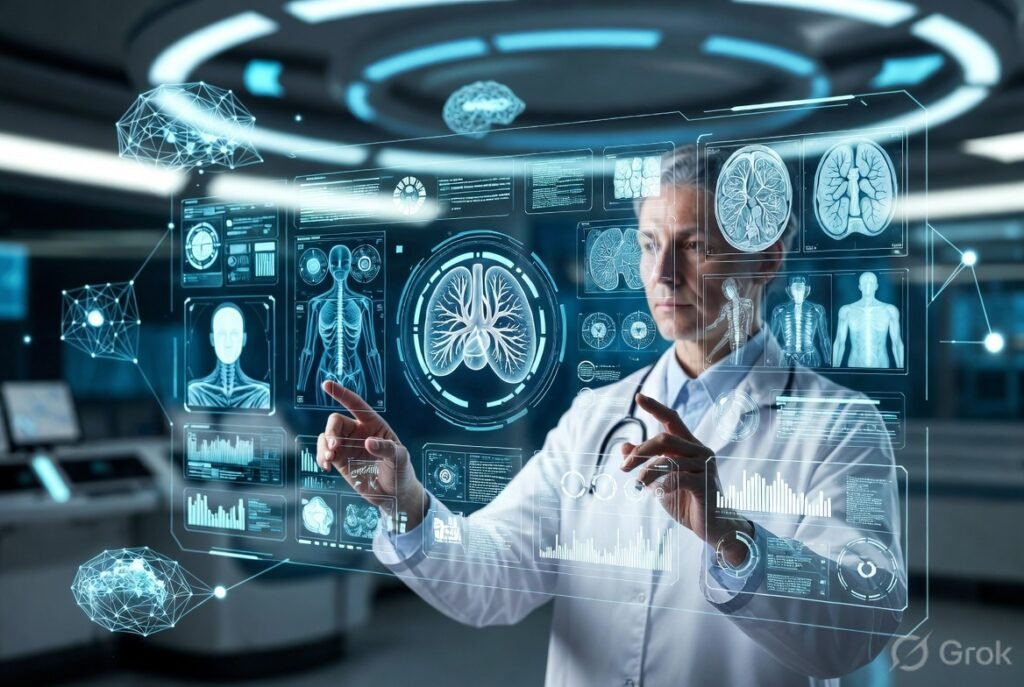
Radiologists examine thousands of medical images every year. AI-powered systems can analyze X-rays, CT scans, and MRI images with remarkable accuracy.
For example, AI tools can identify signs of:
- Breast cancer
- Lung cancer
- Brain tumors
- Heart disease
In many cases, AI detects abnormalities that may be difficult for the human eye to spot during the initial review.
Faster Results for Patients
Traditional diagnosis may take days or even weeks. AI systems can significantly reduce this time.
As a result, patients receive treatment sooner, which often improves recovery outcomes.
Personalized Treatment Plans
Every patient is different. Therefore, a treatment that works well for one person may not work for another.
AI helps healthcare providers create personalized treatment plans based on:
- Medical history
- Lifestyle habits
- Genetic information
- Previous treatment responses
This approach allows doctors to recommend therapies that are more likely to succeed.
For example, cancer specialists increasingly use AI tools to identify treatment options tailored to individual patients.
AI-Powered Virtual Health Assistants
Healthcare facilities often struggle with large volumes of patient inquiries.
Virtual assistants powered by artificial intelligence can help by:
- Scheduling appointments
- Answering common questions
- Providing medication reminders
- Monitoring patient symptoms
These assistants are available 24/7. Consequently, patients receive support even outside regular clinic hours.
Moreover, healthcare staff can focus on more complex medical tasks.
Improving Hospital Operations
Healthcare is not only about patient treatment. Hospitals also manage logistics, staffing, inventory, and administration.
AI can improve these areas significantly.
Smart Resource Management
AI systems analyze hospital data to predict:
- Patient admissions
- Emergency room demand
- Staff requirements
- Equipment usage
This helps healthcare facilities allocate resources more effectively.
Reducing Administrative Burden
Medical professionals spend considerable time on paperwork.
AI-powered automation can assist with:
- Medical documentation
- Insurance processing
- Billing management
- Patient record organization
As a result, doctors spend more time caring for patients.
AI in Drug Discovery and Research
Developing a new medicine traditionally requires years of research and billions of dollars.
AI is accelerating this process.
By analyzing vast amounts of scientific data, AI systems can:
- Identify potential drug candidates
- Predict drug effectiveness
- Detect possible side effects
- Optimize clinical trials
This advancement became especially important during global health emergencies when researchers needed faster solutions.
Many pharmaceutical companies now use AI to reduce research timelines and improve innovation.
Enhancing Patient Monitoring
Remote patient monitoring has become increasingly important.
AI-powered devices collect health information in real time, including:
- Heart rate
- Blood pressure
- Blood sugar levels
- Oxygen saturation
When unusual patterns appear, healthcare providers receive alerts immediately.
This allows doctors to intervene before conditions become serious.
For patients with chronic diseases, continuous monitoring can improve quality of life and reduce hospital visits.
AI in Healthcare and Predictive Analytics
Predictive analytics is another area where AI is creating value.
AI systems analyze historical and real-time data to forecast potential health risks.
For example, AI can help predict:
- Heart attacks
- Diabetes complications
- Patient readmissions
- Disease outbreaks
Because of this capability, healthcare providers can take preventive action before problems escalate.
Preventive care often leads to better outcomes and lower healthcare costs.
Addressing Challenges and Ethical Concerns
Despite its advantages, AI in healthcare is not without challenges.
Data Privacy
Healthcare data is highly sensitive.
Organizations must ensure that patient information remains secure and protected from cyber threats.
Bias in AI Models
AI systems learn from data. If that data contains bias, the results may also be biased.
Therefore, healthcare providers must continuously monitor AI systems for fairness and accuracy.
Human Oversight
AI should support doctors, not replace them.
Medical professionals provide empathy, experience, and judgment that machines cannot replicate.
The most effective approach combines human expertise with advanced technology.
Frequently Asked Questions
Can AI replace doctors?
No. AI is designed to assist healthcare professionals, not replace them. Doctors remain essential for diagnosis, treatment decisions, and patient communication.
Is AI in healthcare accurate?
Many AI systems achieve impressive accuracy rates. However, they work best when used alongside experienced healthcare professionals.
How does AI help patients?
AI helps patients through faster diagnosis, personalized treatment plans, improved monitoring, and better healthcare access.
Is AI used in Indian healthcare?
Yes. Many hospitals and healthcare organizations in India are adopting AI technologies for diagnostics, patient management, and telemedicine services.
The Road Ahead for Smarter Healthcare
The future of healthcare will depend on how effectively technology and human expertise work together. AI is already helping doctors diagnose diseases faster, create personalized treatments, improve hospital operations, and enhance patient experiences.
As technology continues to evolve, AI in healthcare will become even more valuable. Healthcare providers that embrace innovation today will be better prepared to deliver safer, faster, and more effective care tomorrow.vv